AI Business Idea Analysis and Validation

Business Idea Validation with AI: The Entrepreneur’s Complete Guide
You’ve got an idea. It keeps you up at night. You’re convinced it’s the next big thing. But here’s the uncomfortable truth: most startup ideas fail not because they’re bad, but because founders never validated them properly before investing time and money.
The difference between a breakthrough startup and a costly mistake often comes down to one thing: business idea validation. And in 2024, the smartest founders aren’t relying on gut feeling or late-night brainstorming sessions—they’re using AI.
This guide walks you through everything you need to know about validating your business idea with AI technology, complete with real examples, practical frameworks, and actionable steps you can implement today.
Why Business Idea Validation Matters More Than Ever
Let me be direct: validating your business idea isn’t optional anymore—it’s essential.
According to a 2023 survey by the Indian Startup Association, 73% of early-stage startups that failed hadn’t conducted proper market validation. Meanwhile, founders who spent just 2-4 weeks validating their ideas before launching saw a 40% higher success rate in their first year.
Here’s what validation actually does for you:
- Saves you money. Instead of burning through ₹50 lakhs developing a product nobody wants, you discover that in week two.
- Attracts investors. VCs want to see evidence that your idea solves a real problem. Validation data is that evidence.
- Reduces pivoting costs. Early validation lets you adjust your approach while pivots are cheap, not after you’ve built everything.
- Confirms market demand. You’ll know if customers actually want what you’re building before you bet your career on it.
The old way of validating ideas—surveys, focus groups, coffee meetings—still works. But they’re slow, expensive, and prone to bias. That’s where AI comes in.
How AI is Transforming Startup Idea Validation
AI-driven startup idea analysis isn’t science fiction. It’s happening right now, and it’s changing how entrepreneurs validate business ideas.
The Power of AI Business Idea Analyzers
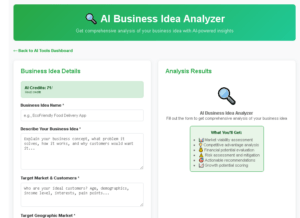
Modern AI tools can analyze your startup idea across multiple dimensions in hours, not weeks:
Market Analysis: AI scans thousands of data points about your target market—size, growth rate, customer pain points, existing solutions, pricing benchmarks. Tools trained on this data can tell you if your market is growing or shrinking, whether it’s oversaturated, and what price points customers will tolerate.
Competitive Intelligence: Instead of manually researching 50 competitors, AI tools map your competitive landscape automatically. They identify white space opportunities, highlight what competitors are doing right (and wrong), and show you where you can differentiate.
Customer Validation: AI can analyze customer sentiment from online communities, forums, social media, and review sites. It identifies what people are actually asking for in your space—not what you think they want.
Feasibility Assessment: AI evaluates whether your idea is technically feasible, what resources you’ll need, realistic timelines, and potential roadblocks.
The result? You go from “I think this might work” to “Here’s the data proving there’s a market for this.”
Real Example: How One Bangalore Founder Used AI Validation
Priya, a former product manager at a mid-size SaaS company, had an idea for an AI-powered tool to help small businesses automate their accounting. Before building anything, she used an AI business idea validator to analyze her concept.
The tool revealed:
- Her target market (Indian SMEs with 10-50 employees) was growing at 18% annually
- Existing solutions were priced between ₹5,000-₹15,000 per month
- The biggest pain point wasn’t automation itself—it was integration with existing Indian accounting software
- Three competitors were already in the space, but none focused specifically on GST compliance automation
Instead of building a generic accounting tool (her original plan), Priya pivoted to focus exclusively on GST compliance automation for small Indian businesses. She validated this narrower idea with 30 potential customers before writing a single line of code.
Result? Her MVP launched 6 months later. Within 18 months, she had 200 paying customers and was generating ₹15 lakhs in monthly recurring revenue.
This level of validation would have taken her 3-4 months using traditional methods. AI got it done in 2 weeks.
Your Step-by-Step Guide to AI Business Idea Validation
Ready to validate your own idea? Here’s how to do it properly.
Step 1: Define Your Core Business Idea Clearly
Before you run it through any AI tool, you need clarity. Write down:
- What problem does your idea solve? (Be specific. “Making business easier” isn’t specific. “Automating invoice reconciliation for freelancers” is.)
- Who experiences this problem? (Define your target customer precisely.)
- How would you solve it? (What’s your proposed solution?)
- Why now? (What’s changed that makes this solvable today?)
This foundation matters because AI tools are only as good as the input you give them.
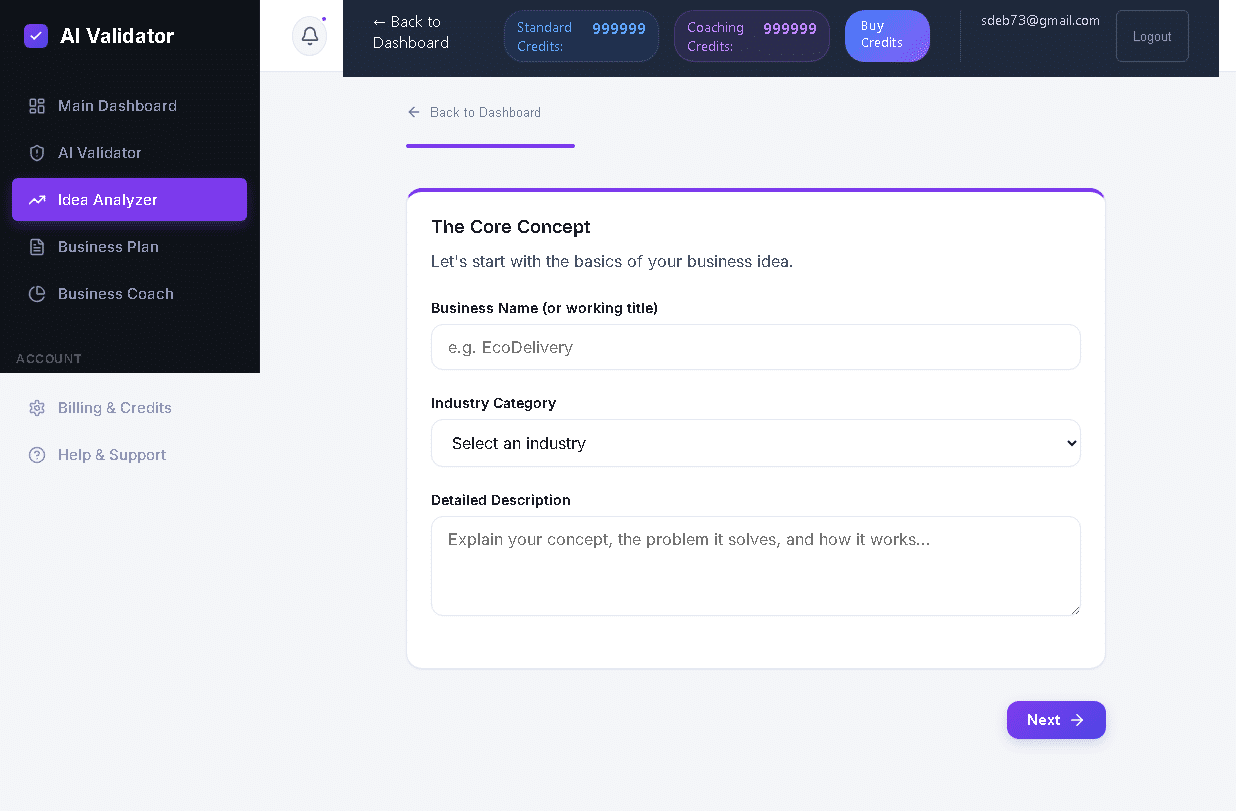
Step 2: Run Your Idea Through an AI Business Idea Analyzer
This is where generative AI startup ideas tools come in. Tools like these analyze your concept across multiple dimensions:
Market Size Estimation: The tool estimates your addressable market based on demographic data, industry reports, and growth trends. For an Indian startup, this might show you that your market is ₹500 crore and growing 25% annually—or that it’s only ₹20 crore and saturated.
Customer Problem Validation: AI analyzes whether your target customers actually experience the problem you’re solving. It pulls data from forums, social media, support tickets of competitors, and surveys to see if people are actively seeking solutions.
Solution Fit Assessment: The tool evaluates whether your proposed solution actually addresses the core problem. Sometimes founders think they’re solving problem A when customers really need help with problem B.
Competitive Positioning: AI maps where your idea sits relative to existing solutions. It identifies if you’re competing on price, features, user experience, or something else entirely.
Step 3: Conduct Rapid Customer Interviews
AI gives you the data. Customer interviews give you the context.
After your AI analysis, reach out to 15-20 potential customers and ask:
- Do you experience the problem I’m solving?
- How are you solving it today?
- What would make you switch to a new solution?
- What would you pay for this?
You’re not selling them. You’re learning. Listen more than you talk.
Pro tip: Use AI-powered tools to help analyze these interview transcripts. They can identify patterns, extract key insights, and highlight the most important customer quotes automatically. What would take you 10 hours to manually analyze, AI does in 10 minutes.
Step 4: Test Your Value Proposition
Once you have customer feedback, refine your core value proposition and test it.
Create a simple landing page describing your solution. Drive traffic to it (even ₹5,000-₹10,000 in ads). Measure:
- Click-through rates
- Time spent on page
- Email signups
- Pre-orders or expressions of interest
AI tools can help you optimize this landing page in real-time, testing different headlines, messaging, and calls-to-action.
Step 5: Analyze the Results
This is where you get honest with yourself.
Strong validation signals look like:
- 20%+ email signup rate from landing page traffic
- 10+ customers willing to pre-order or pay for early access
- Consistent feedback across interviews pointing to the same core problem
- Growing search volume for keywords related to your solution
Weak validation signals look like:
- Less than 5% signup rate
- Customers saying “this would be nice to have” instead of “I need this”
- Contradictory feedback across interviews
- Low search volume for related keywords
If you see weak signals, don’t panic. This is exactly what validation is for. You can pivot, refine, or sometimes walk away before wasting serious money.
Alternative Business Idea Validation Methods to Consider
While AI is powerful, the best approach combines multiple validation methods.
Customer Discovery Interviews: Direct conversations with 20-30 potential customers remain irreplaceable. You pick up on tone, hesitation, and unspoken concerns that surveys miss.
Concierge MVP: Build a minimal version manually (even if it doesn’t scale) and sell it to early customers. This proves demand better than any survey.
Surveys and Questionnaires: Structured surveys reach more people faster. Use AI to analyze responses and identify patterns.
Landing Page Testing: Validate messaging and value proposition without building anything. Track conversion rates as your primary metric.
Competitor Analysis: Study what’s working for competitors and where they’re struggling. AI tools accelerate this dramatically.
Expert Interviews: Talk to people who understand your industry deeply. They’ll spot blind spots you’ve missed.
The smartest founders use 2-3 of these methods simultaneously, cross-validating results. If customer interviews, landing page tests, and AI analysis all point in the same direction, you’ve got strong validation.
Choosing the Right AI Tools for Your Validation
Not all AI business idea validation tools are created equal. Here’s what to look for:
Data Quality: Does the tool use current, reliable data sources? Indian-focused tools should have access to Indian market data, not just global benchmarks.
Customization: Can you input your specific parameters (target market, geography, customer segment)? Generic analysis is less useful than analysis tailored to your situation.
Actionability: Does the tool just give you data, or does it help you understand what to do with that data? The best tools provide recommendations, not just analysis.
Cost: Most AI business idea validators range from free (basic features) to ₹10,000-₹50,000 per month (enterprise features). Start with free tools. Scale up only if you’re getting value.
Integration: Can the tool integrate with other tools you’re using? Can you export data easily?
Speed: You want validation in weeks, not months. Choose tools that give you insights quickly.
Start with 1-2 tools. Many offer free trials. Use them. See what resonates with your working style.

Real Examples: Validated Startup Ideas Using AI
Let me share a few more real examples of how founders used AI-driven startup idea analysis to validate their concepts.
Example 1: The EdTech Founder
Amit wanted to build an online coding bootcamp for Indian students. Before investing ₹20 lakhs in course development, he used an AI tool to validate the idea.
The analysis showed: massive demand (India has 2+ million students learning coding annually), but brutal competition (50+ established bootcamps). His differentiation? Focus on students from tier-2 and tier-3 cities who couldn’t afford ₹3-4 lakh bootcamps in metros.
He validated this niche with customer interviews, found 500+ interested students at ₹50,000 price point, and launched. Today, his bootcamp has 2,000+ students and ₹2 crore in annual revenue.
Example 2: The B2B SaaS Founder
Neha was building a supply chain visibility tool for Indian manufacturers. Her AI analysis revealed that while the market was growing, most competitors were targeting enterprise companies. Her insight: mid-market manufacturers (₹10-100 crore revenue) had the same pain points but couldn’t afford enterprise solutions.
She validated this with 12 customer interviews, landed 3 pilot customers, and built her MVP specifically for this segment. Her focused approach meant faster sales cycles and higher retention than competitors building for everyone.
Example 3: The Marketplace Founder
Rohan wanted to build a hyperlocal delivery platform for fresh vegetables in Pune. Instead of building first, he used AI to validate demand, competition, and unit economics.
The analysis showed: demand was there, but delivery costs would eat 40% of margins—making the business unviable at scale. Rather than fail, Rohan pivoted to a B2B model (selling to restaurants and corporate offices) where unit economics worked. His AI validation saved him from building the wrong business.
Your Next Steps
You don’t need to have all the answers before you start. But you do need validated evidence that customers want what you’re building.
Here’s your action plan for the next 30 days:
Week 1: Clearly define your business idea. Write it down in 3-4 sentences. Get feedback from 2-3 trusted mentors.
Week 2: Run your idea through an AI business idea validator. Spend 2-3 hours analyzing the results. Note the key insights and red flags.
Week 3: Conduct 15-20 customer discovery interviews. Ask about the problem, current solutions, and willingness to pay. Use AI tools to analyze the transcripts.
Week 4: Create a simple landing page. Drive 1,000-2,000 visitors to it. Measure signup rates and collect email addresses.
By the end of month one, you’ll have real data about whether your idea is worth pursuing. Some founders will discover they need to pivot. Others will get the green light to build. Both outcomes are valuable—because you’ll know before you’ve wasted serious time and money.
The founders who win aren’t the ones with the best ideas. They’re the ones who validate ruthlessly, learn quickly, and adapt accordingly.
Your AI business idea validator is your competitive advantage. Use it.

The BizPlan AI Editorial Team comprises startup consultants, financial analysts, and professional technical writers. We compile verified Indian market data and MSME guidelines to help entrepreneurs build investor-ready business plans.