How to Validate Business Idea in India: A Step-by-Step Guide for Indian Entrepreneurs

Starting a business in India is an exciting journey, but it comes with its own set of challenges. One of the most crucial steps in the entrepreneurial journey is validating business idea before investing time, money, and effort. In a country as diverse and dynamic as India, understanding local market trends, consumer behavior, and regulatory frameworks is essential for success. This article will guide you through the process of validating your business idea in India, leveraging modern tools like startup validation tools and AI for startups, and provide actionable insights tailored to the Indian context.
Why You Should Validate Business Idea in India
India is a vast and rapidly growing market with over 1.3 billion people. However, this also means that the competition is fierce, and not every business idea will find its place in the market. Validating your idea helps you assess whether there’s a real demand for your product or service before you go all-in. It allows you to test your assumptions, identify potential risks, and refine your value proposition based on actual market feedback.
Here are some reasons why business idea validation is particularly important in India:
- High competition: With over 40,000 new startups registered each year, the Indian startup ecosystem is highly competitive. Validation helps you stand out.
- Diverse consumer base: India’s population is spread across multiple languages, cultures, and socio-economic backgrounds. Understanding these nuances is key to success.
- Changing market trends: Consumer preferences in India are evolving rapidly, especially with the rise of digital adoption. Staying ahead of these trends is crucial.
- Regulatory complexity: Navigating India’s legal and tax structures can be challenging. Validation helps you understand the regulatory landscape better.
Unique Challenges to Validate Business Idea in India
Validating a business idea in India is not the same as in other parts of the world. Here are some unique challenges Indian entrepreneurs face:
1. Regional Market Variations
India is a land of diversity, with 28 states and 9 union territories, each with its own cultural and economic dynamics. A business idea that works in Mumbai may not perform well in Kolkata or Bangalore. For example, a food delivery startup may need to adjust its menu offerings based on regional cuisine preferences.
2. Consumer Behavior
Indian consumers are price-sensitive and value-driven. While urban consumers are increasingly adopting digital services, rural consumers may still prefer traditional methods. Understanding these behaviors is essential for positioning your product effectively.
3. Regulatory Environment
India has a complex regulatory framework that includes tax laws, labor laws, and compliance requirements. Navigating these can be time-consuming and costly. Validating your idea helps you identify the necessary legal steps and avoid costly mistakes in the future.
4. Infrastructure Gaps
In some regions, infrastructure like reliable internet, transportation, and electricity can be inconsistent. These factors can impact the feasibility of certain business models, especially in rural areas.

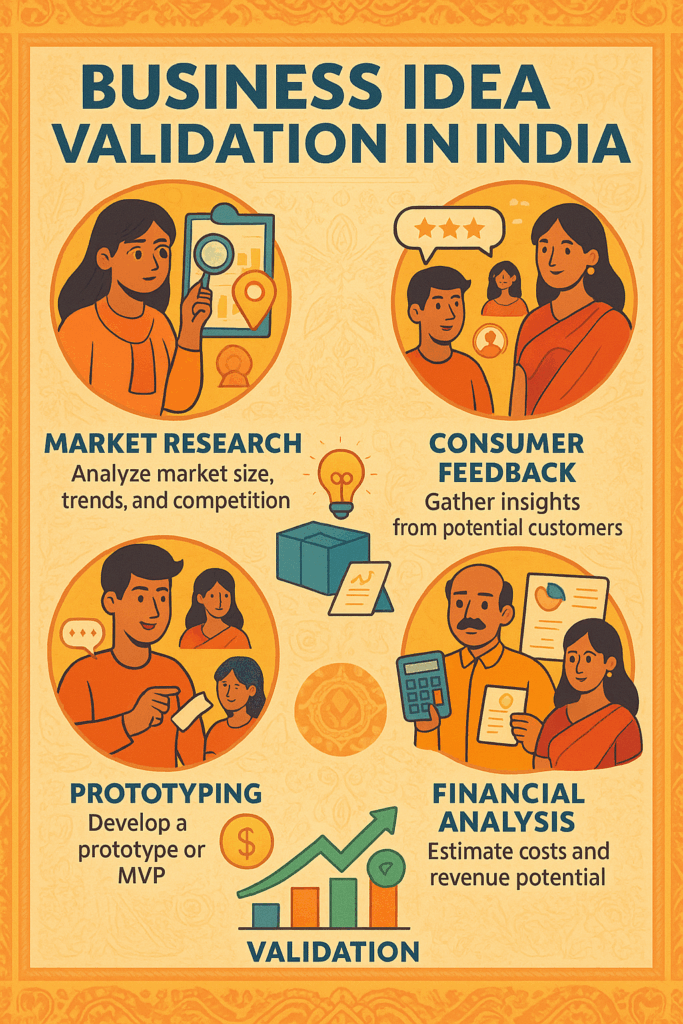
How to Validate Your Business Idea in India: A Step-by-Step Guide
Validating a business idea in India involves a combination of research, analysis, and testing. Here’s a step-by-step guide to help you get started:
1. Conduct Market Research
Market research is the foundation of any successful business. It helps you understand the size of your target market, consumer preferences, and the competitive landscape. In India, this process is even more crucial due to the country’s diverse market.
Here are some steps to conduct effective market research in India:
- Define your target audience: Identify who your ideal customers are based on demographics, geography, and behavior.
- Use online surveys: Platforms like Google Forms, Typeform, and SurveyMonkey can help you gather data from potential customers.
- Analyze competitors: Study your competitors’ offerings, pricing, and customer reviews to identify gaps in the market.
- Engage in local communities: Join Facebook groups, LinkedIn communities, and WhatsApp groups to interact with your target audience directly.
2. Leverage AI for Business Idea Validation
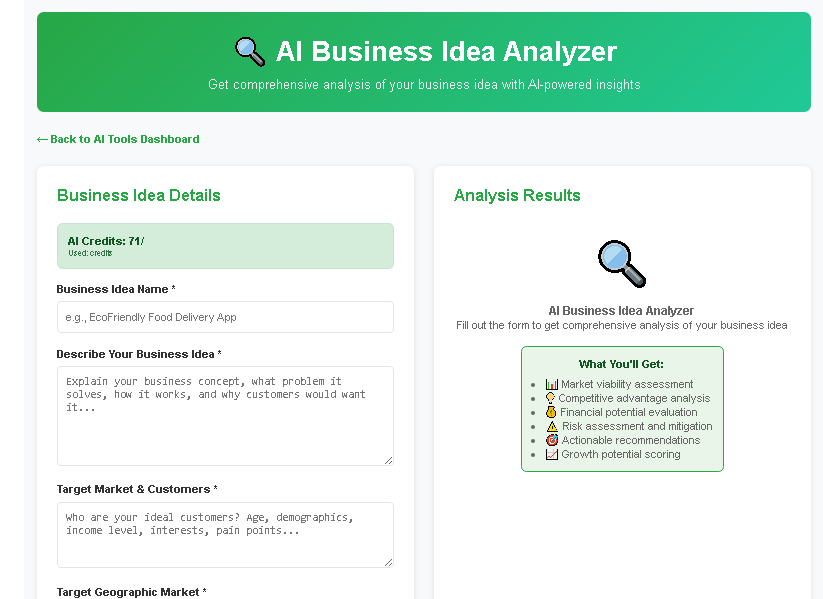
With the rise of AI for startups, you can now use advanced tools to validate your business ideas more efficiently. AI-powered startup validation tools can analyze large datasets, provide insights into market trends, and even predict the success of your business model.
Some popular AI tools for business idea validation include:
- ValidatorAI: This AI-driven platform offers interactive tools to assess your idea’s viability based on market demand, competition, and financial projections.
- Google Trends: Use this free tool to analyze search interest for your product or service in different regions of India.
- Social Listening Tools: Platforms like Hootsuite and Brandwatch can help you monitor conversations about your industry on social media.
3. Create a Minimum Viable Product (MVP)
A Minimum Viable Product (MVP) is a simplified version of your product or service that allows you to test your business idea with real customers. It’s a cost-effective way to validate your idea before launching a full-scale product.
When building an MVP for the Indian market, consider the following:
- Keep it simple: Focus on solving one core problem before adding extra features.
- Test in small regions: Start with a limited audience in a specific city or region before scaling up.
- Collect feedback: Use surveys, interviews, and analytics tools to gather feedback from early users.
4. Test with Real Customers
Once you have an MVP, it’s time to test it with real customers. This is where the real validation happens. Gather feedback from users and use it to refine your product or service.
Here are some ways to test your business idea in India:
- Offer free trials or discounts: Encourage people to try your product for free or at a reduced price.
- Run beta tests: Invite a small group of users to test your product and provide feedback.
- Use online platforms: Platforms like Flipkart, Amazon India, and Shopify can help you test your product with a wider audience.
5. Analyze the Results
After testing your idea, it’s time to analyze the results. Review key metrics, including customer feedback, conversion rates, and sales data. This will help you determine whether your idea is viable and where improvements are needed.
Some key metrics to track include:
- Customer Acquisition Cost (CAC): How much it costs to acquire a new customer.
- Customer Lifetime Value (CLV): How much a customer is worth over their lifetime.
- Net Promoter Score (NPS): Measures customer satisfaction and loyalty.

Case Study: A Successful Business Idea Validation in India
To better understand the process, let’s look at a real-life example of a business idea that was successfully validated in India.
The Startup: Swiggy
Swiggy is one of India’s leading food delivery platforms. Before launching the full app, the founders conducted extensive market research and tested their idea in a few cities.
Here’s how they validated their business idea:
- Market Research: They identified a gap in the food delivery market, especially in Tier 2 and Tier 3 cities.
- MVP Development: They created a basic version of the app and launched it in Bengaluru and Pune.
- User Testing: They gathered feedback from users and made improvements based on their suggestions.
- Expansion Strategy: After validating the concept, they expanded to other cities and introduced new features like home delivery and contactless payments.
By following a structured approach to startup validation tools and using AI-driven insights, Swiggy was able to scale rapidly and become a market leader.
How to Use AI Tools for Business Idea Validation
AI tools are revolutionizing the way entrepreneurs validate their business ideas. These AI tools for planning can analyze vast amounts of data, predict market trends, and provide actionable insights. Here’s how you can use AI for your business idea validation:
1. Use AI to Analyze Market Trends
Tools like Google Trends and Amazon Keyword Tool can help you identify popular search terms and consumer interests in India. AI can analyze this data to predict which products or services are likely to succeed.
2. Predict Product-Market Fit
AI can assess your product-market fit by analyzing customer feedback, competitor data, and market demand. Platforms like ValidatorAI use machine learning algorithms to score your business idea and provide recommendations for improvement.
3. Automate Customer Feedback Analysis
AI-powered sentiment analysis tools can automatically process customer reviews and social media comments to identify common themes and sentiments. This helps you understand what customers like or dislike about your product or service.
4. Forecast Financial Performance Many AI tools now offer financial forecasting capabilities.
By inputting your business model and market data, you can get predictions on potential revenue, break-even points, and profitability timelines.
Legal Considerations When You Validate Business Idea in India
India has a complex legal and regulatory framework that every entrepreneur must understand. Here are some key considerations when validating your business idea:
1. Business Registration
Before launching your business, you need to register it with the appropriate authorities. The type of registration depends on your business structure (sole proprietorship, partnership, LLP, or private limited company).
2. Tax Compliance
India has a Goods and Services Tax (GST) system, and all businesses must comply with tax regulations. Understanding your tax obligations is essential for long-term success.
3. Intellectual Property Rights
If your business involves a unique product, brand, or innovation, you should consider registering your intellectual property. This includes trademarks, patents, and copyrights.
4. Labor Laws
India has strict labor laws that govern employment practices. If you plan to hire employees, you must comply with these laws to avoid potential legal issues.
Success Stories of Indian Startups That Validated Their Ideas
Many successful Indian startups started with a validated business idea. Here are a few inspiring examples:
1. Zomato
Zomato began as a restaurant discovery platform. Before launching the app, the founders validated the idea by creating a website where users could rate and review restaurants. This helped them understand consumer preferences and build a loyal user base.
2. BYJU’S
BYJU’S started as an education app for students. The founders validated their idea by conducting surveys and gathering feedback from parents and students. They used this data to refine their app and expand their offerings.
3. Paytm
Paytm, one of India’s largest digital payment platforms, validated its business idea by offering free mobile recharge services. This helped them attract users and build trust in the early days.

Common Mistakes to Avoid When Validating Your Business Idea
Even the best entrepreneurs can make mistakes when validating their ideas. Here are some common pitfalls to avoid:
- Ignoring local culture: Failing to consider cultural nuances can lead to poor market acceptance. Always research your target audience’s values and preferences to ensure a tailored approach that resonates with them.
- Overlooking competition: Ignoring competitors can result in missed opportunities. Study their strategies and find ways to differentiate yourself from them.
- Not testing enough: Rushing to launch without sufficient testing can lead to failure. Always validate business idea in India with real users and gather comprehensive feedback before scaling up.
- Underestimating costs: Many startups fail due to poor financial planning. Be realistic about your costs and revenue projections.
How to Stay Updated on the Indian Startup Market
The Indian startup ecosystem is constantly evolving. To stay ahead, you must keep pace with the latest trends, policies, and innovations. Here are some ways to stay informed:
- Follow startup news: Websites like YourStory, Inc42, and Startup India provide regular updates on the startup scene.
- Join startup events: Attend events like Startup India Summit, TiEcon, and Demo Day to connect with other entrepreneurs and investors.
- Engage on social media: Follow thought leaders and startups on LinkedIn, Twitter, and Facebook to get real-time updates.
- Subscribe to newsletters: Join email newsletters from platforms like Startup Grind and 360East to receive curated content.
Conclusion: Take the First Step Toward a Successful Business
When you validate business idea in India, it’s the first step toward building a successful startup. By conducting thorough market research, leveraging startup validation tools, and using AI-driven insights, you can increase your chances of success. Remember to consider the unique challenges of the Indian market and tailor your approach accordingly.
If you’re ready to take the next step, try using an AI-based validation tool like ValidatorAI to get instant feedback on your business idea. With the right tools and strategies, you can turn your vision into a thriving business in the vibrant Indian market.
Call to Action
Don’t let your business idea remain just an idea. Use our AI-powered business idea validation tool to test your concept and get expert feedback. Whether you’re launching an e-commerce store, a tech startup, or a service-based business, our platform is designed to help you succeed in the Indian market.
Try our tool today and take the first step toward turning your dream into reality. Validate your business idea now and increase your chances of success in the competitive Indian startup ecosystem.