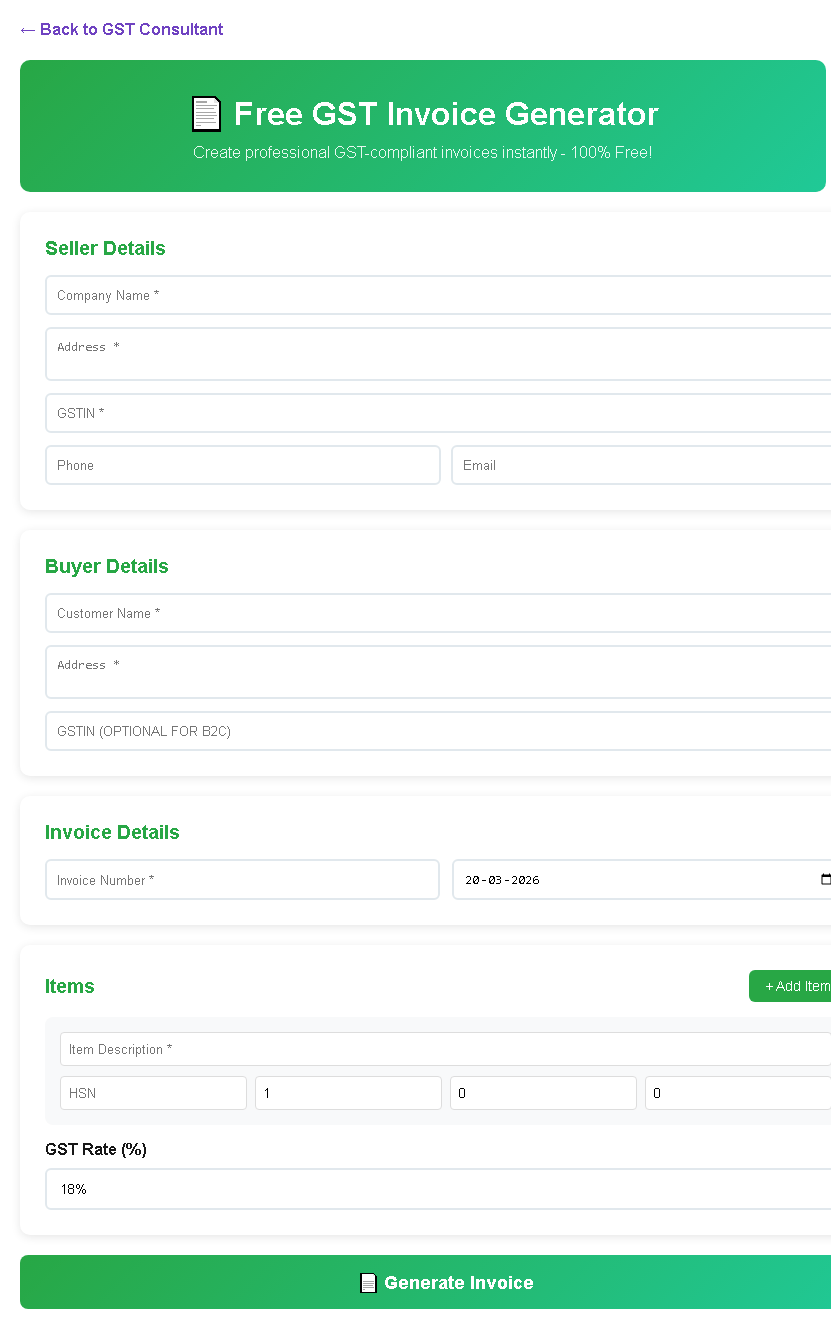
The Harmonized System of Nomenclature (HSN) is an international standardized system used to classify goods for taxation purposes. In India, the HSN code is used to determine the GST (Goods and Services Tax) rate applicable to a particular product. As of the latest update, the GST rate for various products can be calculated using the following formula: GST Amount = (Base Price x GST Rate%) / 100.
For example, if the base price of a product is ₹1,000 and the applicable GST rate is 18%, the GST amount would be ₹180, and the total price would be ₹1,180. You can calculate the GST amount using our GST calculator widget below.
| Base Price (₹) | GST Rate (%) | GST Amount (₹) | Total Price (₹) |
|---|---|---|---|
| 1,000 | 18 | 180 | 1,180 |
Enter your base price and GST rate in the calculator widget below to calculate the GST amount and total price.
function calculateGST() { var basePrice = document.getElementById("base-price").value; var gstRate = document.getElementById("gst-rate").value; var gstAmount = (basePrice * gstRate) / 100; var totalPrice = parseFloat(basePrice) + parseFloat(gstAmount); document.getElementById("gst-amount").innerHTML = "GST Amount: ₹" + gstAmount.toFixed(2); document.getElementById("total-price").innerHTML = "Total Price: ₹" + totalPrice.toFixed(2); }In India, the GST rate for various products is determined by the HSN code. The following table lists the HSN code, GST rate, and effective date for some common products:
| HSN Code | Product Description | GST Rate (%) | Effective Date |
|---|---|---|---|
| 0101 | Live horses, asses, mules and hinnies | 0 | 01-07-2017 |
| 0201 | Meat of bovine animals, fresh or chilled | 12 | 01-07-2017 |
| 0301 | Live fish | 0 | 01-07-2017 |
| 0401 | Milk and cream, not concentrated nor containing added sugar or other sweetening matter | 0 | 01-07-2017 |
| 0501 | Human hair, unworked, whether or not washed or scoured; waste of human hair | 5 | 01-07-2017 |
Some products are exempt from GST or have special conditions. For example, products with HSN code 0101 (live horses, asses, mules, and hinnies) are exempt from GST. Similarly, products with HSN code 0401 (milk and cream, not concentrated nor containing added sugar or other sweetening matter) are also exempt from GST.
Prior to the introduction of GST in India, the tax regime was complex and had multiple tax rates. The pre-GST tax regime had a combination of central excise duty, value-added tax (VAT), and service tax. The GST regime has simplified the tax structure and has a single tax rate for each product.
The following table compares the pre-GST tax rates with the GST rates for some common products:
| Product Description | Pre-GST Tax Rate (%) | GST Rate (%) |
|---|---|---|
| Live horses, asses, mules and hinnies | 5-6 | 0 |
| Meat of bovine animals, fresh or chilled | 12-14 | 12 |
| Live fish | 5-6 | 0 |
| Milk and cream, not concentrated nor containing added sugar or other sweetening matter | 4-5 | 0 |
| Human hair, unworked, whether or not washed or scoured; waste of human hair | 10-12 | 5 |
The key differences between the pre-GST and GST regime are:
The following are some frequently asked questions regarding HSN and GST:
The HSN code is a standardized system used to classify goods for taxation purposes. It is used to determine the GST rate applicable to a particular product.
The GST amount can be calculated using the formula: GST Amount = (Base Price x GST Rate%) / 100. The total price can be calculated by adding the GST amount to the base price.
Some products are exempt from GST or have special conditions. For example, products with HSN code 0101 (live horses, asses, mules, and hinnies) are exempt from GST.
The GST regime has a simplified tax structure, a broader tax base, and has reduced tax evasion compared to the pre-GST tax regime.
To ensure compliance with the GST regime, businesses should:
By following these compliance tips, businesses can avoid common billing mistakes and ensure smooth compliance with the GST regime.
Harmonized System of Nomenclature, an international standardized system used to classify goods for taxation purposes
Using the formula: GST Amount = (Base Price x GST Rate%) / 100
To determine the GST rate applicable to a particular product
Yes, it is an international standardized system
By multiplying the base price with the GST rate percentage and dividing by 100