Business Plan for Bank Loan (India): Free AI Generator, Bank-Ready DPR Format


What a “Business Plan for Bank Loan” Actually Is in India
A business plan for bank loan purposes is not the pitch deck a startup shows investors. When an Indian bank — public or private — receives your loan application, the document its credit department assesses is called a Detailed Project Report (DPR): what the project costs, where the money comes from, what the unit will earn, and how repayment will be generated from operations. Every section below exists because a credit-app memo asks the question; a plan that cannot answer it gets returned to the branch, however good the business is.
This is also why “best free business plan format for loan application” downloads mostly fail: they are investor templates. A bank’s technical officer benchmarks your unit against industry data, checks ratio norms, and verifies your numbers against your bank statements. The generation order has to be numbers first, narrative second.
Which Loan Are You Walking In For?
| Loan type | Typical ticket | Security position | What appraisal leans on |
|---|---|---|---|
| Working-capital (OD/CC) limit | ₹2 lakh onwards | Collateral above bank’s threshold; often CGTMSE-backed below it | Drawings vs sanctioned limit, stock statements, bank-credit flow |
| Term loan — equipment or expansion | ₹5 lakh – ₹5 crore | Hypothecation of the asset financed + collateral where required | DSCR, project cost vs loan, quotations, promoter contribution |
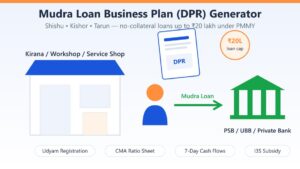
| MUDRA (PMMY) | Up to ₹20 lakh | Collateral-free by design | Category fit (Shishu/Kishor/Tarun/Tarun Plus), utilization history — see our Mudra loan business plan generator |
| Startup / new-enterprise loan | ₹10 lakh – ₹5 crore | Varies; DPIIT recognition opens separate routes | Promoter track record, market evidence, means of finance — see the DPIIT plan generator |
If you are not sure which scheme fits your business, run the ask through the MSME scheme finder first — the DPR you file should match the scheme’s assessment checklist, not a generic outline.
The DPR Format Indian Banks Assess (8 Sections)
- Promoter apponement — who you are: age, education, experience in this exact trade, prior loan history, CIBIL note for each promoter
- Project cost, itemised — machinery, interiors, initial stock, deposits, pre-operative expenses; backed by quotations/proforma invoices, not estimates
- Means of finance — promoter contribution (margin money), loan asked, subsidy expected. A “100% loan” file is a red flag in itself
- Project description & market analysis — what you sell, to whom, at what price, in which catchment, against which competitors — with evidence
- Operating plan — capacity/timings, staff, supply chain, GST and Udyam status
- Financial projections — 3–5 years: P&L, balance sheet, cash flow; first year broken monthly or quarter-wise
- CMA data — the standard ratio table technical officers benchmark your unit against industry averages
- Annexures — KYC, address/search reports, rent proof, quotations, photographs, statutory documents
The Five Numbers the Credit Panel Actually Looks At
- DSCR (Debt Service Coverage Ratio) — operating cash profit ÷ principal + interest. Around 2.0 is the comfortable benchmark on a small-business term loan; below ~1.5 most panels bounce the file.
- Promoter contribution — typically 10–25% of project cost depending on scheme and category; the bank verifies it actually went in, via statements.
- Working-capital norm — your limit is sized against a Tandon-formula style cycle (raw-material, production, finished-goods, receivable days ÷ 365 × anticipated turnover). Overask here is the single most common rejection in OD/CC files.
- Turnover vs loan size — the common-sense check: does projected sales plausibly service the EMI/interest you are asking for?
- Current ratio & profitability trend — from your balance sheet projections; flat or invented margins get spotted against CMA industry averages.
A business plan generator for loan application use should show you these five numbers before you export — if a tool only produces prose, it is not built for bank appraisal.
Collateral-Free Is a Route, Not a Miracle: CGTMSE
For micro and small enterprises, the Credit Guarantee Fund Trust for Micro and Small Enterprises (CGTMSE) lets a member lending institution take a government credit guarantee instead of collateral. Effective 1 April 2025, the guarantee ceiling was raised from ₹5 crore to ₹10 crore of credit support per eligible enterprise, with coverage extending up to 90% for women-led enterprises (75–85% for others, per scheme circulars). Guarantee fees are slabbed by loan size and coverage band, and are borne partly by the borrower and partly by the lender as per the trust’s current fee circular.
Two practical notes: eligibility runs on MSME classification (investment + turnover under the Udyam regime), and the bank sanctions on your file’s strength either way — CGTMSE removes the collateral requirement, not the scrutiny. MUDRA loans under PMMY are collateral-free by design: MUDRA categories run Shishu (up to ₹50,000), Kishor (₹50,000–₹5 lakh), Tarun (₹5–10 lakh) and Tarun Plus (₹10–20 lakh for borrowers who repaid a previous Tarun loan). MUDRA engages no agents or middlemen — anyone charging you for “MUDRA processing” is not on the scheme’s side.
Eligibility & Documents: What the Branch Will Ask For
- Identity & address of every promoter (KYC), plus search report for proprietary/partnership cases
- CIBIL / credit-bureau record — practice varies by loan size, but expect the check; settled accounts and clean repayment history carry the file
- Bank statements of the last 6–12 months for running businesses — your projected numbers must reconcile with the credit flow visible here
- ITR / GST returns where applicable; new units file none, which is why the DPR carries the full weight
- Quotations / proforma invoices for every capital item in the cost
- Udyam registration — free, one session, and several lenders pre-screen on it
- CA certificate on project cost and promoter contribution for most term-loan files above branch powers
How This Business Plan for Bank Loan Generator Works
BizPlan AI Pro’s generator builds the bank’s document, in the bank’s order:
- Answer 15–20 India-specific questions: trade, city and state, loan type and amount, promoter contribution available, GST/Udyam status, existing borrowings.
- The finance engine does the appraisal maths first: itemised project cost, month-wise projections, working-capital cycle, DSCR, break-even — you see the ratios the credit panel will see.
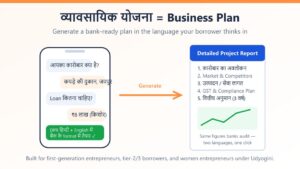
- AI writes the narrative chapters around the validated numbers, in English, Hindi, or both — the wording branch staff are used to reading (there is a dedicated Hindi plan generator too).
- Bankability gate: if the loan ask is unrealistic for your turnover, contribution is too thin, or DSCR fails, export locks and the tool names the exact input to fix. Nothing goes to a counter that cannot survive appraisal.
- Export the DPR PDF with the CMA sheet and the 8-section order above — one validated document, reusable across multiple branches.
Why Loan Business Plans Get Rejected
- Template numbers — same margins and machinery prices as every other shop in the district; technical officers benchmark against CMA averages and spot it.
- Turnover that contradicts the ask — ₹8 lakh needed against visibly thin monthly credit flow fails the common-sense test before the maths starts.
- Inflated working-capital cycle — limits sized on assumption days rather than your actual stock/receivable cycle.
- No skin in the game — undocumented or absent promoter contribution.
- Wrong route — a MUDRA-sized file pushed at a commercial loan counter, or a project report written for investors (equity language, no CMA data) submitted to a bank.
Every one of these is a document-quality failure, not a business-quality failure — which is exactly what a gated generator is for.
FAQs
What format do banks in India want for a loan business plan?
A Detailed Project Report (DPR): project cost, means of finance, market analysis, operating plan, 3–5 year financials, CMA data and annexures. Investor-deck formats are not assessed by credit departments.
Can I get a business loan without collateral?
Yes, if the file qualifies: MUDRA up to ₹20 lakh is collateral-free by design, and CGTMSE credit guarantees (ceiling ₹10 crore of credit support since April 2025) let member banks lend collateral-free to eligible micro and small enterprises. Sanction still depends on the DPR’s strength.
Do banks check CIBIL for a business loan?
Expect them to, for every promoter on the file. A strong DPR cannot erase a bad bureau record, but it presents repayment capacity so completely that borderline files still get a fair technical hearing.
How many years of financial projections does the bank need?
Standard practice is 3–5 years, with the first year broken month-wise or quarter-wise for new units. Running businesses must additionally reconcile projections against the last 6–12 months of bank credit flow.
Can I submit the same plan to multiple banks?
Yes — one validated DPR can be filed at several lenders; apply first where your account relationship exists. Just do not stack sanctioned limits beyond what your projections can service.
What is DSCR and what should it be?
Debt Service Coverage Ratio: operating cash profit divided by principal plus interest due. Around 2.0 is comfortable for a small-business term loan; below about 1.5 most credit panels decline.
Related Pages
Applying under PMMY specifically? Use the Mudra loan business plan generator. Filing in Hindi or bilingually? The business plan generator Hindi builds the same DPR in both languages. Not sure which scheme you qualify for? Start with the MSME scheme finder. The tool itself lives on our business plan generator for India homepage.

The BizPlan AI Editorial Team comprises startup consultants, financial analysts, and professional technical writers. We compile verified Indian market data and MSME guidelines to help entrepreneurs build investor-ready business plans.