D2C E-commerce Business Plan Generator India: Marketplace Commissions, COD & RTO Modelled
Why a D2C Plan Needs a Different Generator
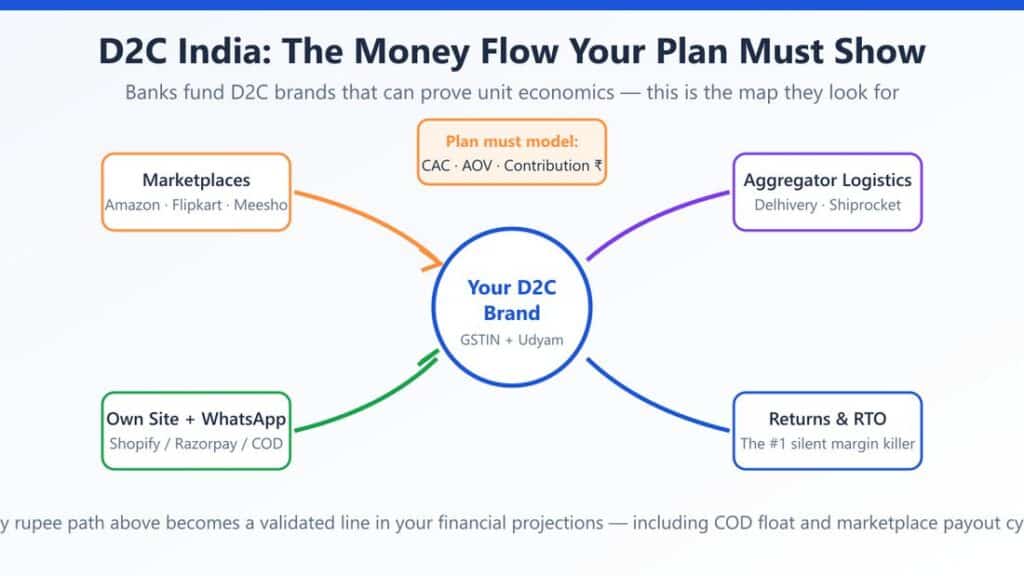
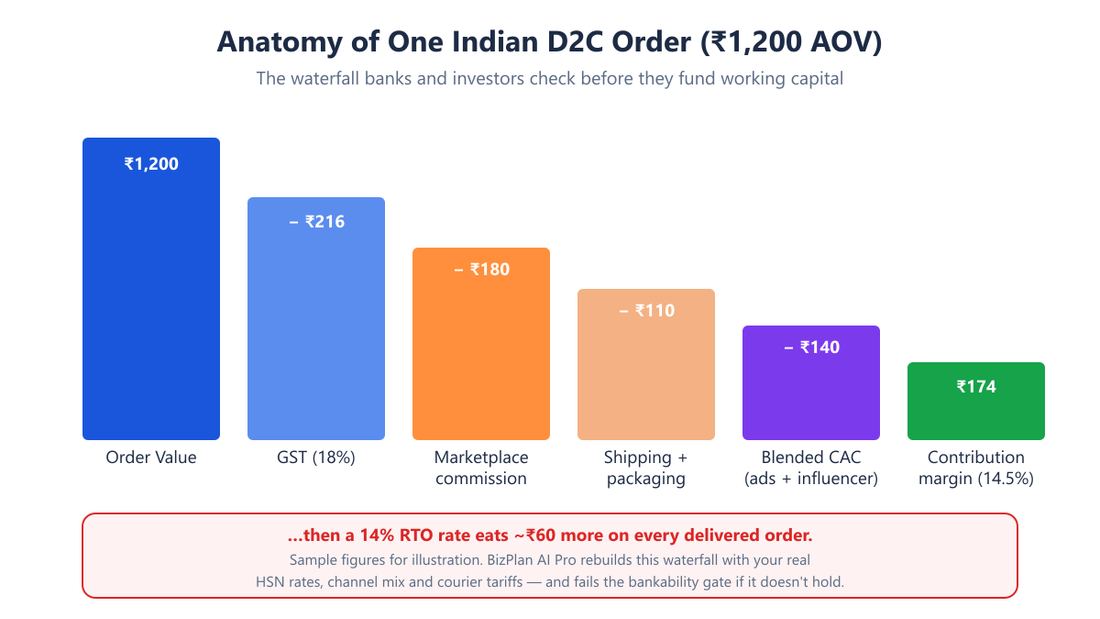
A serious d2c business plan cannot be a generic plan that treats e-commerce as “retail, but online.” In India that assumption kills the file. Marketplace commissions run 15–30% by category, GST applies at the shelf price you advertise, 25–40% of orders in many categories arrive as cash-on-delivery with a 10–20% RTO (return-to-origin) rate riding on top, and courier tariffs swing by zone and weight. Therefore a D2C plan is an unit-economics plan first — and investors and working-capital lenders both read it the same way.
The Indian D2C Cost Stack, Line by Line
| Layer | Typical range | Where generic plans get it wrong |
|---|---|---|
| GST on output | 5 / 12 / 18 / 28% by HSN | Modelling revenue on MRP instead of ex-GST price |
| Marketplace commission + fees | 15–30% closing cost | Using “average 10%” from US articles |
| Shipment + packaging | ₹40–120 per order by zone/weight | Ignoring COD convenience fees and RTO double-ship cost |
| Blended CAC | ₹100–400 (meta/Google/influencer) | Counting only ad spend, not creator sampling and returns on acquisition |
| Payments | ~2% UPI-free / card + gateway | Missing the COD-to-prepaid mix shift entirely |
| Returns & RTO | 5–15% prepaid returns; 15–40% RTO on COD | Treating returns as an “other expense” footnote |
| Working capital | Marketplace payouts T+7 to T+15 | Assuming cash on sale; the inventory cycle eats profitable brands |
The rule any d2c business plan generator must enforce: contribution margin per delivered order — order value minus every variable line above, including expected RTO losses — must be positive and thick enough to cover fixed costs within the projection horizon. If it isn’t, more sales is not the plan; fixing the waterfall is.
How the D2C Business Plan Generator Works
- Channel-weighted interview. Catalogue with HSN-wise GST rates, channel mix (Amazon / Flipkart / Meesho / own site / WhatsApp commerce / quick-commerce), price points, paid vs organic split, COD share, current or assumed RTO rate, courier partner tariffs.
- Per-channel unit economics engine. Every SKU × channel combination gets its own waterfall — commission tables are category-specific, so “apparel on Myntra” and “apparel on Meesho” compute differently.
- Cash-flow reality. Marketplace payout cycles, ad-payment timing and inventory lead-times are modelled, so the plan shows the working-capital peak — the number that decides a WC loan — not just a P&L.
- Compliance chapter. GST registration across states with warehouses (GSTIN per state), e-commerce TCS implications via platforms, RCM on sponsorships where applicable.
- Bankability gate + export. DPR format for a bank WC/term loan, or investor format with cohort retention pages — same validated numbers, different dress.
Funding Paths for Indian D2C Brands (and What Each Reads)
- MUDRA / CGTMSE (₹10–20 lakh): reads the DPR — project cost, stock cycle, promoter margin. Works for inventory-led single-channel brands.
- Working-capital lines from NBFCs: read the payout-cycle maths and drawdown discipline; the plan must show how each stock cycle self-liquidates.
- Angel / institutional: read contribution margin, repeat rate, CAC payback, and channel concentration risk. A plan that shows 80% of revenue on one marketplace gets priced for that risk.
- Quick-commerce supply deals: read MOQ economics and margin-on-invoice — model them as a distinct channel, not “B2B misc.”
FAQs
What margins do Indian D2C brands actually keep?
After the full stack, delivered-order contribution margins of 15–30% on own-site prepaid and 5–15% on marketplace are common, with EBITDA only after fixed costs and returns discipline. Any plan asserting 60% “gross margin” without the waterfall is describing MRP arithmetic, not a business.
Should the plan include Meesho/quick-commerce if I’m not on them yet?
Only as a scenario with honest economics — low-price platforms reshape your blended margin and can cannibalise positioning. The generator models them as switchable channels so you can see the mix effect before committing.
Do I need an accountant for GST in the plan?
For filing, eventually yes. For planning, the HSN-rate engine plus a state-wise GSTIN chapter covers what lenders check; the compliance calendar tells you when the professional becomes load-bearing.
Related
For the scheme side: Mudra plan generator (many D2C brands start as Kishor/Tarun borrowers) and the DPIIT generator if you’re raising. The tool itself lives on our India business plan generator homepage, and the full tool-by-tool comparison is in the best business plan generator for India analysis.

The BizPlan AI Editorial Team comprises startup consultants, financial analysts, and professional technical writers. We compile verified Indian market data and MSME guidelines to help entrepreneurs build investor-ready business plans.