How to Build an AI-Powered Business Plan in 2026

How to Build an AI-Powered Business Plan in 2026: A Comprehensive Guide
In the rapidly evolving landscape of 2026, the traditional static business plan is effectively obsolete. Entrepreneurs who rely on intuition and spreadsheets alone are being outpaced by those leveraging machine learning and predictive analytics. Building an AI-powered business plan is no longer a luxury reserved for tech giants; it is an essential survival mechanism for any modern venture. With the integration of advanced tools, founders can now simulate market conditions, forecast financial risks, and refine their value propositions with a level of precision that was previously unattainable. According to recent industry analysis, the shift toward algorithmic strategic planning has become the defining characteristic of successful startups. However, this transition is fraught with complexity. It is vital to note that 85% of AI projects fail, often due to a lack of clear strategic alignment, as highlighted by PwC. This high failure rate underscores the importance of a structured, data-driven approach to AI integration. As we navigate the complexities of the current fiscal year, understanding how to synthesize human creativity with machine intelligence is the ultimate competitive advantage. Whether you are seeking to optimize your target market or trying to understand the nuances of SG&A expenses, AI provides the framework to turn raw data into actionable intelligence. By utilizing modern business plan generator tools, you can ensure your strategy remains dynamic, scalable, and resilient against market shifts.
The Strategic Role of AI in Modern Business Planning
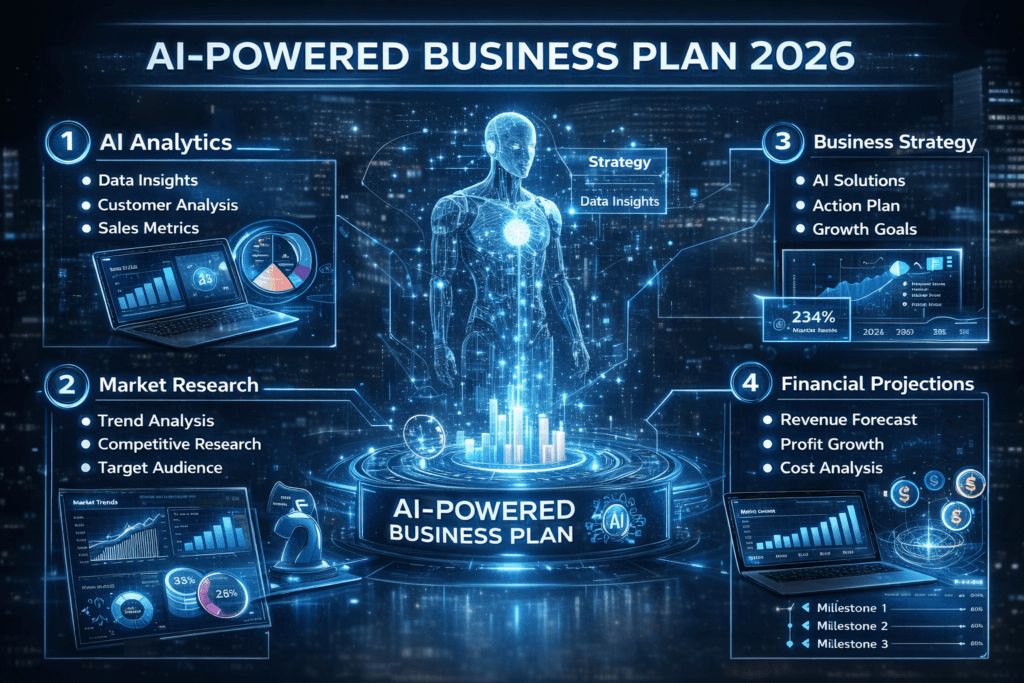
Modern business planning is no longer a linear process of drafting a document; it is an iterative cycle of hypothesis, testing, and refinement. When you build an AI-powered business plan, you are effectively creating a digital twin of your enterprise. This virtual model allows you to test variables—such as supply chain disruptions or changes in consumer sentiment—without risking real capital. The core of this methodology relies on Natural Language Processing (NLP), a field of computer science that allows systems to interpret and manipulate human language. As discussed by IBM, NLP enables businesses to parse vast amounts of unstructured data from industry reports, social media sentiment, and competitive websites to extract meaningful insights that inform your strategic roadmap.
Leveraging Machine Learning for Predictive Accuracy
The application of machine learning algorithms in market research, as explored by the MIT Sloan Management Review, has transformed how startups approach market entry. Instead of relying on historical averages, machine learning models analyze real-time data streams to project future performance. This is particularly useful for identifying shifts in your targeted audience before they become mainstream trends. By integrating these tools, you move from reactive planning to proactive positioning.
- Data Normalization: Cleaning disparate data sources to ensure consistent analysis.
- Pattern Recognition: Identifying hidden correlations between marketing spend and conversion rates.
- Scenario Modeling: Running “what-if” simulations to stress-test your revenue model.
Infrastructure and Tools: Selecting Your AI Stack
Choosing the right technology stack is the most critical decision an entrepreneur will make in 2026. The market is saturated with options, ranging from general-purpose generative models to specialized industry-specific platforms. For non-technical founders, the goal is to bridge the gap between complex infrastructure and usable business intelligence. Organizations using Canva, Upwork, Google Cloud AI Platform, and Microsoft Azure Machine Learning report significant improvements in operational efficiency and strategic clarity.
Evaluating Cost-Effectiveness and Scalability
As analyzed by the Harvard Business Review, the cost-effectiveness of AI solutions is often misunderstood. Founders often focus on the upfront subscription cost rather than the total cost of ownership, which includes data cleaning, maintenance, and integration time. Before committing to a tool, evaluate its ability to scale. An AI tool that works for a solo founder may collapse under the data load of a scaling enterprise. Always verify that your chosen platform allows for seamless data exports and API integration, ensuring you aren’t locked into a proprietary ecosystem that hampers your long-term growth.
Integrating Financial Modeling with AI Intelligence
Financial planning is the backbone of any business plan, yet it is often the most prone to human error. AI-powered financial advisors are changing this by automating the reconciliation of complex datasets and providing real-time forecasting. For startups in India and beyond, understanding the specific mechanics of AI-driven financial advisory is crucial. These systems can monitor your cash flow, predict burn rates, and suggest adjustments to your operational budget based on current market volatility.
Market Research and Competitive Intelligence
In 2026, competitive intelligence is a high-speed game of observation. You are no longer just tracking your direct competitors; you are tracking the entire ecosystem. AI tools can crawl public databases, news outlets, and patent filings to build a comprehensive profile of the market landscape. This level of insight allows you to identify gaps in the market that were previously obscured by the noise of traditional data collection methods. When you leverage these insights, your business plan gains a layer of authority that investors find compelling.
Risk Management and Regulatory Compliance
Navigating the regulatory environment, especially regarding tax and legal compliance, is a significant challenge for new businesses. In India, for example, the complexity of GST requires constant vigilance. Utilizing specialized tax bots can drastically reduce the risk of non-compliance. These tools are designed to stay updated with the latest regulatory changes, acting as a buffer between your operations and potential legal pitfalls. By automating these “boring” but essential tasks, you free up your leadership team to focus on high-level strategy.
The Human Element: Leading with AI
While AI provides the data, the final strategic decision must always rest with human leadership. The most successful businesses in 2026 are those that operate as a “centaur”—a hybrid of human intuition and artificial intelligence. Your role as a leader is to interpret the data, set the vision, and ensure that the AI is aligned with your core values. Do not abdicate your decision-making responsibilities to an algorithm; instead, use the algorithm to inform and sharpen your judgment.
Comparison of AI Implementation Approaches
| Approach | Primary Benefit | Complexity |
|---|---|---|
| Custom Built Models | Full control over data privacy | High |
| AI-Powered Platforms | Rapid deployment | Low |
The table above highlights the trade-offs between different paths to AI integration. For the vast majority of startups, the “AI-Powered Platform” approach provides the best balance of speed and functionality. While building custom models offers theoretical superiority, the time-to-market trade-off is often prohibitive. According to data from Upwork (as of 16 Dec 2025), the most successful startups are those that focus on integrating pre-built solutions that offer immediate ROI, allowing them to iterate on their business model without becoming bogged down in infrastructure development. Choosing the right partner or toolset is a critical strategic decision that should be revisited quarterly as your needs evolve.
Frequently Asked Questions
What are the key components of an AI-powered business plan?
An AI-powered business plan goes beyond the traditional executive summary and financial tables. It includes a dynamic data integration layer that connects your core business functions—such as marketing, operations, and finance—into a single, real-time dashboard. This allows for automated scenario planning where you can see the impact of hypothetical market changes on your bottom line.
Additionally, it incorporates predictive analytics for customer acquisition costs and lifetime value, providing a more accurate picture of your growth trajectory. By leveraging machine learning for competitive monitoring, your plan also includes a live feed of market shifts, ensuring that your strategic assumptions are always validated by the latest available information.
How can companies measure the effectiveness of their AI solutions, as suggested by Gartner?
Measuring AI effectiveness requires a shift from vanity metrics to outcome-based KPIs. Companies should track the delta between human-only decision-making and AI-augmented decision-making. If your AI tools are not directly impacting your primary business objectives—such as cost reduction, revenue growth, or customer retention—then they are merely overhead.
Furthermore, it is essential to monitor the “model drift,” where the accuracy of an AI tool degrades over time as market conditions change. Regularly auditing your AI outputs against actual results is critical. According to industry best practices, a successful AI implementation should demonstrate a measurable improvement in decision speed and accuracy within the first 90 days of deployment.
How to start an AI business in 2026?
The most common pitfall for new founders is attempting to build an “everything” platform. To start an AI business in 2026, you must identify a highly specific, high-friction problem in a niche market and solve it with a targeted AI solution. By focusing your resources, you can achieve superior model accuracy and faster adoption rates.
Start by validating the problem with potential customers before writing a single line of code. Once the need is confirmed, use accessible, high-performance tools like those provided by cloud providers to build your MVP. This lean approach allows you to scale efficiently and pivot based on actual user feedback rather than theoretical assumptions.
What are the new AI developments in 2026?
In 2026, the focus has shifted from generative text to autonomous agents capable of executing complex workflows. We are seeing the rise of “agentic” systems that can not only draft a business plan but also execute tasks like market outreach, financial reconciliation, and automated A/B testing across multiple platforms simultaneously.
Furthermore, the integration of edge computing with AI is allowing for faster, more private processing of data. This is critical for businesses operating in highly regulated sectors where data sovereignty is a priority. Staying updated with these 2026 research trends is essential for any founder looking to maintain a competitive edge.
Is it necessary to have a technical co-founder to build an AI business?
No, it is not strictly necessary, provided you utilize modern, low-code or no-code platforms that democratize access to AI infrastructure. However, you must possess a high level of “AI fluency”—the ability to understand how these tools work, their limitations, and their potential applications.
You can effectively build a robust business by focusing on the application layer rather than the model layer. By acting as a product manager who understands how to bridge the gap between business needs and machine learning capabilities, you can lead a successful venture without needing to write complex code yourself.
How does AI change the way we define our target market?
AI transforms market definition from a static demographic profile into a dynamic behavioral model. Instead of targeting “males 25-34 in urban areas,” AI allows you to target users based on their intent, digital footprint, and propensity to purchase, as identified through pattern recognition.
This level of granularity ensures that your marketing spend is directed toward the individuals most likely to convert. By continuously updating your target market definition based on real-time engagement data, you ensure that your business plan remains aligned with the shifting realities of your customer base.

What is the biggest risk when using AI for business planning?
The biggest risk is “hallucination” and over-reliance on black-box algorithms. If you blindly accept the output of an AI model without proper human verification, you risk making high-stakes decisions based on flawed or biased data. Always maintain a “human-in-the-loop” approach where critical strategic pivots are vetted by experienced professionals.
Additionally, data privacy and security are paramount. Ensure that the tools you use comply with global data protection standards. Failing to protect your proprietary data while training your models can lead to significant intellectual property loss, which can be fatal for a new startup.
How do I compare BizplanAI Pro against other tools?
When comparing tools like BizplanAI Pro to alternatives such as VentureKit or Coachvox AI, you should evaluate them based on the depth of their financial modeling capabilities, the transparency of their AI logic, and their ease of integration with your existing workflow.
Look for tools that offer more than just text generation; prioritize platforms that provide actionable financial insights, competitive landscape mapping, and real-time KPI tracking. The best tool is the one that integrates seamlessly into your daily operations rather than existing as a standalone document creation platform.

Conclusion
Building an AI-powered business plan is the definitive way to future-proof your company in 2026. By leveraging the power of NLP, machine learning, and predictive analytics, you transform your strategy from a static document into a dynamic, intelligent engine that guides your growth. While the failure rate for AI projects remains high, those who approach the technology with a clear focus, a commitment to data integrity, and a healthy balance of human judgment will emerge as the market leaders of their respective sectors. Do not be intimidated by the technical jargon; the tools available today are designed to be intuitive and accessible to any founder with a clear vision. Whether you are validating a new idea with a free AI business coach or scaling an established enterprise, the technology is ready to work for you. The time for hesitation has passed. Take the first step today by auditing your current planning processes and identifying where AI can provide the most immediate, measurable value. Your competitors are already automating their futures—are you ready to do the same? Start your journey toward an AI-optimized business model now, and ensure your venture is built to thrive in the complex, high-speed economy of tomorrow.

R. Sharma is a senior startup advisor and business planning specialist at BizPlan AI Pro. With over a decade of experience in Indian corporate finance and MSME consulting, he has helped hundreds of founders structure financial projections and secure bank funding.