NEW
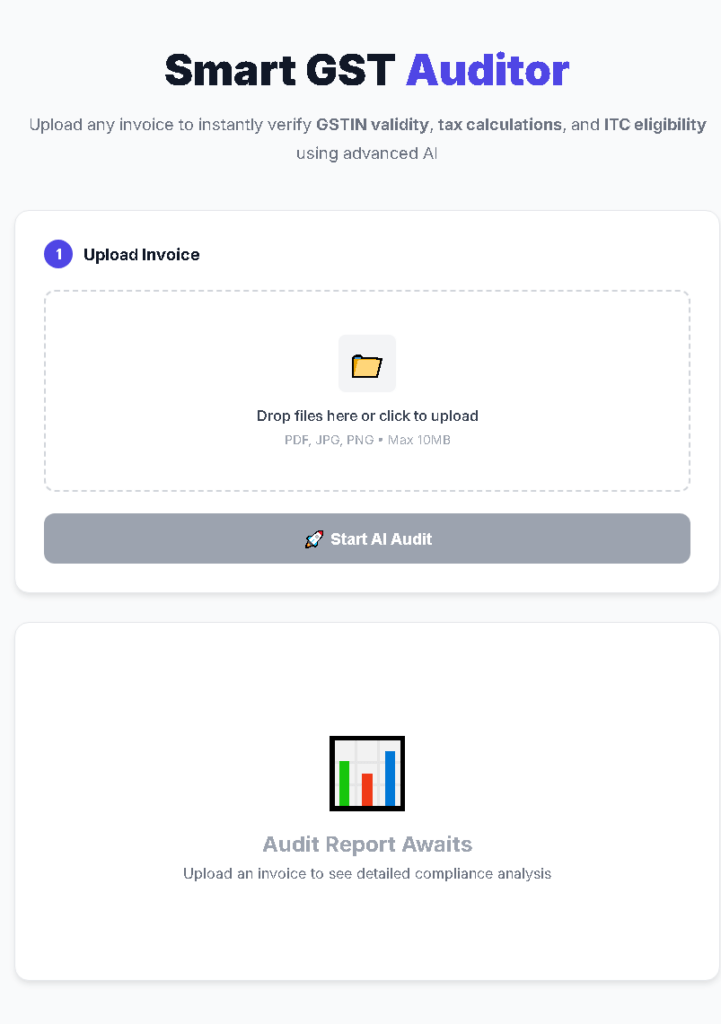
Scan GST Invoices on WhatsApp! Get instant AI analysis + 5 Free Credits.
Try Now

How to Build an AI-Powered Business Plan in 2026

How to Build an AI-Powered Business Plan in 2026: A Comprehensive Guide

In the rapidly evolving landscape of 2026, the traditional static business plan is effectively obsolete. Entrepreneurs who rely on intuition and spreadsheets alone are being outpaced by those leveraging machine learning and predictive analytics. Building an AI-powered business plan is no longer a luxury reserved for tech giants; it is an essential survival mechanism for any modern venture. With the integration of advanced tools, founders can now simulate market conditions, forecast financial risks, and refine their value propositions with a level of precision that was previously unattainable. According to recent industry analysis, the shift toward algorithmic strategic planning has become the defining characteristic of successful startups. However, this transition is fraught with complexity. It is vital to note that 85% of AI projects fail, often due to a lack of clear strategic alignment, as highlighted by PwC. This high failure rate underscores the importance of a structured, data-driven approach to AI integration. As we navigate the complexities of the current fiscal year, understanding how to synthesize human creativity with machine intelligence is the ultimate competitive advantage. Whether you are seeking to optimize your target market or trying to understand the nuances of SG&A expenses, AI provides the framework to turn raw data into actionable intelligence. By utilizing modern business plan generator tools, you can ensure your strategy remains dynamic, scalable, and resilient against market shifts.

The Strategic Role of AI in Modern Business Planning

Modern business planning is no longer a linear process of drafting a document; it is an iterative cycle of hypothesis, testing, and refinement. When you build an AI-powered business plan, you are effectively creating a digital twin of your enterprise. This virtual model allows you to test variables—such as supply chain disruptions or changes in consumer sentiment—without risking real capital. The core of this methodology relies on Natural Language Processing (NLP), a field of computer science that allows systems to interpret and manipulate human language. As discussed by IBM, NLP enables businesses to parse vast amounts of unstructured data from industry reports, social media sentiment, and competitive websites to extract meaningful insights that inform your strategic roadmap.

Leveraging Machine Learning for Predictive Accuracy

The application of machine learning algorithms in market research, as explored by the MIT Sloan Management Review, has transformed how startups approach market entry. Instead of relying on historical averages, machine learning models analyze real-time data streams to project future performance. This is particularly useful for identifying shifts in your targeted audience before they become mainstream trends. By integrating these tools, you move from reactive planning to proactive positioning.

  • Data Normalization: Cleaning disparate data sources to ensure consistent analysis.
  • Pattern Recognition: Identifying hidden correlations between marketing spend and conversion rates.
  • Scenario Modeling: Running “what-if” simulations to stress-test your revenue model.

Infrastructure and Tools: Selecting Your AI Stack

Choosing the right technology stack is the most critical decision an entrepreneur will make in 2026. The market is saturated with options, ranging from general-purpose generative models to specialized industry-specific platforms. For non-technical founders, the goal is to bridge the gap between complex infrastructure and usable business intelligence. Organizations using Canva, Upwork, Google Cloud AI Platform, and Microsoft Azure Machine Learning report significant improvements in operational efficiency and strategic clarity.

Evaluating Cost-Effectiveness and Scalability

As analyzed by the Harvard Business Review, the cost-effectiveness of AI solutions is often misunderstood. Founders often focus on the upfront subscription cost rather than the total cost of ownership, which includes data cleaning, maintenance, and integration time. Before committing to a tool, evaluate its ability to scale. An AI tool that works for a solo founder may collapse under the data load of a scaling enterprise. Always verify that your chosen platform allows for seamless data exports and API integration, ensuring you aren’t locked into a proprietary ecosystem that hampers your long-term growth.

Integrating Financial Modeling with AI Intelligence

Financial planning is the backbone of any business plan, yet it is often the most prone to human error. AI-powered financial advisors are changing this by automating the reconciliation of complex datasets and providing real-time forecasting. For startups in India and beyond, understanding the specific mechanics of AI-driven financial advisory is crucial. These systems can monitor your cash flow, predict burn rates, and suggest adjustments to your operational budget based on current market volatility.
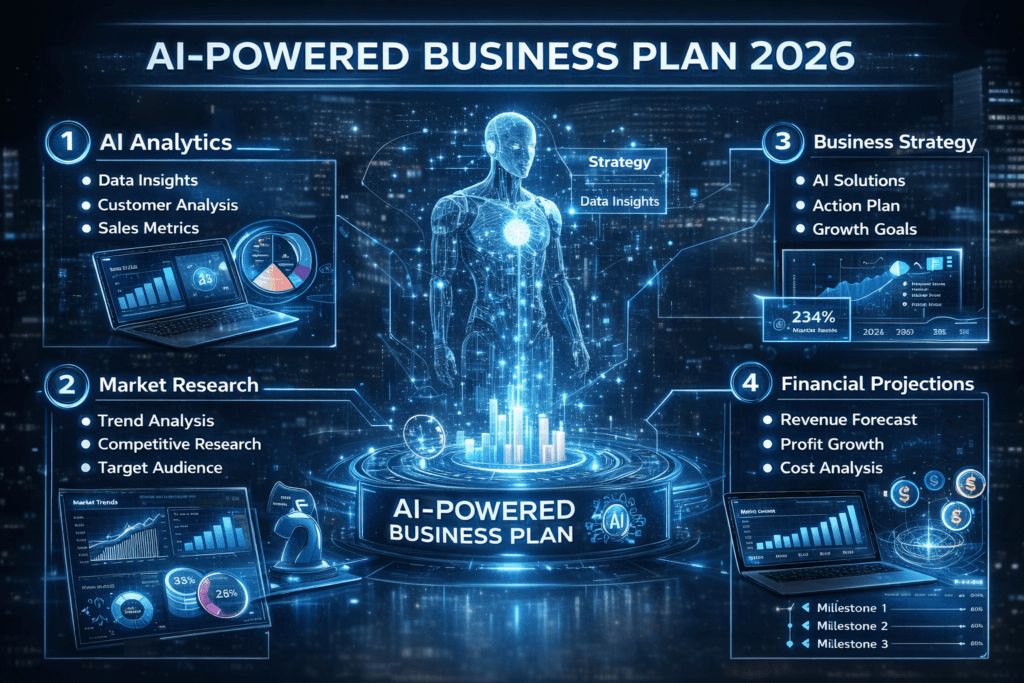
AI-powered business plan
How to Build an AI-Powered Business Plan in 2026 4

Market Research and Competitive Intelligence

In 2026, competitive intelligence is a high-speed game of observation. You are no longer just tracking your direct competitors; you are tracking the entire ecosystem. AI tools can crawl public databases, news outlets, and patent filings to build a comprehensive profile of the market landscape. This level of insight allows you to identify gaps in the market that were previously obscured by the noise of traditional data collection methods. When you leverage these insights, your business plan gains a layer of authority that investors find compelling.

Risk Management and Regulatory Compliance

Navigating the regulatory environment, especially regarding tax and legal compliance, is a significant challenge for new businesses. In India, for example, the complexity of GST requires constant vigilance. Utilizing specialized tax bots can drastically reduce the risk of non-compliance. These tools are designed to stay updated with the latest regulatory changes, acting as a buffer between your operations and potential legal pitfalls. By automating these “boring” but essential tasks, you free up your leadership team to focus on high-level strategy.

The Human Element: Leading with AI

While AI provides the data, the final strategic decision must always rest with human leadership. The most successful businesses in 2026 are those that operate as a “centaur”—a hybrid of human intuition and artificial intelligence. Your role as a leader is to interpret the data, set the vision, and ensure that the AI is aligned with your core values. Do not abdicate your decision-making responsibilities to an algorithm; instead, use the algorithm to inform and sharpen your judgment.

Comparison of AI Implementation Approaches

ApproachPrimary BenefitComplexity
Custom Built ModelsFull control over data privacyHigh
AI-Powered PlatformsRapid deploymentLow

The table above highlights the trade-offs between different paths to AI integration. For the vast majority of startups, the “AI-Powered Platform” approach provides the best balance of speed and functionality. While building custom models offers theoretical superiority, the time-to-market trade-off is often prohibitive. According to data from Upwork (as of 16 Dec 2025), the most successful startups are those that focus on integrating pre-built solutions that offer immediate ROI, allowing them to iterate on their business model without becoming bogged down in infrastructure development. Choosing the right partner or toolset is a critical strategic decision that should be revisited quarterly as your needs evolve.

Frequently Asked Questions

What are the key components of an AI-powered business plan?

An AI-powered business plan goes beyond the traditional executive summary and financial tables. It includes a dynamic data integration layer that connects your core business functions—such as marketing, operations, and finance—into a single, real-time dashboard. This allows for automated scenario planning where you can see the impact of hypothetical market changes on your bottom line.

Additionally, it incorporates predictive analytics for customer acquisition costs and lifetime value, providing a more accurate picture of your growth trajectory. By leveraging machine learning for competitive monitoring, your plan also includes a live feed of market shifts, ensuring that your strategic assumptions are always validated by the latest available information.

How can companies measure the effectiveness of their AI solutions, as suggested by Gartner?

Measuring AI effectiveness requires a shift from vanity metrics to outcome-based KPIs. Companies should track the delta between human-only decision-making and AI-augmented decision-making. If your AI tools are not directly impacting your primary business objectives—such as cost reduction, revenue growth, or customer retention—then they are merely overhead.

Furthermore, it is essential to monitor the “model drift,” where the accuracy of an AI tool degrades over time as market conditions change. Regularly auditing your AI outputs against actual results is critical. According to industry best practices, a successful AI implementation should demonstrate a measurable improvement in decision speed and accuracy within the first 90 days of deployment.

How to start an AI business in 2026?

The most common pitfall for new founders is attempting to build an “everything” platform. To start an AI business in 2026, you must identify a highly specific, high-friction problem in a niche market and solve it with a targeted AI solution. By focusing your resources, you can achieve superior model accuracy and faster adoption rates.

Start by validating the problem with potential customers before writing a single line of code. Once the need is confirmed, use accessible, high-performance tools like those provided by cloud providers to build your MVP. This lean approach allows you to scale efficiently and pivot based on actual user feedback rather than theoretical assumptions.

What are the new AI developments in 2026?

In 2026, the focus has shifted from generative text to autonomous agents capable of executing complex workflows. We are seeing the rise of “agentic” systems that can not only draft a business plan but also execute tasks like market outreach, financial reconciliation, and automated A/B testing across multiple platforms simultaneously.

Furthermore, the integration of edge computing with AI is allowing for faster, more private processing of data. This is critical for businesses operating in highly regulated sectors where data sovereignty is a priority. Staying updated with these 2026 research trends is essential for any founder looking to maintain a competitive edge.

Is it necessary to have a technical co-founder to build an AI business?

No, it is not strictly necessary, provided you utilize modern, low-code or no-code platforms that democratize access to AI infrastructure. However, you must possess a high level of “AI fluency”—the ability to understand how these tools work, their limitations, and their potential applications.

You can effectively build a robust business by focusing on the application layer rather than the model layer. By acting as a product manager who understands how to bridge the gap between business needs and machine learning capabilities, you can lead a successful venture without needing to write complex code yourself.

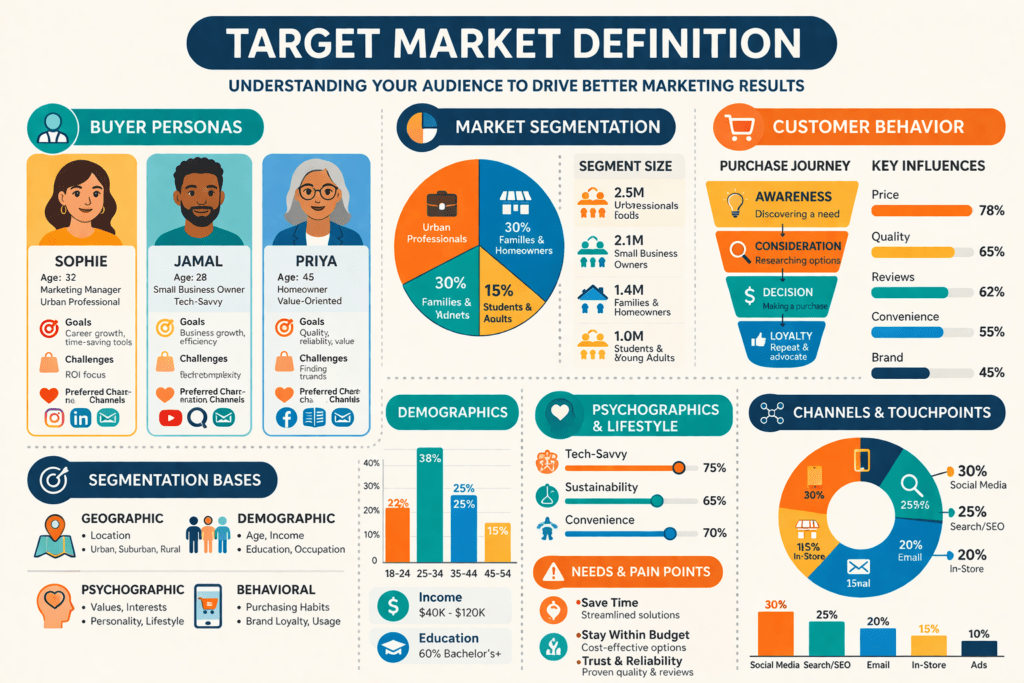
How does AI change the way we define our target market?

AI transforms market definition from a static demographic profile into a dynamic behavioral model. Instead of targeting “males 25-34 in urban areas,” AI allows you to target users based on their intent, digital footprint, and propensity to purchase, as identified through pattern recognition.

This level of granularity ensures that your marketing spend is directed toward the individuals most likely to convert. By continuously updating your target market definition based on real-time engagement data, you ensure that your business plan remains aligned with the shifting realities of your customer base.

AI business ideas
How to Build an AI-Powered Business Plan in 2026 5

What is the biggest risk when using AI for business planning?

The biggest risk is “hallucination” and over-reliance on black-box algorithms. If you blindly accept the output of an AI model without proper human verification, you risk making high-stakes decisions based on flawed or biased data. Always maintain a “human-in-the-loop” approach where critical strategic pivots are vetted by experienced professionals.

Additionally, data privacy and security are paramount. Ensure that the tools you use comply with global data protection standards. Failing to protect your proprietary data while training your models can lead to significant intellectual property loss, which can be fatal for a new startup.

How do I compare BizplanAI Pro against other tools?

When comparing tools like BizplanAI Pro to alternatives such as VentureKit or Coachvox AI, you should evaluate them based on the depth of their financial modeling capabilities, the transparency of their AI logic, and their ease of integration with your existing workflow.

Look for tools that offer more than just text generation; prioritize platforms that provide actionable financial insights, competitive landscape mapping, and real-time KPI tracking. The best tool is the one that integrates seamlessly into your daily operations rather than existing as a standalone document creation platform.

business plan generator
How to Build an AI-Powered Business Plan in 2026 6

Conclusion

Building an AI-powered business plan is the definitive way to future-proof your company in 2026. By leveraging the power of NLP, machine learning, and predictive analytics, you transform your strategy from a static document into a dynamic, intelligent engine that guides your growth. While the failure rate for AI projects remains high, those who approach the technology with a clear focus, a commitment to data integrity, and a healthy balance of human judgment will emerge as the market leaders of their respective sectors. Do not be intimidated by the technical jargon; the tools available today are designed to be intuitive and accessible to any founder with a clear vision. Whether you are validating a new idea with a free AI business coach or scaling an established enterprise, the technology is ready to work for you. The time for hesitation has passed. Take the first step today by auditing your current planning processes and identifying where AI can provide the most immediate, measurable value. Your competitors are already automating their futures—are you ready to do the same? Start your journey toward an AI-optimized business model now, and ensure your venture is built to thrive in the complex, high-speed economy of tomorrow.


🚀 Release Notes: Introducing the AI Pitch Deck Generator

Product: BizPlan AI Pro

Date: April 19, 2026

New Feature: Pitch Deck Generator (v1.0)

We are thrilled to announce the newest addition to the BizPlan AI Pro suite: the AI Pitch Deck Generator.

Raising capital just got a whole lot easier. Instead of staring at a blank presentation screen, Indian founders can now generate a complete, investor-ready 10-slide pitch deck in seconds using advanced AI.

✨ Key Features

  • Instant 10-Slide Generation: Just input a few details about your startup (Business Name, Problem, Solution, Traction, and Ask). Our AI automatically structures a compelling narrative across 10 critical slides, including Market Size, Revenue Model, Competition, and Financials.
  • Premium PDF Export: Say goodbye to boring templates. Your deck is automatically rendered into a sleek, premium dark-themed PDF with a professional Figma-like layout—ready to download, email to VCs, or present immediately.
  • Credit Protected: Powered by our secure credit system. If an error ever occurs during generation, our fail-safe architecture automatically restores your credit so you never lose out.

💳 Pricing & Usage

The Pitch Deck Generator uses 1 Standard AI Credit per generation.

🛠️ How to Use It

  1. Log in to your BizPlan AI Pro Dashboard.
  2. Look for the “NEW ⭐” badge on the Pitch Deck Generator card under “Your AI Tools” and click Launch Tool.
  3. Fill out the quick startup questionnaire.
  4. Click 🚀 Generate Pitch Deck.
  5. Once the success screen appears, click 📄 Download PDF to get your beautifully formatted investor deck!

Log in today to create your winning pitch and take your startup to the next level!

AI analyze KPIs revenue strategy

How AI Analyzes KPIs to Drive Revenue Strategy: A Comprehensive Guide for 2026

In the rapidly evolving business landscape of 2026, the intersection of artificial intelligence and financial oversight has become the primary differentiator between market leaders and stagnant enterprises. Business owners, particularly Indian founders of SaaS companies and D2C brands, are facing unprecedented pressure to optimize their financial health while managing limited resources. The fundamental challenge lies in the ability to effectively interpret complex datasets. When you deploy an AI financial advisor, you are not merely automating a spreadsheet; you are engaging a sophisticated engine capable of synthesizing disparate data points into actionable intelligence. By leveraging machine learning to monitor performance, organizations can achieve a level of precision that was previously reserved for large corporations with multi-million dollar finance departments.

The imperative for modern businesses is clear: speed and accuracy in financial decision-making define long-term viability. Many founders find themselves trapped in the manual analysis of metrics, losing valuable hours that could be spent on product iteration or market expansion. Utilizing advanced tools to parse Key Performance Indicators (KPIs) allows for real-time adjustments to your revenue strategy, ensuring that every tactical shift is backed by empirical data. Whether you are navigating the complexities of SG&A management or scaling your ARR, the integration of AI provides the analytical rigor required to maintain a healthy 85% gross profit margin in the SaaS space. This guide explores the mechanics of AI-driven financial analysis, the strategic benefits of automation, and how your business can thrive by adopting these cutting-edge methodologies.

The Mechanics of AI-Driven KPI Analysis

At its core, AI-driven KPI analysis transforms raw data—customer acquisition costs, churn rates, and lifetime value—into a coherent narrative of your business health. Traditional financial management often relies on retrospective reporting, which provides a view of what has already occurred. Conversely, an AI-powered system utilizes generative models to project future outcomes based on historical trends and real-time market data. This proactive approach allows founders to pivot their targeted audience strategies before a revenue dip manifests as a terminal decline.

Understanding the Predictive Power of AI

Predictive analytics in finance is not about crystal-ball gazing; it is about probabilistic modeling. By analyzing your current pipeline and historical conversion rates, AI can predict revenue shortfalls up to three months in advance. This lead time is critical for making adjustments to your marketing spend or adjusting your pricing tiers. For example, the AI Financial Advisor is specifically optimized for SaaS and subscription businesses to detect these subtle shifts in user behavior. It can analyze your entire stack of KPIs and generate a comprehensive revenue strategy in under 60 seconds, a feat that would take a human analyst days of tedious calculation.

  • Granular Data Processing: AI parses thousands of data points to identify hidden correlations between user engagement and renewal rates.
  • Automated Anomaly Detection: AI systems alert you to sudden spikes in operational costs or dips in conversion that might indicate a technical issue or a shift in market sentiment.
  • Strategic Alignment: By mapping KPIs to specific growth stages, the AI ensures your resource allocation is always optimized for your current goals.

Revenue Strategy Optimization: The AI Advantage

Optimizing a revenue strategy requires a delicate balance between aggressive growth and sustainable margins. Many founders struggle with the volatility of their net profit margins. In the SaaS world, a 20% net profit margin is considered a strong benchmark for sustainability. Achieving this requires constant fine-tuning of your cost structures and revenue streams. AI acts as a continuous auditor, reviewing your financial performance against industry benchmarks to ensure you are not overspending on non-essential overheads.

AI analyze KPIs revenue strategy
AI analyze KPIs revenue strategy 10

Reducing Reliance on Expensive CFOs

For early-stage startups, hiring a full-time financial officer is a significant burn on capital, often costing between ₹30,000 and ₹1,00,000 per month. While a human CFO is invaluable for complex legal and strategic maneuvers, much of the initial diagnostic and reporting work can be handled by an AI financial advisor at a fraction of the cost, starting at just ₹399/month. This allows founders to allocate capital toward product development and marketing, which are the primary drivers of growth in the early stages. By utilizing advanced business planning tools, you effectively democratize access to high-level financial strategy.

The 30% Rule: Balancing Human Insight and Machine Efficiency

While AI is a powerful tool, it is essential to maintain human oversight. This is where the “30% rule” becomes critical. This rule dictates that no more than 30% of your operational or creative output should come directly from AI tools. This ensures that the final decisions—which carry the weight of business risk and cultural nuance—remain in the hands of the founders. AI should be treated as a co-pilot, providing the insights, while you provide the strategic vision and the final execution.

Applying the 30% Rule to Financial Strategy

When you use AI to analyze your KPIs, it should provide the data-driven foundation for your strategy. Your role as a founder is to contextualize that data within your unique market positioning and long-term mission. For instance, if the AI suggests cutting a specific marketing channel due to high CAC, you must determine if that channel is essential for long-term brand awareness despite the current cost. By keeping the AI’s influence at 30%, you prevent the “black box” nature of machine learning from overriding your strategic intuition.

Comparison of Financial Management Methods

FeatureTraditional CFO/AnalystAI-Powered Advisor
Cost₹30,000–₹1,00,000/mo₹399/month
Speed of AnalysisDays/WeeksUnder 60 seconds
Data CapacityLimited by manual inputMassive datasets
24/7 AvailabilityNoYes

The table above illustrates the stark contrast in accessibility and efficiency. While traditional methods rely on human expertise, which is undeniably valuable for complex decision-making, the cost and time barriers are significant. Conversely, AI-powered tools provide a democratized entry point for founders. When you are looking for the best business plan generator for agencies or startups, you are essentially looking for this level of analytical speed. The integration of AI does not replace the need for strategic thinking; rather, it elevates the quality of the data upon which that thinking is based.

high-tech AI-driven analytics
AI analyze KPIs revenue strategy 11

Enhancing Operational Efficiency with AI

Operational efficiency is the bedrock of a scalable business. When you use AI to analyze your KPIs, you are looking for leaks in your financial bucket. For example, are your subscription tiers priced correctly? Is your churn rate tied to a specific onboarding bottleneck? AI can correlate these events, providing a clear path to optimization. Using AI for business validation and strategy allows you to iterate faster than your competitors, who may still be relying on manual spreadsheet reviews.

Fraud Detection and Risk Mitigation

Beyond simple KPI tracking, AI has proven invaluable in security. According to research on AI-powered fraud detection, businesses that implement machine learning for financial monitoring see a marked improvement in ROI. By identifying fraudulent transactions or anomalous patterns in real-time, AI shields your revenue from leaks that often go unnoticed in manual systems. This is particularly relevant for D2C brands that manage thousands of micro-transactions daily.

Strategic Implementation of AI Tools

To successfully integrate AI into your revenue strategy, you must first define your objectives. Are you trying to improve your target market penetration, or are you focused on optimizing your gross margins to reach that industry-standard 70–85% gross margin? Start by auditing your current tech stack. Are you using tools that allow for API integration with your financial data? If not, you are losing the ability to automate the flow of information into your AI advisor.

  • Data Centralization: Ensure all your financial sources (Stripe, bank feeds, ERP) are connected to your AI tool.
  • Continuous Monitoring: Set up automated alerts for your most critical KPIs, such as MRR growth and burn rate.
  • Quarterly Strategy Reviews: Use the AI to generate a “State of the Business” report every quarter to align your team on new targets.

Frequently Asked Questions

How can AI analyze KPIs to improve revenue strategy?

AI improves revenue strategy by processing massive datasets in real-time to uncover trends that human analysts often miss. By integrating your financial data with an AI model, the system can track metrics like Customer Acquisition Cost (CAC), Lifetime Value (LTV), and churn rates against your historical revenue goals. It then identifies which levers—such as pricing adjustments, marketing channel shifts, or product feature changes—will have the highest impact on your bottom line.

Once the AI identifies these potential improvements, it provides actionable insights that allow you to adjust your revenue strategy immediately. This eliminates the “wait and see” approach common in traditional financial planning. By acting on these insights, you can shift your resource allocation toward the most profitable segments of your business, ensuring that your strategy is always optimized for maximum growth and efficiency.

What are the benefits of using AI in revenue strategy development?

The primary benefit of using AI in revenue strategy is the dramatic reduction in time-to-insight. In a competitive market, being able to pivot your strategy based on current data can be the difference between capturing a market share or losing it. AI provides a consistent, objective analysis that removes emotional bias from financial decision-making, ensuring that your strategic choices are grounded in hard data.

Additionally, AI tools are highly scalable. Whether you have 100 customers or 100,000, the AI can analyze your KPIs with the same speed and accuracy. This scalability allows founders to focus on high-level vision and team leadership rather than getting bogged down in the minutiae of daily financial reporting. It democratizes access to expert-level financial analysis, allowing even the smallest startups to compete with established players.

What are the 4 pillars of KPI?

KPIs are essentially signals that should inform your business actions. To manage them effectively, it is best to group them into four main pillars: Financial, Customer, Internal Process, and Learning/Growth. The Financial pillar focuses on revenue, profit margins, and cash flow. The Customer pillar tracks satisfaction, churn, and acquisition costs. The Internal Process pillar monitors operational efficiency and the time taken to deliver value. The Learning/Growth pillar looks at employee training and the innovation pipeline.

By categorizing your metrics into these four pillars, you ensure that you are not just looking at revenue, but at the health of the entire ecosystem. An AI advisor can track these pillars simultaneously, providing a holistic view of your business that prevents you from optimizing one area at the expense of another. This balanced approach is essential for long-term sustainability.

What is the 30% rule for AI?

The 30% rule is a guideline for responsible AI adoption in professional settings. It suggests that when creating a project, strategy, or piece of code, no more than 30% of the work should be done directly by AI tools. The remaining 70% must be the result of human expertise, critical thinking, and strategic oversight. This ensures that the work reflects your company’s values and unique market positioning.

Applying this rule prevents the “homogenization” of strategy, where businesses rely too heavily on generic AI outputs. By keeping your human contribution at the 70% mark, you maintain control over the final outcome while still benefiting from the massive productivity gains offered by AI. It is the perfect balance between efficiency and authenticity.

How does AI help in maintaining a healthy SaaS gross margin?

Maintaining a gross margin between 70% and 85% is vital for SaaS companies. AI helps by monitoring the cost of goods sold (COGS), which includes infrastructure, hosting, and support costs. By analyzing these expenses against revenue growth, AI can identify when your infrastructure costs are scaling faster than your revenue, allowing you to optimize your server usage or automate customer support processes before margins erode.

Furthermore, AI can analyze the profitability of individual customer tiers or product modules. If certain features are costing more to maintain than they are generating in revenue, the AI can flag these for review. This level of granular visibility ensures that every dollar spent is contributing to your overall profitability, helping you maintain that industry-standard margin even as you scale.

Can AI replace a human CFO?

AI cannot fully replace a human CFO, as it lacks the ability to navigate complex human relationships, legal negotiations, and nuanced leadership decisions. However, it can handle the vast majority of the analytical and reporting work that a CFO typically performs. For startups, this means you can delay the expensive hire of a full-time CFO until your revenue warrants it, using an AI tool to cover the analytical gap in the meantime.

Think of the AI as your 24/7 data analyst and the human CFO as your high-level strategist. By automating the reporting, forecasting, and KPI tracking, you allow your leadership team to focus on the truly difficult decisions. As your business grows, you can eventually transition to a hybrid model where the AI provides the data, and your human financial leadership provides the strategic direction.

How quickly can AI generate a revenue strategy?

Advanced AI tools, such as the AI Financial Advisor, can analyze your entire KPI stack and generate a comprehensive revenue strategy in under 60 seconds. This is possible because these models are trained on vast datasets and optimized for specific business patterns, allowing them to instantly recognize correlations that would take a human hours or days to calculate.

This speed is not just a convenience; it is a strategic asset. In a fast-moving market, the ability to iterate your revenue strategy in seconds allows for “agile finance.” You can test different pricing models, marketing spends, or operational changes and see the projected impact almost immediately. This rapid feedback loop is the hallmark of a data-driven, high-growth startup.

Is AI-powered KPI analysis secure?

Security is a primary concern for any business using AI to handle financial data. Reputable AI financial advisors use enterprise-grade encryption and adhere to strict data privacy standards. When choosing an AI tool, it is crucial to ensure that your data is not being used to train public models without your consent and that the platform complies with regional data protection regulations.

When implemented correctly, AI can actually *increase* your security. By monitoring for anomalous patterns in your financial data, AI acts as a sophisticated watchman, identifying potential fraud or security breaches much faster than a manual audit ever could. Always verify the security credentials of your chosen AI tool to ensure your proprietary business data remains confidential.

revenue KPI dashboards
AI analyze KPIs revenue strategy 12

Conclusion

The integration of AI into your revenue strategy is no longer a luxury; it is a necessity for any founder aiming to scale in 2026. By leveraging tools like an AI Financial Advisor, you can gain immediate, actionable insights into your KPIs, maintain healthy profit margins, and optimize your operational efficiency—all for a fraction of the cost of traditional financial management. As the market becomes increasingly competitive, the founders who adopt these technologies will be the ones who define the future of their industries.

Remember, the goal is not to automate your business away, but to empower your decision-making with the best data possible. Use the 30% rule to keep your human intuition at the center of your strategy, and let AI handle the heavy lifting of data analysis. Start your journey toward financial clarity today. Whether you are looking to validate your next big idea or optimize your current revenue streams, the tools exist to help you succeed. Take control of your financial future by integrating AI into your workflow today—your bottom line will thank you.

Custom GPT vs. Dedicated Tax Bots: Evaluating the Best AI Tools in GST

Custom GPT vs. Dedicated Tax Bots: Evaluating the Best AI Tools in GST

The GST compliance landscape in India is evolving rapidly, and AI tools are now at the center of that transformation. Whether you’re a CA, SME owner, trader, or startup founder, choosing the right AI tool for GST — a generic Custom GPT or a purpose-built GST tax bot — can significantly impact your compliance accuracy, time savings, and cost efficiency.


What Is a Custom GPT?

A Custom GPT is a version of OpenAI’s ChatGPT that has been fine-tuned or configured with domain-specific documents, instructions, and personas. In the context of GST, a Custom GPT is typically trained on CGST/SGST Acts, CBIC notifications, circulars, and GST rate schedules.

Custom GPTs work as professional knowledge assistants. For example, ICAI’s Custom GST GPT — built by CA Mohit Gaba — serves as a professional drafting assistant that reduces time in responding to GST notices, provides accurate legal interpretation, and simplifies compliance by providing both historical and current GST rates.

The core architecture of a Custom GPT involves:

  • A curated document library (PDFs of GST law, notifications, rulings)
  • A system-level prompt that defines tone, role, and constraints
  • OpenAI’s underlying GPT-4 or GPT-4o model for reasoning
  • Retrieval-Augmented Generation (RAG) to fetch relevant sections

What Are Dedicated GST Tax Bots?

Dedicated GST tax bots are purpose-built AI applications designed exclusively for Indian GST compliance. Unlike a Custom GPT hosted on OpenAI’s platform, these are standalone products with their own infrastructure, databases, integrations, and user interfaces. They are engineered to do one thing extremely well — handle GST.

Examples include TaxBotGPT.AI, which empowers businesses to track, manage, and respond to GST notices with deadline management features, and BizPlan AI Pro’s GST WhatsApp Bot at bizplanaipro.in, India’s first WhatsApp-based AI GST consultant with features like invoice OCR scanning, ITC validation, and real-time GSTIN verification.

Key characteristics of dedicated GST tax bots:

  • Built specifically on Indian GST law and CBIC regulations
  • Integrated with GSTN-aligned databases for real-time or near-real-time updates
  • Accessible via familiar channels like WhatsApp, mobile apps, or web portals
  • Support vernacular languages like Hindi and Hinglish
  • Designed for non-technical users — traders, shopkeepers, small business owners

Custom GPT vs. Dedicated GST Bot: Core Differences

Understanding the functional differences helps you make the right choice based on your business profile and compliance needs.

Custom GPT vs. Dedicated Tax Bots
Custom GPT vs. Dedicated Tax Bots: Evaluating the Best AI Tools in GST 14

Architecture & Data Control

Custom GPTs built on OpenAI’s platform have a fundamental limitation: you cannot see user queries or push real-time corrections from the backend. The platform relies entirely on the documents you upload, and unless you build a serverless retrieval pipeline, the data can go stale. Dedicated GST tax bots, on the other hand, operate on proprietary infrastructure where the developers control the update cycle, push law amendments immediately, and maintain audit trails of user interactions.

As one builder noted bluntly: “Even ICAI’s own GST GPT clearly states its update cut-off dates and acknowledges it’s not live-connected to GSTN.” This is the key architectural gap that dedicated bots are designed to close.

Real-Time GST Compliance Updates

CBIC regularly issues notifications, circulars, amendments, and new e-invoicing thresholds. A Custom GPT updated last month may already be outdated. There is no public CBIC API for notifications or circulars, meaning that keeping a Custom GPT live-updated requires significant engineering investment.

Dedicated tools like BizPlan AI Pro explicitly state that their AI is trained on the latest CGST/SGST Acts, Rules, and Notifications updated for FY 2025-26 and even cites relevant law sections in its answers. This operational discipline is difficult to replicate with a plain Custom GPT.

Accessibility & User Experience

Custom GPTs require users to have a ChatGPT account (paid, for GPT-4 access), navigate the OpenAI interface, and type well-structured prompts to get useful answers. This creates a barrier for India’s 6.3 crore+ GST registrants, many of whom are small traders and shop owners in Tier 2 and Tier 3 cities.

Dedicated bots built on WhatsApp remove this friction entirely. BizPlan AI Pro’s GST WhatsApp Bot lets users simply send a message like “GST on cotton shirt HSN code?” or “Penalty for late GSTR-3B filing?” and get an accurate, cited response in Hindi, English, or Hinglish — without any app install or subscription setup.


Feature Comparison Table

FeatureCustom GPT (OpenAI)BizPlan AI Pro GST BotTaxBotGPT.AI
PlatformChatGPT Web/APIWhatsApp/Web PortalWeb Portal
Live CBIC Updates❌ (manual upload)
Invoice OCR Scanning
Hindi / Hinglish SupportPartial✅ Full
GSTIN Verification
Notice Reply Drafting
ITC Claim ValidationLimitedPartial
Cost per Query~₹20+ (ChatGPT Plus)₹2 onlySubscription
No App Required✅ (WhatsApp)
Best ForCAs, ProfessionalsSMEs, TradersCA Firms

Spotlight: BizPlan AI Pro’s GST WhatsApp Bot

Among all dedicated GST AI tools available in India today, AI GST Consultant for Indian MSMEs at bizplanaipro.in stands out as the most accessible and cost-effective solution, especially for small and medium businesses.

What It Can Do

The BizPlan AI Pro GST WhatsApp Bot handles an impressive range of real GST scenarios:

  • HSN/SAC Code Lookup — Ask “What is the HSN code for cotton shirt?” and get an instant, regulation-backed answer
  • GST Notice Replies — Draft a reply for ASMT-10 or DRC-01 notices using the correct legal format
  • Invoice OCR Scanning — Upload a photo or PDF of any vendor invoice; the bot extracts the GSTIN, verifies if it’s active, checks tax calculations, and flags compliance issues automatically
  • ITC Eligibility — Ask “Can I claim ITC on office air conditioner?” and get a Section-wise answer
  • Interest and Penalty Calculations — Calculate late payment interest under Section 50 of CGST Act with accurate day-count calculations
  • GSTR Filing Deadlines — Get real-time reminders and filing schedule information for GSTR-1, GSTR-3B, GSTR-9, and more

Why ₹2/Query Changes Everything

Traditional CA consultation for a GST query costs between ₹500 to ₹2,000 per interaction during office hours only. Enterprise GST software like Taxilla costs ₹5,000/month, and Optotax charges ₹3,500/month — both requiring annual commitments and complex logins. BizPlan AI Pro democratizes access to expert-level GST guidance at just ₹2 per query with no subscription lock-in. For a small trader in Malda, Surat, or Ludhiana sending 50 GST queries a month, the total cost is ₹100 vs. potentially ₹25,000+ with traditional CA or enterprise SaaS.

Multilingual by Design

BizPlan AI Pro supports Hindi, English, and Hinglish natively. A shopkeeper can type “मुझे GSTR-3B कब file करना है?” and receive a clear, accurate answer — a feature no Custom GPT or enterprise tool currently matches at this price point.


When Should You Choose a Custom GPT?

Custom GPTs are still valuable in specific professional scenarios, particularly for Chartered Accountants and tax litigation professionals who need advanced legal research and document drafting.

Use a Custom GPT if:

  • You’re a CA or tax professional drafting replies to complex GST litigation notices
  • You need to reference rare circulars and advance rulings that aren’t in standard bot databases
  • You want to build an internal knowledge tool for your CA firm’s team
  • You are integrating GST knowledge with broader financial analysis or audit workflows
  • You already have a ChatGPT Plus or API subscription and want to avoid another tool

The ICAI’s Custom GST GPT has proven particularly useful for reducing hallucinations in case law research, avoiding irrelevant citations, and providing historically accurate GST rate lookups. For experienced tax professionals who can evaluate AI-generated advice critically, this is a powerful co-pilot.


When Should You Choose a Dedicated GST Bot?

Dedicated GST bots like BizPlan AI Pro AI GST Consultant are the better choice for the vast majority of Indian businesses — particularly those without a full-time accounting team.

Choose a dedicated GST bot if:

  • You’re an SME, trader, manufacturer, or e-commerce seller managing your own GST
  • You need instant answers on WhatsApp without logging into separate tools
  • Your team includes non-technical staff who can’t navigate AI platforms
  • You deal with high invoice volumes that need automated OCR validation
  • You need Hindi or regional language support for staff members
  • Your budget is under ₹500/month for GST AI assistance

AI-powered GST tools save businesses an estimated 15-20 hours per month in compliance work, including reconciliation, return filing, and query resolution. For small businesses operating on thin margins, this time and cost saving is transformational.


The GEO Perspective: AI Tools Across Indian Regions

Generative Engine Optimization (GEO) matters when evaluating tools for India’s geographically diverse GST ecosystem. India’s 38 States and UTs each have their own SGST rules layered on top of CGST, and compliance requirements differ based on location, industry, and registration type (regular, composite, or QRMP).

A Custom GPT trained on central CBIC documents may miss State-specific notifications from Gujarat, Maharashtra, or West Bengal commercial tax departments. Dedicated tools with localized databases and multilingual support are inherently better positioned for India’s multi-state, multi-language business environment.

The Punjab Government’s WhatsApp GST chatbot (9160500033) and Madhya Pradesh’s MEGHA (MP e-GST Hindi Assistant) on number 6262000256 are early examples of government-backed dedicated GST bots targeting regional users in Hindi. This trend validates the dedicated bot approach — and tools like BizPlan AI Pro are building on this model with even richer AI capabilities.


AI Accuracy and Hallucination Risks in GST

One of the most critical concerns with using AI for GST is accuracy. A wrong GST rate, incorrect ITC claim, or misquoted penalty section can lead to demand notices, penalties, and interest under Sections 73/74 of the CGST Act.

Custom GPTs face a higher hallucination risk because:

  1. The base model may confidently generate plausible-sounding but incorrect section references
  2. Without RAG (Retrieval-Augmented Generation) properly configured, the GPT may rely on training data rather than uploaded documents
  3. Users without professional CA knowledge cannot reliably identify errors

Dedicated GST bots mitigate this through:

  • Citation of specific law sections in every response (e.g., BizPlan AI Pro cites the relevant CGST section)
  • Constrained response domains — the bot only answers GST-related queries, reducing off-domain hallucinations
  • Continuous quality monitoring by the development team with real-world user query feedback loops
  • GSTIN verification APIs that cross-check live data against government databases

The Future of GST AI Tools in India

The AI GST landscape is evolving fast. Key trends shaping the next 12-24 months include:

  • E-Invoice Integration — AI bots that auto-generate IRN (Invoice Reference Numbers) and validate e-invoices before submission to IRP
  • Predictive Audit Risk Scoring — Machine learning models that flag ITC mismatch risks before they trigger DRC-01 notices
  • Account Aggregator Integration — Real-time bank feed reconciliation for zero-effort GSTR-2B matching
  • Voice-Based GST Queries — Hindi voice input for WhatsApp bots, making GST accessible to entirely non-literate populations in India’s business community
  • Automated Annual Return Filing — AI agents that compile and file GSTR-9 and GSTR-9C with minimal human intervention

BizPlan AI Pro’s current WhatsApp infrastructure at bizplanaipro.in positions it well to adopt voice and agentic capabilities as Meta’s WhatsApp Business API evolves.


Making the Right Choice for Your Business

The decision between a Custom GPT and a dedicated GST bot ultimately comes down to who you are and what you need:

  • Individual CAs and tax litigation professionals with complex research needs → Custom GPT (ICAI GST GPT or similar)
  • SMEs, traders, manufacturers, and startups who need daily GST help at low cost → BizPlan AI Pro GST WhatsApp Bot (bizplanaipro.in)
  • CA firms managing multiple clients with dashboard needs → Optotax or ClearTax GST
  • Large enterprises with ERP integration needs → Taxilla or EY AI hybrid solutions

The GST compliance journey for India’s 1.4 billion-person economy is too vast and diverse for any single tool to serve everyone. But as AI tools become sharper, cheaper, and more accessible — with innovations like BizPlan AI Pro’s ₹2/query WhatsApp bot leading the charge — the gap between “having expert GST guidance” and “not being able to afford it” is closing faster than ever.


Looking for instant GST help on WhatsApp? Visit bizplanaipro.in and activate India’s most affordable AI GST consultant — starting at just ₹2 per query, available 24/7 in Hindi and English.

What is an AI Financial Advisor? How It Works for Indian Startups

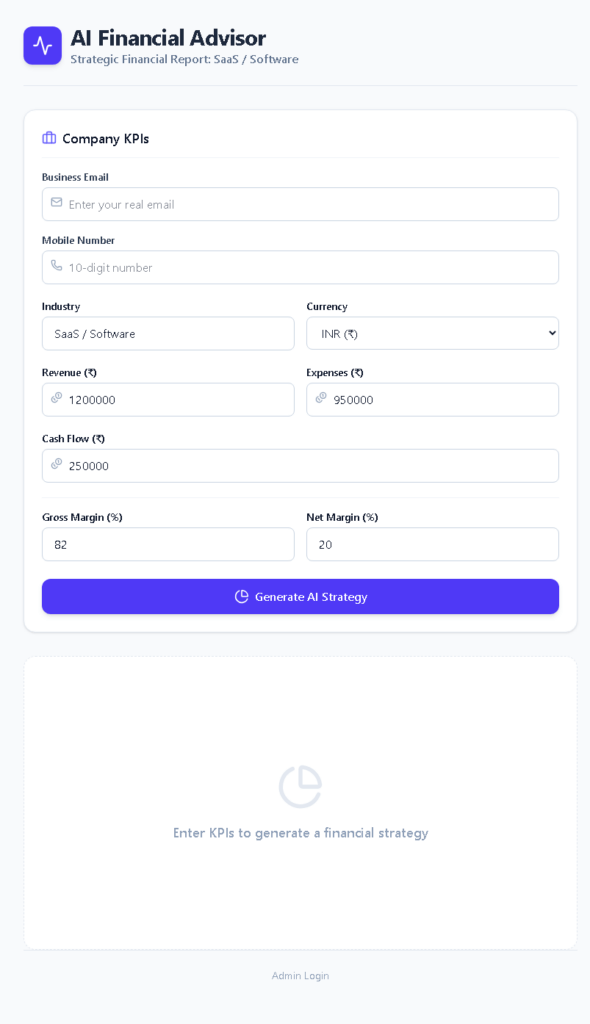
An AI Financial Advisor is an automated CFO dashboard that uses generative artificial intelligence to analyze your business’s core financial KPIs — Revenue, Expenses, Cash Flow, and Profit Margins — and instantly generate actionable growth strategies, revenue optimization plans, and risk assessments. For Indian startups, it replaces expensive financial consultants at a fraction of the cost.


The Financial Blind Spot Killing Indian Startups

Most Indian founders know their revenue number. They know roughly what they spend every month. But ask them what their gross profit margin means, whether their cash flow is healthy, or where exactly they should invest their next ₹5 lakh — and most go silent.

This isn’t a knowledge problem. It’s an access problem.

A qualified CFO or financial consultant in India charges anywhere from ₹30,000 to ₹1,00,000 per month. For a bootstrapped SaaS founder in Bengaluru or a D2C brand owner in Delhi, that’s simply not viable in the early stages. The result? Founders make critical financial decisions — pricing, hiring, marketing spend — on gut feeling instead of data. According to research highlighted on LinkedIn, traditional human advisors typically charge 1% or more of assets under management (AUM), creating a significant barrier to entry for many investors. 

This is exactly the gap that AI Financial Advisors are designed to fill.


What is an AI Financial Advisor?

An AI Financial Advisor is a software platform that uses generative AI and machine learning to process your raw financial data and produce CFO-level strategic guidance automatically. Unlike traditional accounting software that simply records what happened, an AI Financial Advisor interprets your numbers and tells you what to do next.

When you enter your key financial metrics into the tool, the AI:

  • Benchmarks your performance against industry standards
  • Identifies margin leaks and revenue gaps
  • Generates specific revenue optimization strategies
  • Recommends where to allocate your available capital
  • Flags operational and market risks unique to your business type
  • Scores your overall financial health out of 100

The output is not a spreadsheet — it’s a complete strategic report with an Executive Summary, Revenue Optimization tactics, Capital Allocation plan, and Risk Assessment, all formatted and ready to share with investors, banks, or co-founders.


How Does an AI Financial Advisor Work? — The 4-Step Process

Step 1: KPI Ingestion

You enter five core financial metrics into the dashboard:

  1. Total Revenue — Your gross income for the period
  2. Total Expenses — All operating costs combined
  3. Cash Flow — Net inflow after expenses (operating cash flow)
  4. Gross Profit Margin (%) — Revenue minus direct costs, as a percentage
  5. Net Profit Margin (%) — Final profit after all deductions, as a percentage

These five numbers are all the AI needs. No 40-row spreadsheet. No accountant on a call. Just five inputs that any founder knows or can find in under two minutes.

Step 2: Benchmark Analysis and Health Scoring

Once your KPIs are entered, the AI cross-references them against industry-specific benchmarks. For example:

  • A healthy SaaS gross margin typically sits between 70–85%
  • A strong net profit margin for a growing SaaS business is 15–25%
  • Positive cash flow signals operational sustainability and investment capacity

If your gross margin is 60% when the SaaS benchmark is 80%, the AI immediately flags this as a margin leak and begins investigating which expense category is responsible. It then calculates your overall Financial Health Score out of 100, giving you an instant, objective grade of your company’s financial condition.

Step 3: Strategy Generation

This is where generative AI makes the biggest difference over traditional tools. The AI doesn’t just report what your numbers are — it tells you what to do about them.

Based on your KPI profile, the AI generates three types of strategies:

Revenue Optimization Tactics:

  • If your gross margin is strong but net margin is low, the AI identifies operating expense categories dragging down profitability and suggests restructuring
  • If your cash flow is positive and margins are healthy, the AI recommends scaling customer acquisition through targeted marketing channels
  • If ARPU is low relative to revenue, the AI suggests upselling premium plans or introducing value-based pricing tiers

Capital Allocation Plan:

  • Strong margins + positive cash flow → Invest in Product R&D and Sales & Marketing
  • Thin margins + tight cash flow → Prioritize cost reduction and customer retention before scaling
  • High revenue + low net margin → Focus on operational efficiency before new market expansion

Risk Assessment:
The AI identifies the top risks specific to your business type and financial profile — whether that’s customer churn for a SaaS business, inventory cost pressure for a D2C brand, or talent retention costs for a services company.

Step 4: Investor-Ready Report Generation

The final output is a structured, scored financial strategy report that covers:

  • Executive Summary — A concise interpretation of your financial health
  • Revenue Optimization — 3 specific, actionable growth tactics
  • Capital Allocation — Where to invest your cash flow for maximum ROI
  • Key Risks — 4–5 risks ranked by severity with mitigation suggestions
  • Financial Health Score — An objective 0–100 rating

On the Pro plan, this report exports as a high-fidelity A4 PDF — vector-quality, professionally formatted, and ready to share with investors, bank loan officers, or board members.


Why Do Indian Startups Specifically Need This?

The Consultant Access Gap

The Indian startup ecosystem has grown dramatically — with over 1,40,000 registered startups as of 2026 — but financial advisory services have not democratized at the same pace. Most financial consultants in India still cater to mid-size and enterprise clients. Bootstrapped founders are largely left to figure out their financial strategy alone. Learn how AI Financial Advisors work.

The “I Know My Revenue But Not What To Do With It” Problem

This is the most common pain point among early-stage Indian founders. They diligently track revenue and expenses, but the gap between raw numbers and actionable strategy remains. An AI Financial Advisor bridges this exact gap — it connects the dots between your KPIs and tells you precisely where to invest your cash flow and how to fix margin leaks.

GST-Era Financial Complexity

Indian businesses operate under a complex GST framework, multiple revenue recognition rules, and RBI compliance requirements. While an AI Financial Advisor doesn’t replace a CA for compliance, it provides the strategic layer that sits on top of compliance — turning clean financial data into a growth roadmap.

Investor Readiness for Indian Funding Rounds

Whether you’re approaching angel investors on LetsVenture, applying for a SIDBI startup loan, or pitching to a seed-stage VC, every conversation starts with the same question: “Show me your financials.” An AI-generated financial report with a clear score, revenue optimization strategy, and risk assessment gives founders an instant, professional response — without needing to hire a consultant first.


Real-World Example: SaaS Company Using AI Financial Advisor

Consider a SaaS company with the following financials:

  • Total Revenue: ₹12,00,000
  • Total Expenses: ₹9,50,000
  • Cash Flow: ₹2,50,000
  • Gross Profit Margin: 85%
  • Net Profit Margin: 20%

When these numbers are entered into BizPlan AI Pro’s AI Financial Advisor, the AI scores the business 88 out of 100 and generates the following strategy:

Revenue Optimization:

  • Develop premium feature tiers to increase ARPU through upselling
  • Run targeted marketing campaigns to expand into untapped SaaS segments
  • Evaluate value-based pricing to better align plans with customer willingness to pay

Capital Allocation:

  • Invest in R&D for new product features to maintain competitive edge
  • Increase Sales & Marketing budget — strong margins justify aggressive acquisition
  • Build out Customer Success programs to reduce churn and drive renewals

Key Risks Flagged:

  • Intense competition from established SaaS players
  • Potential churn if product innovation slows
  • Cybersecurity and data privacy compliance gaps
  • Talent acquisition challenges for technical staff

In under 60 seconds, this founder received a complete strategic roadmap — the equivalent of a one-hour CFO consultation.

AI Financial Advisor
What is an AI Financial Advisor? How It Works for Indian Startups 17

AI Financial Advisor vs Hiring a CFO: A Direct Comparison

FactorAI Financial AdvisorHuman CFO
Monthly Cost₹399₹30,000–₹1,00,000
Setup TimeUnder 60 seconds2–4 weeks onboarding
Availability24/7, instantBusiness hours
OutputStrategy report + PDFEmail/presentation
BiasZero — purely data-drivenVaries by experience
Best ForEarly-stage founders, bootstrapped startupsSeries A+ companies

A human CFO brings irreplaceable value at scale — for complex M&A decisions, board-level governance, or multi-entity structures. But for a founder who simply needs to understand their margins, optimize their pricing, and know where to invest their cash flow, an AI Financial Advisor delivers 80% of the value at less than 2% of the cost.


Who Should Use an AI Financial Advisor in India?

SaaS and Software Founders who want to optimize subscription revenue, improve ARPU, and understand gross margin health relative to MRR growth.

D2C and Product Brand Owners who need to identify SKU-level margin leaks, manage inventory spend, and understand which products deserve more capital.

Agency and Service Business Owners who want to convert monthly revenue and expense data into a clear picture of which service lines are most profitable.

Bootstrapped Startup Founders at the pre-seed or seed stage who are preparing financial data for their first investor conversation.

Small Business Owners who have real revenue but no financial guidance — and want to make data-driven decisions without a consultant.


financial literacy
What is an AI Financial Advisor? How It Works for Indian Startups 18

Frequently Asked Questions

Is an AI Financial Advisor accurate?

Yes — to the extent that your input KPIs are accurate. The AI benchmarks your numbers against real industry data and applies strategic logic based on proven financial frameworks. It is not a substitute for a Chartered Accountant for tax and compliance purposes, but for strategic financial planning, it is highly reliable.

What KPIs do I need to use an AI Financial Advisor?

You need just five: Total Revenue, Total Expenses, Cash Flow, Gross Profit Margin (%), and Net Profit Margin (%). If you don’t have these exact numbers, your basic P&L statement or a 10-minute review of your bank statements will give you everything needed.

Is my financial data secure?

On platforms like BizPlan AI Pro, your KPI data is used only to generate your report. No financial data is stored or shared with third parties.

Can I share the AI Financial Report with investors?

Absolutely. The Pro plan generates a high-fidelity A4 PDF specifically formatted for investor presentations, bank loan applications, and stakeholder meetings — with no blurry charts or cut-off text.


Get Your Free AI Financial Report

If you’re an Indian founder who knows your revenue and expenses but isn’t sure what to do with those numbers, an AI Financial Advisor gives you the strategic clarity you need — instantly and affordably.

BizPlan AI Pro’s AI Financial Advisor generates your first complete financial strategy report — Executive Summary, Revenue Optimization, Capital Allocation, and Risk Assessment — completely free. No credit card required.

Your numbers already tell a story. The AI just helps you read it.


Ready to get your financial health score? → Start Your Free AI Financial Report

🚀 Release Notes: AI Financial Advisor v1.0

We are thrilled to announce the launch of the AI Financial Advisor, an automated, AI-driven CFO dashboard designed to help founders and business owners turn raw financial metrics into actionable growth strategies.

AI Financial Advisor
🚀 Release Notes: AI Financial Advisor v1.0 20

✨ Key Features in this Release:

  • Generative AI Financial Modeling: Enter core KPIs (Revenue, Expenses, Cash Flow, Gross/Net Margins) to instantly generate an Executive Summary, Revenue Optimization tactics, Capital Allocation strategies, and Risk Assessments.
  • Native High-Fidelity PDF Export: A completely custom-built print engine that generates razor-sharp, vector-quality A4 PDF reports. Formatted perfectly for investor meetings and stakeholder updates without cut-off text or blurry charts.
  • Frictionless Freemium Funnel: Users can generate their first AI report completely free to experience the value instantly.
  • Cashfree Payments Integration: A seamless, secure upgrade path to the Pro Tier (₹399/month) supporting UPI, Credit/Debit Cards, and Net Banking directly within the application.

💡 Why This Application is Highly Useful

This tool creates immense value for both the end-users (business owners).

For the Business Owner

  1. Fractional CFO at a Fraction of the Cost: Hiring a financial consultant or CFO costs thousands of rupees a month. This tool provides instant, objective, data-driven financial strategies for just ₹399/month.
  2. Actionable Overwhelming Data: Many founders know their revenue and expenses but don’t know what to do with those numbers. The AI connects the dots, telling them exactly where to invest their cash flow and how to fix margin leaks.
  3. Investor-Ready Deliverables: The flawless PDF export allows founders to instantly generate professional financial health reports to share with partners, banks, or potential investors.
🎯 START FREE AI FINANCIAL ADVISOR NOW

AI Startup Ideas

The Definitive Guide to AI Startup Ideas for 2026: Building Scalable Ventures

The landscape of entrepreneurship is undergoing a seismic shift as artificial intelligence transitions from a futuristic concept to the bedrock of modern commerce. With the current market volatility, understanding how to launch a venture is more critical than ever, especially considering that 90% of startups fail due to a lack of market need or poor execution. For founders in 2026, success requires more than just a clever algorithm; it demands a rigorous approach to identifying viable AI business ideas that solve genuine pain points. By leveraging modern frameworks, entrepreneurs can navigate the complexities of product development, ensuring their targeted audience receives tangible value rather than just another wrapper for existing models. Whether you are exploring generative media platforms or autonomous transport features, the barrier to entry is lowering, yet the bar for quality is rising. To succeed, you must move beyond the hype and focus on sustainable business models. If you are struggling to bridge the gap between initial inspiration and a functional roadmap, utilizing a 2026 top free business plan generator tool can provide the structural foundation necessary for long-term growth.

Understanding the Seven Pillars of Artificial Intelligence

To build a successful company, you must first understand the underlying technology. AI is not a monolith; it is a spectrum of capabilities, and matching your startup concept to the right level of intelligence is crucial for technical feasibility. According to industry standards, there are 7 types of AI that define the capabilities of any software solution: Reactive Machines, Limited Memory AI, Theory of Mind AI, Self-Aware AI, Narrow AI (Weak AI), General AI (Strong AI), and Superintelligent AI.

Applying AI Classifications to Your Business Model

Most current AI business ideas operate within the realm of Narrow AI (Weak AI) or Limited Memory AI. These systems excel at performing specific tasks—such as data analysis, content generation, or predictive maintenance—at a scale impossible for humans. If you are developing a product for agriculture or real estate, you are likely utilizing Narrow AI to process massive datasets. Attempting to build “General AI” or “Self-Aware AI” is currently outside the scope of viable commercial startups and is often a pitfall for founders who over-engineer their solutions. By focusing on Narrow AI, you can deliver highly specialized value to a niche market, which is far more profitable than attempting to build a general-purpose brain. Understanding these distinctions allows you to communicate your value proposition clearly to investors and stakeholders, demonstrating that your product is built on a foundation of technical reality rather than speculative science fiction.

AI startup ideas
AI Startup Ideas 25

High-Growth Sectors for Innovative Startup Concepts

The most successful ventures in 2026 are those that apply intelligence to traditional, “unsexy” industries. While everyone is chasing the next viral chatbot, massive opportunities exist in sectors like agriculture, logistics, and education. Integrating automation into these fields can lead to significant cost reductions and efficiency gains. For instance, in the agricultural sector, AI-powered predictive analytics can optimize crop yields, while in logistics, autonomous transport features are revolutionizing supply chain management.

Targeting Niche Markets with AI Solutions

When selecting your focus, look for industries with high operational costs and manual, repetitive workflows. According to recent market analysis, top AI startup ideas for niche markets are flourishing in:

  • Agriculture: AI-driven crop monitoring and automated irrigation systems.
  • Real Estate: Predictive property valuation and automated document processing.
  • Smart Home Management: Energy optimization systems that learn user behavior.
  • Education and E-learning: Personalized curriculum paths for individual students.
  • Transportation and Logistics: Dynamic route optimization and autonomous fleet management.

These sectors often have well-defined, measurable KPIs, making it easier to calculate your target market definition and project ROI for potential clients. By solving a specific problem in a specific industry, you avoid the “solution in search of a problem” trap that plagues so many early-stage companies. Instead of fighting for attention in a saturated consumer market, you become an essential infrastructure component for your clients. This B2B approach often leads to higher customer lifetime values and more stable revenue streams, which are essential for long-term sustainability.

The Role of AI-Powered Marketing and Content Creation

Generative AI has fundamentally changed the landscape of digital marketing. Businesses are no longer just using AI to automate emails; they are using it to create entire content ecosystems. This shift has opened doors for agencies and SaaS platforms that offer personalized marketing at scale. A robust business plan generator for agencies can help you outline how your services will integrate with these evolving technologies to maintain a competitive edge.

Building Scalable Generative Media Platforms

Generative media is one of the most accessible areas for new founders. Whether it is video synthesis, high-fidelity audio generation, or personalized nutrition plans, the key is using AI to reduce the cost of production while increasing the quality of the output. When building these tools, consider the SG&A meaning for your specific model; high computing costs can quickly eat into your margins if you are not careful about your infrastructure choices. Organizations using Startup.ai report 100 credits per month for Pro users, allowing for cost-effective experimentation before you scale your operations. By focusing on high-value, low-latency applications, you can create a business that is both highly scalable and operationally lean.

Benchmarking Against Industry Leaders

To understand the potential of your own startup, look at companies that have successfully bridged the gap between experimental tech and market adoption. Successful entities like Doppel, Omnea, Listen Labs, Blossom, Joyful Health, Avoca, Traba, and Harmonic provide a blueprint for how to monetize AI. These companies demonstrate that the most successful AI business ideas often involve deep domain expertise combined with sophisticated model deployment. When you look at these leaders, notice how they focus on UX and workflow integration rather than just the “AI-ness” of their product.

Comparative Analysis of Market Leaders

The following table illustrates the diverse nature of top-tier AI companies. Note how each addresses a unique pain point in the market.

CompanyFocus Area
DoppelPersonalized Media
OmneaEnterprise Security
TrabaLabor Marketplace
HarmonicData Synthesis

This comparison highlights that there is no “one size fits all” approach to building a successful startup. While some focus on consumer engagement (Doppel), others prioritize enterprise-grade security (Omnea). When developing your own strategy, you must decide whether you are building a tool that optimizes current human workflows or one that replaces them entirely. Each path requires a different set of resources and a different approach to your go-to-market strategy. For those needing guidance, utilizing a free AI business coach can help clarify which model best aligns with your personal strengths and the available market opportunity.

 entrepreneurship
AI Startup Ideas 26

Validated Frameworks for Startup Development

The journey from an idea to a revenue-generating entity is fraught with uncertainty. You must validate your hypothesis as early as possible. Using resources like Google for Startups India’s AI Startup School, you can gain access to mentorship and curriculum that helps turn raw concepts into structured businesses. This process is essential for avoiding the common pitfalls that cause the majority of startups to fail.

The Importance of Idea Validation

Before writing a single line of code, you must validate your concept. There are over 50 AI startup ideas for 2026 available online, each with varying levels of market size and startup costs. Your job is to select one and test it against real-world constraints. Use tools like Stratup.ai or Startup.ai to prototype your ideas. These tools are designed to help you simulate the business environment and refine your value proposition. By conducting this validation early, you can iterate on your idea without burning through your initial capital. If you find your concept is lacking traction, do not hesitate to pivot. A successful entrepreneur is one who is guided by data, not ego.

Navigating the AI Business Lifecycle

Building an AI startup is a marathon, not a sprint. The lifecycle involves moving from ideation to prototype, then to MVP, and finally to a scalable product. Throughout this process, you will need to constantly evaluate your target market definition to ensure you are still solving a relevant problem. Many founders fail because they lose sight of the customer’s needs, focusing instead on the latest model updates or technical trends.

Key Phases of Development

  • Phase 1: Ideation & Validation: Use AI tools to scan for gaps in the market and validate your initial hypothesis.
  • Phase 2: MVP Development: Focus on core functionality. Use a business plan tool to keep your roadmap aligned with your financial goals.
  • Phase 3: Scaling & Optimization: Once you have product-market fit, focus on automating your own internal workflows to keep overhead low.

As you progress, ensure you are tracking your metrics carefully. If you are struggling with the competitive landscape, it is often useful to look at alternative business plan solutions to ensure you are using the most modern methodologies available. Remember that your goal is not to have the most advanced AI, but to have the most useful product for your specific audience.

AI business ideas
AI Startup Ideas 27

Frequently Asked Questions

What resources are available for AI startup ideas?

There is a wealth of resources available for aspiring founders. Beyond general research, you should tap into specialized platforms like Google for Startups India’s AI Startup School, which provides structured learning paths. Additionally, many incubators offer proprietary databases of 50+ AI startup ideas that have been vetted for market potential. Using these resources allows you to skip the “blank page” phase and start building from a position of informed strategy.

Furthermore, leveraging modern AI-driven tools can help you refine your business model. Whether you are using a free AI business coach to simulate investor questions or using advanced analytics to map out your competition, the current ecosystem provides more support than at any point in history. The key is to synthesize this information into a cohesive plan rather than becoming overwhelmed by the volume of data.

How can I develop an AI startup?

Developing an AI startup begins with identifying a specific, high-friction problem within a niche industry. Avoid broad, general-purpose tools. Instead, look for manual, time-consuming tasks—such as processing invoices or managing complex logistics—where AI can offer a 10x improvement in efficiency. Once you have your problem, validate it by talking to potential customers and ensuring they are willing to pay for a solution.

After validation, focus on building an MVP using established frameworks. Tools like Startup.ai can assist you in managing your development resources. Throughout this process, maintain a strict focus on your targeted audience. If your product doesn’t directly solve their primary pain point, no amount of advanced technology will save it. Keep your operations lean, monitor your expenses, and always keep your long-term business plan updated as you receive real-world feedback.

market analysis
AI Startup Ideas 28

Conclusion

Launching a venture in the current era requires a delicate balance of technical ambition and operational pragmatism. As we have explored, the most successful AI business ideas are those that move beyond the novelty of the technology to provide concrete, measurable value to a specific niche. By utilizing the seven types of AI intelligently, focusing on high-growth sectors, and rigorously validating your concepts, you can significantly mitigate the risks that cause most startups to fail. Remember that tools like 2026’s top free business plan generator are not just for documentation; they are for strategic alignment. They help you stay focused on your goals, manage your resources effectively, and communicate your vision to stakeholders. The path to success is rarely linear, but with the right tools and a commitment to solving genuine problems, you can build a sustainable and impactful enterprise. Do not wait for the “perfect” moment—start validating your idea today, iterate based on feedback, and use the resources available to build a business that stands the test of time. Your journey into the AI space begins with a single, well-researched step.

AI Business Ideas

AI Business Ideas: The Definitive Guide to Building a Future-Proof Venture in 2026

The global economic landscape has shifted permanently toward automated intelligence. For modern entrepreneurs, the search for viable AI business ideas is no longer a luxury—it is a survival mandate. As we navigate the complex terrain of 2026, the intersection of machine learning, generative models, and industry-specific problem solving offers unprecedented startup opportunities. Organizations using Wix report that AI business ideas such as personalized nutrition plans, autonomous transport features, and generative media platforms are expected to grow. These are not merely technological trends; they are foundational shifts in how value is created, delivered, and scaled in a digital-first economy.

Building a successful enterprise today requires more than just a clever concept; it demands a deep understanding of how to bridge the gap between complex algorithms and human needs. Whether you are exploring the intricacies of SG&A meaning to manage your operational overhead or leveraging an AI business coach to refine your go-to-market strategy, the methodology of entrepreneurship has evolved. As noted by Google’s startup initiatives, India’s fintech, healthcare, and agricultural sectors are particularly ripe for AI-driven transformation. Entrepreneurs who can effectively integrate these tools—such as using a top free business plan generator to validate their initial hypotheses—will be the ones to define the next decade of innovation.

AI-Powered Business Models vs. Traditional Entrepreneurship

The fundamental distinction between traditional business models and those powered by artificial intelligence lies in the velocity of data processing and the ability to scale personalized experiences. Traditional businesses often rely on manual oversight, rigid hierarchies, and linear growth trajectories. In contrast, AI-driven ventures utilize predictive analytics to anticipate market fluctuations and optimize resource allocation in real-time. When assessing startup opportunities, one must consider that AI allows for the automation of high-level cognitive tasks, which were once the exclusive domain of senior human experts.

 AI business ideas
AI Business Ideas 33

Accelerating Growth with AI Ecosystems and Incubators

In 2026, the path to AI entrepreneurship is significantly smoother due to specialized support systems. Platforms like StartupAI and Stratup.ai provide founders with the validation frameworks necessary to test AI startup ideas before committing heavy capital. Furthermore, initiatives like Google for Startups India’s AI Startup School have democratized access to technical mentorship, allowing founders to refine their AI innovation strategies with industry-grade precision.

  • Validation Frameworks: Use platforms like Stratup.ai to stress-test your business logic against current market demands.
  • Educational Pipelines: Leverage AI Startup School programs to understand the technical architecture required for scalable AI-powered business models.
  • Community Feedback: Engaging with specialized AI incubators provides a network of peers facing similar scaling hurdles.

Leveraging AI for Operational Efficiency and Contract Intelligence

One of the most significant shifts is the transition from manual document management to AI-powered contract intelligence. AI-powered contract intelligence for legal or procurement teams can automate clause detection, risk flagging, and contract review. This capability allows a small team to perform the work that previously required a large legal department. By understanding the SG&A meaning—Selling, General, and Administrative expenses—entrepreneurs can identify these AI automation points as prime opportunities to optimize overhead while increasing output quality.

  • Data-Driven Decision Making: AI platforms allow for the ingestion of massive datasets to inform business pivots before a crisis occurs.
  • Scalable Personalization: Unlike traditional service models, AI can tailor individual user experiences at a scale of millions.
  • Predictive Maintenance and Operations: Applying AI to logistics or manufacturing allows for the prevention of downtime rather than just reacting to it.

The Future of AI-Driven Market Disruption

The next wave of AI business ideas will focus on “Agentic AI”—systems that don’t just provide information but execute complex workflows autonomously. By integrating LLMs with specialized APIs, founders can build agents that handle customer support, supply chain logistics, and financial reconciliation without human intervention. This shift represents the pinnacle of AI innovation, moving from passive tools to active, value-generating partners in your business operations.

High-Growth Niche Markets for AI Startups

Niche markets represent the most accessible entry point for new founders. Rather than attempting to compete with tech giants in general-purpose AI, successful entrepreneurs are finding success in vertical-specific solutions. AI Startup Ideas for Niche Markets include agriculture, real estate, smart home management, education and e-learning, and transportation and logistics. Each of these fields suffers from information asymmetry or operational inefficiencies that AI is uniquely positioned to solve.

Rapid Deployment with No-Code AI Tools

The barrier to entry for building complex software has plummeted thanks to the rise of no-code app builders. Traditionally, an entrepreneur needed a massive budget for a dev team to build a Minimum Viable Product (MVP). Today, no-code tools allow non-technical founders to build, iterate, and launch products in a fraction of the time. This shift is essential for testing AI business ideas without incurring the massive debt associated with traditional software development.

Optimizing Professional Services with AI Research and SOP Tools

Professional services firms are often bogged down by repetitive, knowledge-intensive tasks. The implementation of an AI research desk or an SOP tool can transform a consultant’s efficiency. By automating the extraction of insights from complex documents, firms can offer higher value at a lower price point. This is particularly relevant for those acting as a business mentor in India, where the demand for professional efficiency is skyrocketing.

AI-Driven Fintech and Compliance Solutions

As India’s fintech sector continues its rapid expansion, the need for intelligent compliance tools has never been greater. AI is being applied to automate the complexities of GST filing and invoice management. For instance, understanding how AI is revolutionizing GST compliance in India is essential for any fintech founder. Using tools like an AI GST invoice scanner on WhatsApp can provide a significant competitive edge by simplifying a notoriously difficult process for SMEs.

Coffee shop business brainstorming session
AI Business Ideas 34

Essential AI Infrastructure Tools

Tool NamePrimary FunctionBest For
BizplanAI ProBusiness Planning, Strategy & Business Idea ValidationEntrepreneurs
Stratup.aiIdea ValidationEarly-stage Founders
No-code app builderMVP DevelopmentNon-technical Founders
AI research deskMarket IntelligenceConsultants
SOP toolOperational EfficiencyScaling Teams

Scalable Coaching and Mentorship Strategies

The rise of the “creator-mentor” economy has made coaching a highly lucrative field. However, to scale a coaching business, you must move beyond 1-on-1 sessions. Utilizing AI tools for business coaches allows for the creation of scalable assets, such as automated curriculum delivery and personalized feedback loops. Whether you are using BizplanAI Pro vs Coachvox AI, the objective remains the same: providing maximum value while minimizing the time spent on manual administrative tasks.

 AI business ideas tool
AI Business Ideas 35

Frequently Asked Questions

What are the best AI business ideas for entrepreneurs?

The best AI business ideas for entrepreneurs in 2026 center on solving high-friction, repetitive problems within specific vertical markets. Rather than building general-purpose models, focus on creating AI-powered business solutions for sectors like legal compliance, agricultural supply chain optimization, or automated financial reporting. Successful entrepreneurs identify “information asymmetry”—where one party has more data than another—and use AI to bridge that gap. For example, creating an AI tool that automates GST compliance for SMEs in India or a platform that uses predictive analytics to reduce food waste in logistics are highly viable paths. The key is to ensure your idea provides measurable ROI for your customers, allowing you to charge for value rather than just for software access. Always validate these concepts using tools like Stratup.ai to ensure there is genuine market demand before you begin development.

How can I use AI to grow my startup?

To grow your startup using AI, you must integrate intelligence into both your product and your internal operations. Internally, utilize AI for AI entrepreneurship efficiency: automate your SOPs, use AI research desks to stay ahead of market trends, and implement AI-driven contract intelligence to manage legal risks without a massive overhead. Externally, focus on “AI-first” product features that offer personalized user experiences at scale—something traditional software cannot easily replicate. By using no-code AI tools, you can rapidly iterate on your product based on real-time user feedback, significantly reducing your time-to-market. Furthermore, participating in programs like Google’s AI Startup School can help you refine your growth strategy, providing the technical and business mentorship needed to scale from a prototype to a market-leading venture. The goal is to use AI to lower your cost of customer acquisition while simultaneously increasing the lifetime value of your users.

What are some AI business ideas for entrepreneurs?

Entrepreneurs can explore a wide variety of AI business ideas, ranging from niche SaaS products to service-based automation. Key areas include developing AI-powered contract intelligence, creating personalized nutrition plans for the wellness market, or building generative media platforms. The most successful ideas typically solve a high-friction problem in a specific industry, such as agriculture or real estate, where AI can provide predictive insights that were previously unavailable.

To start, validate your idea by using top bizplanr alternatives or similar planning tools to ensure your business model is sound. By focusing on specific vertical markets, you can avoid the crowded general-AI space and build a defensible, high-value startup.

How can I use no-code app builders for my business?

No-code app builders allow you to develop functional, professional-grade software without writing a single line of code. You can use these platforms to build customer-facing dashboards, automated internal workflows, or marketplaces. This is particularly useful for founders who need to launch an MVP quickly to gather user data and refine their business model before seeking investment.

By leveraging drag-and-drop interfaces and pre-integrated AI APIs, you can focus your energy on the customer experience and the unique value proposition of your product. This approach is highly recommended for entrepreneurs aiming for a lean, capital-efficient startup journey in 2026.

What is the best AI business to start?

The “best” AI business is one that addresses a persistent, expensive, and time-consuming problem in an industry you understand well. Currently, sectors like fintech, education, and healthcare are seeing the most significant traction. A business that automates high-cost administrative tasks—such as GST compliance or legal review—tends to have a faster path to profitability.

How to start an AI company in India?

Starting an AI company in India requires a combination of strong technical foundations and an understanding of the local regulatory environment. Begin by identifying a specific pain point, such as agricultural supply chain inefficiencies or fintech compliance. Utilize local startup support resources, such as those provided by Google, and leverage AI-driven tools to manage your operational overhead from day one.

What are 7 types of AI?

The seven common classifications of AI often discussed include Reactive Machines, Limited Memory, Theory of Mind, Self-Aware AI, Narrow AI (ANI), General AI (AGI), and Super AI (ASI). In the context of current business, most startups operate within the realm of Narrow AI, which is highly efficient at performing specific tasks like image recognition, language processing, or predictive analytics.

product idea
AI Business Ideas 36

Conclusion

The pursuit of AI business ideas is an endeavor that rewards both vision and technical agility. As we have explored, the tools available in 2026—from no-code builders to sophisticated AI research desks—have effectively democratized the ability to launch complex, high-impact ventures. Whether you are automating your legal procurement processes or revolutionizing fintech compliance, the key to success lies in choosing a specific niche and applying AI to create measurable, repeatable value. The entrepreneurs who thrive will be those who treat technology not as an end in itself, but as a lever to solve real-world problems more effectively than their predecessors.

The window for early-mover advantage in many of these niche sectors is closing. Do not wait for the perfect conditions to begin your journey. Start by validating your hypothesis with professional-grade tools, refine your strategy with expert guidance, and iterate based on real-world data. If you are ready to turn your concept into a concrete, profitable business, start by generating your roadmap today. Take the first step by exploring our comprehensive resources at BizplanAI Pro and build the future you envision.

Target Market Definition

Target Market Definition: The Strategic Blueprint for Business Success

In the hyper-competitive landscape of 2026, the difference between a thriving enterprise and a failed startup often boils down to one fundamental concept: the target market definition. Many entrepreneurs fall into the trap of believing that their product is for “everyone.” In reality, attempting to appeal to everyone is the fastest route to appealing to no one. By focusing your resources on a specific, well-defined group of consumers, you dramatically increase your efficiency and return on investment.

According to the American Marketing Association (AMA), a target market is a specific group of consumers at which a company aims its marketing efforts. Organizations using Qualtrics and Coursera report 414 per cent more likely to report success than those who didn’t. Whether you are building your first venture or scaling an existing one, understanding your audience is the bedrock of sustainable growth.

If you are currently in the planning phase, you may want to utilize a 2026 Top Free Business Plan Generator Tool to help structure your market analysis. Furthermore, understanding the nuances of SG&A meaning is essential when allocating the budget required to reach these specific groups. By leveraging data-driven insights from organizations like Nielsen or educational resources from Coursera, you can move beyond guesswork and into precision marketing.

Strategic Importance of Target Market Definition

At its most basic level, your target market is the specific segment of the population most likely to purchase your product or service. This is not merely an exercise in demographic guessing; it is a scientific process of identifying commonalities among your most valuable customers. When you define your target, you are essentially creating a roadmap for your entire business strategy, from product development to pricing and distribution.

Consider the research provided by CoSchedule and a study by Forbes, which highlights that high-growth companies prioritize audience clarity above almost all other variables. Without a clear definition, you are essentially shooting in the dark. Your marketing spend becomes diluted, your messaging feels generic, and your conversion rates suffer. By narrowing your focus, you allow your brand voice to resonate deeply with the people who actually care about your solution.

To begin this process, look at your existing data or conduct primary research using platforms like Qualtrics. Ask yourself:

  • What pain points does my product solve?
  • Who experiences these pain points most acutely?
  • Where do these individuals congregate, both physically and digitally?
  • What is their preferred method of communication and purchasing?

By answering these questions, you transition from a broad, ineffective approach to a high-conversion strategy that prioritizes quality over quantity.

Demographic Segmentation for Market Targeting

Demographic-based market segmentation remains the most common starting point for businesses worldwide. By categorizing your audience based on quantifiable data, you can build a profile of the consumer to whom your product is most likely to appeal. This method provides the concrete “who” that informs your broader marketing strategy.

When you break down your audience into segments, you are looking for patterns in:

  • Age and Gender: Crucial for tailoring product design and advertising imagery.
  • Income Level: Determines your pricing strategy and premium vs. value positioning.
  • Education and Occupation: Helps in selecting the right channels for your advertisements.
  • Geographic Location: Vital for logistics, local SEO, and cultural relevance.

If you find the process of segmenting your market overwhelming, consider using an Free AI Business Coach to help you synthesize your data into actionable insights. Managing your business effectively requires more than just marketing; it requires a holistic view of your operations. For those managing complex agencies, exploring the 10 Best business plan generator for agency 2026 can provide the structural support needed to scale your segmentation efforts.

target market definition
Target Market Definition 40

Psychographic and Behavioral Segmentation Strategies

While demographics tell you *who* your customer is, psychographics and behavioral data tell you *why* they buy. In 2026, relying solely on age or location is insufficient. To truly dominate your niche, you must understand the values, interests, and lifestyle choices of your target audience. This is where your brand transforms from a commodity into a solution.

Psychographic segmentation involves looking at:

  • Values and Beliefs: Does your target market prioritize sustainability, convenience, or luxury?
  • Interests and Hobbies: Where do they spend their free time and what content do they consume?
  • Buying Habits: Are they impulse buyers, or do they conduct extensive research before purchasing?
  • Brand Loyalty: Are they prone to switching brands, or do they stick with what they know?

By combining these insights with your demographic data, you create a “buyer persona.” This persona acts as a proxy for your real customers, allowing you to test marketing messages and product features against a realistic profile. If you are struggling to validate these ideas, comparing tools like BizplanAI Pro vs ideaproof can show you how to leverage AI to refine these personas efficiently.

AI-Driven Market Analysis and Targeting

The year 2026 has ushered in an era where AI is no longer optional—it is a competitive necessity. AI-driven tools can analyze vast datasets in seconds, identifying trends in consumer behavior that would take human researchers weeks to uncover. Whether you are automating your GST compliance or refining your audience targeting, AI is the engine of modern business.

For instance, if you are looking to optimize your business operations, understanding how to use AI Tools for Business Coaches can provide a framework for better client management. Similarly, if you are in the financial or consulting sector, learning How AI is Revolutionizing GST Compliance in India can help you identify new market segments that are currently underserved. AI allows you to:

  • Predict Future Needs: Use predictive analytics to anticipate what your target market will want next quarter.
  • Personalize Messaging: Deliver hyper-targeted content that speaks directly to the individual’s current pain points.
  • Optimize Ad Spend: Automatically shift budget toward the segments that are delivering the highest ROI.

When you integrate these technologies, you aren’t just guessing; you are operating based on empirical evidence.

target market examples
Target Market Definition 41

Avoiding Common Market Definition Pitfalls

Even with the best tools available, many businesses fall into common traps that derail their marketing efforts. Avoiding these mistakes is just as important as the research itself. The most frequent error is “market drift,” where a business tries to expand its target market too quickly, losing its core identity in the process.

Other common pitfalls include:

  • Ignoring Negative Feedback: Sometimes the most valuable information comes from the people who *don’t* want your product.
  • Over-segmentation: Creating a target market so small that it is impossible to achieve the scale required for profitability.
  • Static Definitions: Assuming that your target market will remain the same for years. Markets evolve, and your definition must evolve with them.

If you find your business model stuck, it might be time to evaluate your tools. Comparing BizplanAI Pro vs bizplanr or looking into Top bizplanr alternatives 2026 can provide you with the fresh perspective needed to pivot your strategy effectively.

Executing Your Target Market Strategy

Once you have a clear target market definition, the next step is implementation. This involves aligning your product, price, place, and promotion (the 4 Ps) with the specific needs of that group. If your target market is budget-conscious students, your pricing strategy must be accessible, and your marketing channels should be heavily focused on social media platforms where they spend their time.

Execution requires a disciplined approach to tracking metrics. You should be constantly measuring:

  • Customer Acquisition Cost (CAC): Is it becoming cheaper or more expensive to reach your target?
  • Customer Lifetime Value (CLV): Are you attracting high-value customers who stay for the long term?
  • Conversion Rate: Is your messaging actually persuading your target to take action?

For those seeking guidance, a Business Mentor in India can provide the contextual wisdom needed to apply these global principles to local market conditions. Remember, your strategy should be living and breathing, constantly updated based on the data you collect from your campaigns.

Market Analysis Methods Comparison

ApproachPrimary FocusBest For
Demographic SegmentationAge, Gender, Income, LocationBroad market entry and initial product positioning.
Psychographic SegmentationValues, Interests, LifestyleBuilding brand loyalty and emotional connection.
Behavioral SegmentationPurchase history, usage rateRetargeting and maximizing customer lifetime value.

Frequently Asked Questions

What is a target market?

A target market is a defined group of consumers who share common characteristics and are the most likely to purchase a company’s product or service. Rather than attempting to sell to everyone, a business identifies a specific segment that aligns with its value proposition. This allows for more efficient marketing, as resources are concentrated on individuals who have a genuine need for the solution being offered.

By focusing on a target market, businesses can tailor their messaging, pricing, and distribution channels to meet the unique preferences of that group. This strategic focus is essential for reducing waste and increasing the likelihood of conversion, ultimately leading to higher profitability and sustainable growth in a crowded marketplace.

How do I define my target market?

Defining a target market involves extensive research to understand which individuals are most likely to purchase a product. The process begins with analyzing your current customer base to identify commonalities, followed by market research to understand the broader landscape. You should utilize tools like surveys, focus groups, and data analytics to gather both quantitative demographic information and qualitative psychographic insights.

Once you have collected this data, you should synthesize it into a buyer persona—a semi-fictional representation of your ideal customer. This persona should include details about their pain points, goals, and buying behaviors. Finally, you must test this definition against real-world campaigns, refining your approach as you gather more data on what resonates with your audience.

What best describes a target market?

A target market is best described as a specific, reachable group of consumers that a business has identified as the primary focus for its marketing efforts. It is not just about who *can* buy your product, but who is *most likely* to derive value from it and remain a loyal customer. This group serves as the anchor for all strategic business decisions.

What are the 4 types of target market?

The four traditional types of market segmentation used to define a target market are Demographic, Psychographic, Geographic, and Behavioral. Demographic segmentation covers the “who,” geographic covers the “where,” psychographic covers the “why,” and behavioral covers the “how” of the consumer’s purchasing process.

Is target market definition a one-time task?

No, defining your target market is an iterative process. As your business grows, your product evolves, and market conditions change, your target market may shift. It is crucial to revisit your definitions periodically to ensure they still reflect the reality of your customer base and the competitive environment.

 target market segmentation
Target Market Definition 42

Conclusion

Mastering the target market definition is the single most effective way to ensure your business remains relevant and profitable in 2026. By moving away from generic, “one-size-fits-all” marketing and embracing a data-driven approach to segmentation, you position your brand to capture the attention of the people who matter most. Whether you are analyzing demographic data or using AI to understand complex consumer behaviors, the goal remains the same: to provide the right solution to the right person at the right time.

The tools and strategies discussed in this guide are designed to help you build that foundation of clarity. From utilizing top-tier planning tools to comparing platforms like BizplanAI Pro vs venturekit or BizplanAI Pro vs Coachvox AI, you have access to more resources than ever before. Do not leave your business success to chance. Start by defining your target market today, refine your strategy with precision, and watch as your conversion rates—and your business—begin to scale. Take the first step toward total market clarity by auditing your current strategy today.

Targeted Audience

Mastering Your Target Audience: The Blueprint for Precision Marketing in 2026

In the hyper-competitive digital landscape of 2026, the era of “spray and pray” marketing is officially dead. Businesses that attempt to speak to everyone often find themselves speaking to no one. Instead, the most successful brands are those that master the art of the targeted audience. By focusing your resources on a specific group of consumers or businesses most likely to convert, you stop wasting budget on disinterested parties and start building genuine, profitable relationships.

According to Salesforce, a target audience is a specific group of consumers or businesses that a company aims to reach with its marketing efforts, based on shared demographics, needs, or behaviors. This strategic focus is not merely a suggestion; it is a financial imperative. Organizations using Salesforce report that companies that use data to personalize their marketing see a 10% to 30% increase in sales. When you align your messaging with the specific pain points and desires of your ideal customer, you move from being a commodity to being a solution.

Whether you are a startup or a global enterprise, understanding exactly who you are serving is the foundation of every high-performing digital strategy. It allows you to craft messages that resonate, select the right channels for engagement, and ultimately drive higher returns on your marketing investment. If you are ready to refine your approach, it is time to look at the data-driven methods that turn casual browsers into loyal brand advocates.

Defining the Core of Your Market Strategy

Before you launch a single campaign, you must clearly define who is on the other side of the screen. According to Wikipedia, the target audience is the intended audience or readership of a publication, advertisement, or other message catered specifically to the previously intended. This definition highlights the necessity of intentionality in your creative process.

Think of your marketing as a conversation. If you walk into a room and shout, you might get attention, but you won’t get a meaningful response. If you identify the people in the room who actually need your help—and speak to them directly—the conversation transforms. This is the power of audience targeting, which allows you to segment your audience into groups based on criteria such as behavioral characteristics, demographics, and interests, according to Adobe. A targeted audience is more likely to engage with personalized content, and data-driven marketing strategies are key to creating targeted audience segments.

  • Demographics: Age, gender, location, and income levels.
  • Behavioral Data: Past purchase history, website engagement, and interaction frequency.
  • Psychographics: Values, lifestyle choices, and personal interests.
  • Intent Signals: Current search behavior and immediate needs identified by Criteo.

By leveraging tools like Lotame or Adobe, you can move beyond guesswork. You can analyze raw data to build a targeted audience profile, which is a specific group of customers most likely to respond positively to your promotions, products, and services (IRE Journals). Are you currently utilizing your CRM data to its full potential, or are you flying blind? Now is the time to audit your data collection methods.

targeted audience
Targeted Audience 47

The Financial Impact of Personalization

Why should you care about narrowing your focus? The answer lies in the bottom line. Modern consumers have high expectations; they demand relevance. Organizations using Mailchimp report that 77% of consumers have chosen, recommended, or paid more for a brand that provides a personalized service or experience. When you treat your audience as a monolith, you ignore the nuanced needs that drive purchasing decisions.

Personalization is the bridge between a cold lead and a converted customer. When a user feels that a brand “gets” them, the psychological friction of the purchase process decreases. This is why customer segmentation is not just a marketing tactic; it is a core business strategy. By dividing your potential customers into smaller, manageable groups, you can tailor your value propositions to match their specific stage in the customer journey.

Consider the difference between a generic blast email and a targeted sequence. The former is often relegated to the spam folder, while the latter feels like a helpful nudge. Using platforms like Mailchimp, you can automate these personalized touchpoints, ensuring that your message reaches the right person at the exact moment they are ready to engage. If your conversion rates are stagnating, consider whether your content is personalized enough to trigger action.

Omnichannel vs. Multichannel: Reaching the Right People

Many businesses confuse being “everywhere” with being effective. This is the difference between multichannel and omnichannel marketing. Multichannel marketing is about being present on multiple platforms—social media, email, web, and print—to reach your audience. However, if these channels are siloed, the customer experience becomes fragmented and disjointed.

Omnichannel marketing, by contrast, creates a seamless experience across all touchpoints. It recognizes that your audience might discover your brand on a mobile device, research it on a desktop, and finalize the purchase in-store. By maintaining a consistent, data-backed understanding of your target audience, you ensure that the narrative remains intact regardless of the medium.

  • Consistency: Your brand voice and value proposition must remain uniform.
  • Data Integration: Use tools like Salesforce to unify customer data across all channels.
  • Contextual Relevance: Adjust your messaging to fit the medium without losing the core intent.

Ask yourself: Does your customer experience feel like a single conversation, or does it feel like different departments are shouting different messages? An integrated approach, supported by robust analytics, is the only way to scale effectively in 2026.

B2B vs. B2C: Adapting Your Targeting Approach

The principles of audience targeting remain consistent, but the application differs significantly between B2B and B2C environments. In B2C, the focus is often on emotional triggers, lifestyle alignment, and immediate gratification. Brands like H&M or Zara excel here by understanding the fast-paced, trend-driven nature of their audience.

In B2B, the focus shifts toward logic, ROI, and long-term partnership. The buying cycle is longer, and the decision-making unit is often a committee rather than an individual. You aren’t just selling to a person; you are selling to a business objective. Your content must demonstrate how your product solves a specific, high-stakes problem for the organization.

Regardless of the model, the goal remains the same: identify the decision-maker and speak to their specific needs. Using collaborative tools like Miro can help your team map out these complex buyer journeys, ensuring that every piece of content created serves the ultimate goal of moving the prospect closer to a decision.

targeted audience profile
Targeted Audience 48

Comparison of Marketing Tools for Audience Management

Selecting the right stack to manage your audience data is critical for operational efficiency. Below is a comparison of tools that help facilitate effective audience targeting.

ToolPrimary FunctionBest For
SalesforceCRM & Customer DataEnterprise-level B2B and B2C relationship management
MailchimpEmail & AutomationSmall to mid-sized businesses focused on personalized outreach
CriteoAd RetargetingDriving conversions via intent-based advertising
AdobeExperience CloudAdvanced data-driven personalization at scale
LotameData ManagementAudience discovery and data enrichment
MiroVisual CollaborationMapping customer personas and journey strategies

Frequently Asked Questions

What do you mean by targeted audience?

A targeted audience refers to the specific group of individuals or businesses that a company identifies as the most likely buyers of its products or services. Instead of trying to appeal to the general public, a business narrows its focus to a segment that shares common characteristics, such as demographics, purchasing behaviors, or specific pain points.

By focusing on this group, marketing efforts become more efficient and cost-effective. You are no longer casting a wide net; you are using a spear to reach the people who are actually interested in what you offer. This approach results in higher engagement, better conversion rates, and a stronger return on investment for your advertising spend.

What are the 7 types of audiences?

In various marketing and psychological frameworks, audiences are often categorized by their behavioral traits and motivations. The seven common types include Essentialists, Connection-seekers, Experience-chasers, Comfort-zoners, Introverts, Onliners, and the Social-savvy.

Understanding these archetypes helps marketers tailor their messaging. For example, a “Connection-seeker” will respond better to community-focused content, whereas an “Experience-chaser” will be more motivated by exclusive events or unique product trials. Identifying which of these types makes up the bulk of your customer base allows for highly nuanced communication strategies.

Who is Zara’s target audience?

Zara’s target audience consists primarily of fashion-conscious individuals who value trendy, high-style clothing at accessible price points. They focus on younger to middle-aged consumers—typically aged 18 to 40—who are highly aware of global fashion trends and want to update their wardrobes frequently.

This audience is characterized by a desire for “fast fashion” and a willingness to engage with both digital and physical retail environments. Because Zara leverages data to track what is moving in their stores, they are able to keep their inventory aligned with the immediate, changing tastes of this specific demographic, ensuring that their product offerings remain relevant and highly desirable.

buyer journeys
Targeted Audience 49

What is your target audience example?

A classic example of a target audience would be a software company selling project management tools. Their target audience is not “everyone who works.” Instead, it is “Project Managers and Team Leads in mid-sized tech companies who are struggling with remote team collaboration.”

By defining the audience this specifically, the company can create content that addresses the exact frustrations of remote work, such as missed deadlines or communication silos. The marketing message would focus on solving these specific problems, making the product appear as a necessary solution rather than just another generic tool.

What are the 4 types of audience?

When analyzing how an audience receives a message, experts often categorize them into four types: friendly, neutral, uninterested, and hostile. A friendly audience is already on your side; they are receptive to your message and likely need little convincing.

A neutral audience is undecided or indifferent and requires facts and logical arguments to be swayed. An uninterested audience lacks the time or attention to care, so your strategy must be to hook them quickly with a strong value proposition. Finally, a hostile audience is actively opposed to your message, requiring a highly empathetic and evidence-based approach to even begin a dialogue.

customer segmentation
Targeted Audience 50

Conclusion

Mastering your target audience is the single most effective way to improve your marketing performance in 2026. By shifting your focus from volume to precision, you align your resources with the people who are most likely to value your solutions. As we have explored, using data-driven insights from platforms like Salesforce and Adobe allows you to move beyond assumptions and into a realm of highly personalized, high-converting communication.

Remember that your audience is not static. Their needs, behaviors, and preferences will evolve alongside the market. Continuous market research and a commitment to analyzing your customer segments are the keys to long-term success. Do not settle for broad-reach campaigns that drain your budget without delivering results. Take the time to audit your current strategy, define your ideal customer profile, and start speaking directly to the people who matter most to your business growth. Start refining your targeting today to see the difference in your conversion metrics tomorrow.