India’s startup ecosystem is one of the fastest‑growing in the world, with more than 70,000 new ventures launched in the last five years alone. While the sheer volume of ideas creates a vibrant environment, it also means that competition for funding, talent, and customers is fierce. Conducting rigorous market research is no longer a “nice‑to‑have” activity; it is a strategic imperative that can differentiate a fledgling startup from the crowd.
Effective market research helps Indian startup founders:
When market research is executed with a focus on the Indian context, startups can accelerate product‑market fit, reduce time‑to‑revenue, and increase the odds of scaling nationally or globally.
India’s regulatory landscape varies dramatically between sectors. For example, fintech startups must comply with RBI guidelines, while health‑tech ventures face strict protocols from the Ministry of Health and Family Welfare. A tailored research approach must map out:
India’s consumer base is split by language, income, and urban‑rural divide. A one‑size‑fits‑all survey will miss critical insights such as:
Early‑stage startups often operate on limited runway. Market research must be cost‑effective yet robust, balancing primary data collection with secondary sources to avoid overspending.
Skilled tech talent is concentrated in Bengaluru, Hyderabad, and Pune, but salary expectations have risen by 30% YoY. Understanding regional talent pools and remote‑work readiness is essential for building a scalable team.
| Challenge Category | Key Issues | Impact on Startup |
|---|---|---|
| Regulatory Compliance | Sector‑specific licences, data‑privacy laws, GST registration | Delays in product launch; potential fines |
| Consumer Fragmentation | Language diversity, payment preferences, regional festivals | Misaligned product features; low adoption rates |
| Funding Constraints | Limited runway, high investor expectations | Pressure to achieve quick milestones; risk of under‑research |
| Talent Scarcity | High salary benchmarks, geographic concentration | Increased hiring costs; slower development cycles |
| Infrastructure Variability | Internet speed gaps, logistics bottlenecks in Tier‑2/3 | Product performance issues; delivery delays |
The Lean Startup methodology emphasizes rapid hypothesis testing. Indian startups can adopt a three‑step cycle:
Combining large‑scale surveys with deep‑dive focus groups yields both breadth and depth. In India, online surveys distributed through regional social media platforms (e.g., ShareChat, Helo) can capture diverse demographics, while in‑person focus groups in co‑working spaces reveal cultural nuances.
Startups must map not only direct competitors but also “adjacent” players such as large conglomerates entering the same space. A quadrant analysis (price vs. differentiation) helps identify white‑space opportunities.
Leverage secondary data from government reports (e.g., NSSO consumption surveys) and private datasets (e.g., Nielsen India) to create granular personas that include:
| Methodology | Application in Indian Context | Best Practice Tips |
|---|---|---|
| Lean Validation | Rapid hypothesis testing with low‑cost MVPs | Use regional language landing pages; track WhatsApp opt‑ins |
| Mixed‑Methods | Combine online surveys (via Kantar) with offline focus groups | Ensure sample includes Tier‑1, Tier‑2, and Tier‑3 respondents |
| Competitive Mapping | Quadrant analysis of price vs. feature set for Indian market | Include emerging unicorns and traditional players |
| Persona Development | Build personas using NSSO and private consumer panels | Incorporate language, festival buying cycles, and payment habits |
| AI‑Driven Trend Analysis | Leverage AI tools like BizplanAI pro for real‑time market signals | Set alerts for keyword spikes during major Indian events |
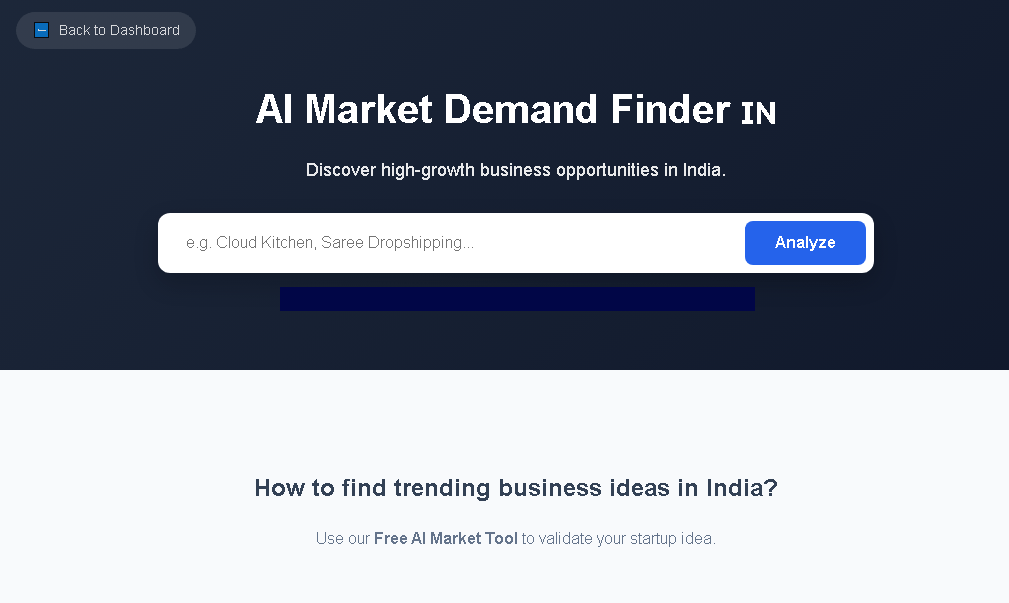
BizplanAI pro offers an AI‑driven dashboard that analyses Indian market trends, competitor activity, and consumer sentiment. Starting at just Rs. 299 /‑ on a pay‑as‑you‑go model, it provides:
| Resource / Tool | Type | Key Offering for Indian Startups | Cost (Approx.) |
|---|---|---|---|
| BizplanAI pro | AI Market Intelligence Platform | Real‑time trend & competitor analysis, multi‑language keyword insights | Rs. 299 /‑ (pay‑as‑you‑go) |
| MOSPI Data Bank | Government Open Data | Household income, consumption patterns, demographic breakdowns | Free |
| Nielsen India Retail Audit | Commercial Research | Point‑of‑sale data, SKU performance, shopper journey | Starting ₹1 Lakh per report |
| Startup India Hub | Government Portal | Registered startup directory, funding schemes, incubator listings | Free |
| Crunchbase India | Commercial Database | Funding rounds, investor profiles, exit activity | ₹9 999 /‑ per year (Pro) |
Start with a crystal‑clear objective such as “Validate demand for a subscription‑based health‑tech platform among urban millennials.” Pair this with measurable success metrics:
Use a combination of demographic, psychographic, and behavioural variables to create segments. In India, common segmentation axes include:
| Segment Name | Key Demographics | Primary Pain Points | Preferred Channels |
|---|---|---|---|
| Urban Millennials (Metro) | Age 22‑35, INR 5‑12 Lakh income, 80% smartphone penetration | Time‑scarcity, desire for digital convenience | Instagram, LinkedIn, OTT ads |
| Tier‑2 Professionals | Age 25‑40, INR 3‑7 Lakh, bilingual (English/Hindi) | Price sensitivity, cash‑on‑delivery habit | WhatsApp, Facebook, regional YouTube channels |
| Rural Early‑Adopters | Age 18‑45, INR 1‑3 Lakh, 4G mobile internet | Limited access to credit, trust in local brands | WhatsApp, regional radio, community fairs |
Match each segment to an appropriate method:
Pull in industry reports from Nielsen, government consumption data, and competitor intelligence from BizplanAI pro. Cross‑validate primary findings with these macro trends to ensure consistency.
Translate insights into concrete product and go‑to‑market decisions:
Launch a pilot in two cities (Bengaluru and Jaipur) using the derived pricing and feature set. Track the success metrics defined in Step 1 and iterate within 30 days.
Using a blend of free government data, low‑cost online surveys (₹5‑₹10 per response), and an AI tool like BizplanAI pro (starting at Rs. 299 /‑), a startup can conduct a solid research cycle for under ₹50,000.
For an early‑stage startup focusing on a single product category, the end‑to‑end process—from objective setting to MVP validation—can be completed in 6‑8 weeks if the research plan is well‑structured.
Yes. Mobile‑first surveys, WhatsApp audio questionnaires, and partnerships with local NGOs enable remote data collection while respecting regional language preferences.
Key steps include obtaining RBI approval for payment gateways, ensuring compliance with the upcoming Personal Data Protection Bill, and registering under the Payments and Settlement Systems Act.
BizplanAI pro automates competitor scanning, real‑time trend monitoring, and multi‑language keyword analysis, cutting manual data‑gathering time by up to 70% and allowing founders to focus on strategy execution.
Not always. Many Indian startups successfully conduct lean research using in‑house teams, free public data, and affordable AI platforms. However, for highly regulated sectors (e.g., pharma), a specialist agency may add compliance assurance.
It helps identify target customers, assess competition, validate demand, and attract investors, increasing the chances of success in a crowded market.
Define the problem, set clear objectives, identify the target audience, and choose appropriate primary and secondary research methods.
Use online surveys, social media polls, interviews, and focus groups, leveraging free tools and local networks to collect cost‑effective insights.
Government reports (e.g., Startup India), industry publications, market reports from firms like NASSCOM, and databases such as Crunchbase or Tracxn.
Investors rely on data‑driven validation of market size, growth potential, and customer adoption to assess risk and decide on funding allocations.