AI Business Idea Evaluator: 5 Revolutionary Tools to Vet Your Next Venture
For every entrepreneur, the journey begins with a spark—a brilliant idea that promises to solve a problem, disrupt an industry, or create new value. But between that initial spark and a thriving business lies a valley of uncertainty. Is the idea viable? Is the market ready? Are you overlooking a fatal flaw? Traditionally, answering these questions involved a mix of gut instinct, biased feedback from friends, and expensive, time-consuming market research. Today, a new class of co-founder has emerged: the AI business idea evaluator. This technology offers an unbiased, data-driven, and lightning-fast way to stress-test your concepts, turning uncertainty into actionable insight and giving you the confidence to move forward or the wisdom to pivot before you invest a single dollar.
This guide dives deep into the world of AI business idea evaluators. We’ll explore how they work, the critical features you must look for, and a step-by-step process to leverage them effectively. Forget guesswork; it’s time to validate your vision with the power of artificial intelligence.
Why Traditional Business Idea Evaluation is Broken
Before we explore the AI-powered future, it’s essential to understand the flaws in the old ways of vetting a business concept. For decades, entrepreneurs relied on a handful of methods, each with significant drawbacks that could lead a promising venture astray before it even began.
Confirmation Bias from Your Inner Circle: When you share an idea with friends and family, they want to be supportive. This often leads to overly positive, uncritical feedback. They love you, but they are not your target market, and their encouragement can create a dangerous echo chamber that masks real-world risks.
The “Gut Feeling” Fallacy: While intuition is a valuable entrepreneurial trait, relying on it alone is a high-stakes gamble. A gut feeling doesn’t account for market saturation, competitor pricing strategies, or shifting consumer behavior. It’s a starting point, not a business plan.
Slow and Cost-Prohibitive Market Research: Professional market research is incredibly valuable, but it’s also incredibly expensive and slow. For a boot-strapping founder, commissioning surveys, focus groups, and industry reports can cost thousands of dollars and take weeks or months—a luxury most startups cannot afford.
Surface-Level Competitor Analysis: A manual search for competitors often reveals only the most obvious players. It’s difficult to uncover indirect competitors, emerging startups, or international companies poised to enter your market. This incomplete picture can lead to a fatal underestimation of the competitive landscape.
These traditional methods are filled with human bias, data gaps, and logistical hurdles. They create a high-risk environment where passion can easily overshadow practicality, leading to failed ventures and wasted resources.
AI Business Idea Evaluator 7
The Rise of the AI Business Idea Evaluator: Your Unbiased Co-Founder
An AI business idea evaluator is a sophisticated software tool that leverages large language models (LLMs) and machine learning algorithms to analyze a business concept against a vast sea of data. Think of it as an instant, on-demand consultant that has consumed millions of business plans, market reports, financial statements, and consumer trend articles. It provides an objective, data-backed assessment of your idea’s potential without the emotional bias of a human counterpart.
How AI Evaluators Work: The Core Mechanics
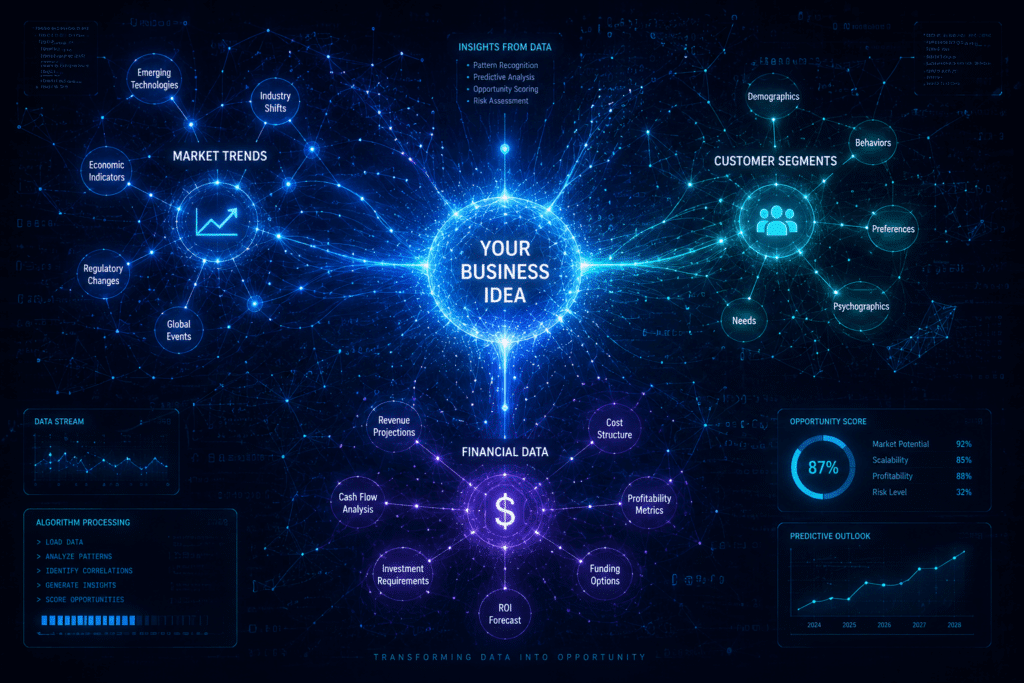
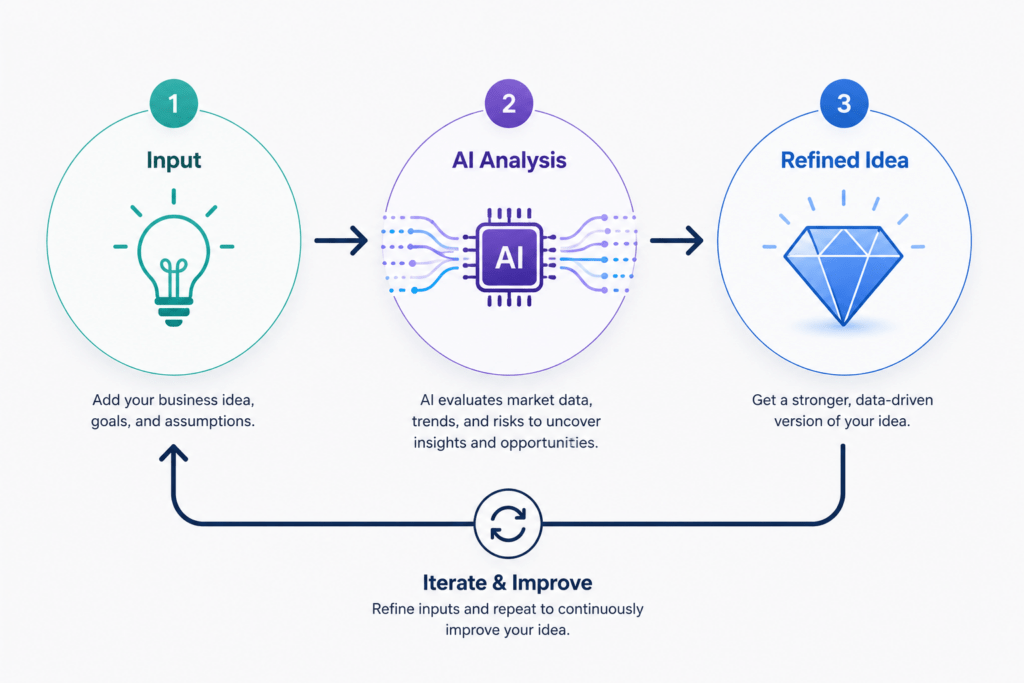
At its core, an AI evaluator operates through a multi-stage process. When you input your business idea, the AI doesn’t just “understand” the words; it deconstructs the concept into fundamental components. It identifies the industry, the target audience, the value proposition, and the proposed revenue model. From there, it initiates a massive data-analysis sequence:
Data Aggregation: The AI scours the internet and proprietary databases for relevant information. This includes industry growth statistics, public company financial records, venture capital funding trends, social media sentiment, online reviews of similar products, and academic research.
Pattern Recognition: Using machine learning, the AI identifies patterns and correlations within this data. It looks for characteristics common to successful businesses in your chosen niche and flags red flags associated with failed ventures.
Predictive Modeling: The tool uses predictive algorithms to forecast potential outcomes. It can estimate market size, project potential revenue based on different pricing models, and simulate the potential impact of key market forces.
Report Synthesis: Finally, the AI synthesizes all its findings into a structured, human-readable report. This output moves beyond a simple “good idea” or “bad idea” to provide detailed insights into specific strengths, weaknesses, opportunities, and threats.
Key Metrics an AI Tool Analyzes
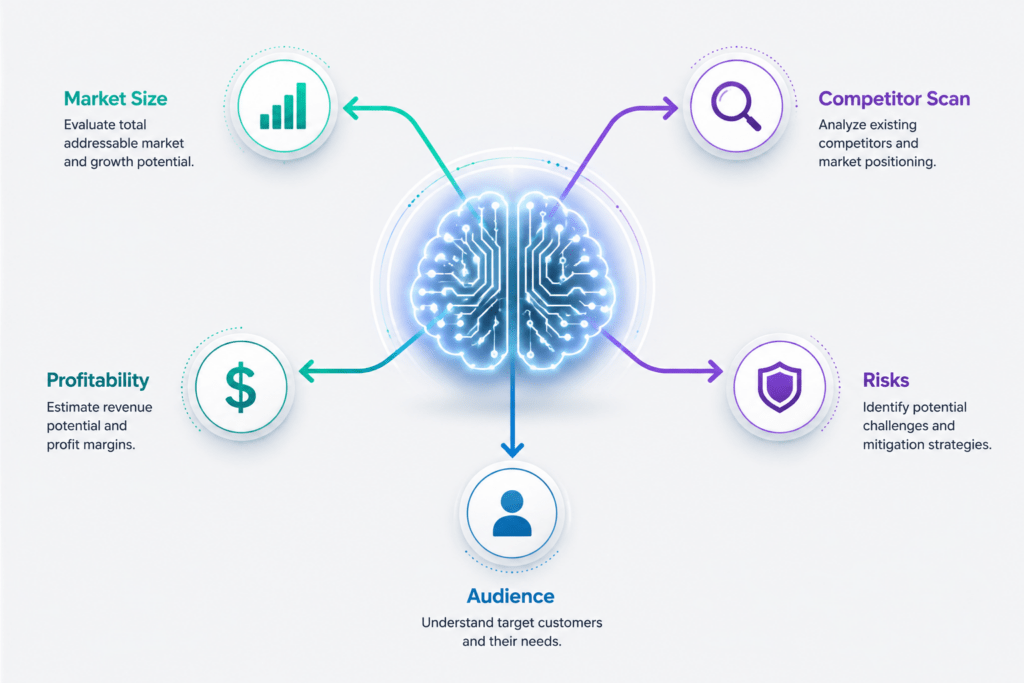
A robust AI business idea validator will assess your concept across several critical dimensions to provide a holistic view of its viability. These typically include:
Market Size & Demand (TAM, SAM, SOM): Is there a large enough pool of potential customers to build a sustainable business? The AI quantifies the Total Addressable Market, Serviceable Available Market, and Serviceable Obtainable Market.
Competition Level: How saturated is the market? The AI identifies key competitors, analyzes their market share, and assesses the overall difficulty of entry.
Profitability Potential: Based on industry benchmarks for cost of goods sold (COGS), customer acquisition cost (CAC), and pricing models, the AI estimates the potential for profitability and long-term financial health.
Scalability: Does the business model have the potential to grow exponentially without a proportional increase in resources? The AI evaluates factors that support or hinder scaling.
Innovation & Uniqueness: How differentiated is your idea? The AI assesses the novelty of your value proposition compared to existing solutions.
Top 5 Features to Look for in an AI Business Idea Evaluator
Not all AI evaluators are created equal. As you explore different tools, prioritize those that offer a comprehensive suite of features designed to give you a 360-degree view of your business concept’s potential. Here are the five must-have capabilities.
AI Business Idea Evaluator 8
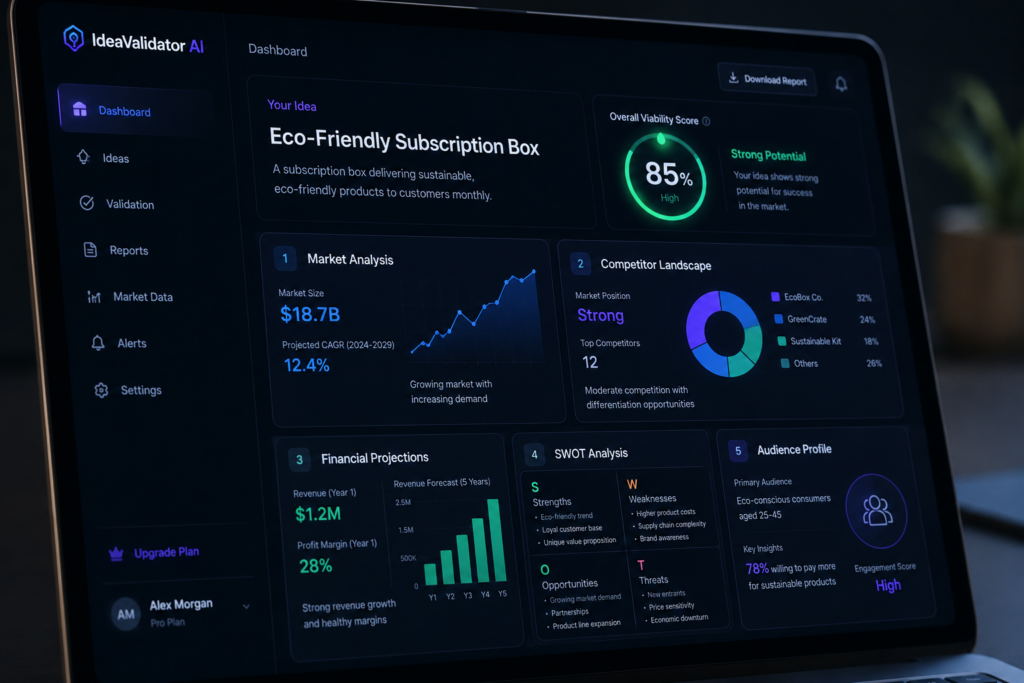
1. Comprehensive Market Analysis
A great AI evaluator goes beyond a simple market size number. It should provide a deep dive into the industry’s health and trajectory. Look for tools that deliver detailed reports on market growth trends, citing historical data and future projections from reputable sources. It should also analyze consumer behavior patterns, identifying what motivates purchasing decisions in your target sector. A truly advanced tool will even perform sentiment analysis, scraping social media and review sites to gauge public opinion about the problem you aim to solve or the solutions that already exist.
2. Competitor Landscape Mapping
Knowing your competition is non-negotiable. An AI evaluator should act as your digital scout, automatically identifying not just your direct competitors but also indirect and emerging ones you might have missed. The analysis shouldn’t stop at a simple list. The best tools will dissect competitor strategies, analyzing their pricing, marketing messages, customer reviews, and online presence. The ultimate goal is to generate a report that highlights “gaps in the market”—unserved customer needs or weaknesses in competitor offerings that your business can exploit.
3. Financial Viability Projections
While an AI can’t predict your exact bank balance, it can provide powerful financial forecasts based on industry data. A top-tier evaluator should be able to generate pro-forma financial statements, including estimated startup costs, operational expenses, and potential revenue streams. It should allow you to model different scenarios—what happens if you price your product 10% higher? What’s the impact of a 20% increase in marketing spend? This feature transforms your idea from a concept into a tangible financial model, helping you understand your break-even point and assess its investment-worthiness.
4. SWOT Analysis Generation
The SWOT (Strengths, Weaknesses, Opportunities, Threats) framework is a cornerstone of business strategy. Manually creating one can be subjective and incomplete. An AI evaluator automates this process with brutal objectivity. It analyzes your business concept to identify its inherent Strengths (e.g., unique technology) and Weaknesses (e.g., high capital requirement). Simultaneously, it scans the external environment to pinpoint Opportunities (e.g., a growing market trend) and Threats (e.g., upcoming regulations, powerful new competitors). This instant, data-driven analysis is a core function of any serious Read our complete guide on ai business analysis tool →.
5. Target Audience Profiling
You can have the best product in the world, but it will fail if you market it to the wrong people. An elite AI evaluator helps you build detailed customer personas. It moves beyond basic demographics (age, gender, location) to uncover psychographics—their values, interests, online behaviors, and pain points. By analyzing forum discussions, social media groups, and product reviews, the AI can tell you what language your audience uses, what media they consume, and what truly motivates them. This information is pure gold for crafting marketing messages that resonate and building a product they’ll love.
AI Business Idea Evaluator 9
Step-by-Step Guide: How to Use an AI Business Idea Evaluator Effectively
Having access to a powerful tool is only half the battle. To get the most out of an AI evaluator, you need a strategic approach. It’s not a magic button but an iterative partner in refining your vision.
Step 1: Crafting Your Initial Prompt
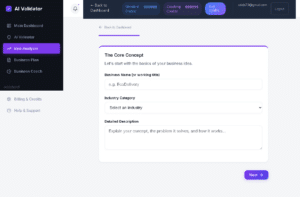
The quality of the AI’s output is directly proportional to the quality of your input. This is the “Garbage In, Garbage Out” principle. Don’t just enter “a subscription box for coffee.” Provide a detailed, structured prompt. Include:
The Core Concept: What is the product or service?
The Value Proposition: What unique problem does it solve or benefit does it provide?
The Target Audience: Who are you selling to? Be as specific as possible.
The Revenue Model: How will you make money (e.g., subscription, one-time sale, freemium)?
Your Unique Angle: What is your secret sauce or competitive advantage?
Example of a Weak Prompt: “AI for real estate agents.”
Example of a Strong Prompt: “An AI-powered SaaS platform for residential real estate agents. The core feature uses predictive analytics to identify homeowners in a specific zip code who are most likely to sell their property within the next 6-12 months based on public data like property age, mortgage data, and demographic shifts. The revenue model is a monthly subscription tiered by the number of leads generated.”
Step 2: Interpreting the AI’s Feedback
When you receive the report, resist the urge to only look at the top-line score or a simple “viable/not viable” conclusion. Dive into the details. If the AI flags a “high competition” risk, look at the specific competitors it identified. Are they truly a threat, or do they serve a slightly different niche? If it suggests a low profitability potential, examine the cost assumptions it made. Perhaps your unique business model allows for lower costs than the industry average. Use the AI’s analysis as a set of hypotheses to investigate further, not as a final judgment.
Step 3: Iterating on Your Idea
The most powerful way to use an AI evaluator is as an iterative loop. Take the weaknesses and threats it identifies and use them as a creative challenge.
Weakness Identified: “High customer acquisition cost.” Iteration: “How can I build in a viral loop or a strong referral program to lower CAC?” You can then feed this refined idea back into the evaluator.
Threat Identified: “Market is saturated with generic solutions.” Iteration: “I will pivot to focus exclusively on a niche sub-market, like ‘first-time millennial homebuyers’.”
This process of testing, learning, and refining transforms your initial concept into a resilient, well-thought-out business strategy. The goal is to continuously improve your idea until the AI analysis reflects a strong balance of opportunity and viability, which is essential when generating new Read our complete guide on ai company ideas →.
AI Business Idea Evaluator 10
Beyond Validation: Using AI to Refine and Pivot
The role of an AI business idea evaluator extends far beyond a simple thumbs-up or thumbs-down. Its true power lies in its ability to be a strategic partner throughout the early stages of your entrepreneurial journey. Once the initial validation is complete, you can leverage the tool to explore new dimensions of your business.
For example, you can use the AI as a brainstorming partner. Feed it your core concept and ask it to generate potential new features, alternative revenue models, or untapped niche markets. You could ask, “Given my validated business idea for an eco-friendly subscription box, what are three potential high-margin add-on products I could offer?” or “What are three adjacent customer segments that might also be interested in this product?”
Furthermore, if the initial evaluation reveals a significant flaw in your concept, the tool can be instrumental in orchestrating a pivot. Instead of abandoning the idea altogether, you can use the AI’s market analysis to find a new direction. If it determines your target market is too small, you can ask it to identify larger markets with similar pain points. This transforms the evaluator from a judge into a creative navigator, helping you find a path to a viable business model even when your first route is blocked.
The Limitations and Future of AI Business Idea Evaluation
As powerful as these tools are, it is crucial to acknowledge their limitations. AI evaluators are analytical, not creative in a human sense. They cannot predict “black swan” events, radical shifts in culture, or the viral potential of a truly practical, category-defining idea. The data they are trained on is historical, so they may be less effective at evaluating concepts in entirely new, unprecedented markets.
Moreover, AI lacks human intuition, passion, and the ability to build relationships—the very elements that often drive an entrepreneur to succeed against the odds. An AI might have told the founders of Airbnb that their idea of having strangers sleep in people’s homes was too risky based on historical data.
The future, however, is bright. We can expect these tools to become even more sophisticated. Future iterations will likely integrate real-time data streams, allowing for up-to-the-minute analysis of market trends. They may incorporate more advanced predictive modeling to simulate competitive responses to your market entry. Ultimately, the AI business idea evaluator is not here to replace the entrepreneur. It is here to empower them, to handle the heavy lifting of data analysis so that founders can focus on what they do best: building, innovating, and leading.
Frequently Asked Questions (FAQ)
How do you evaluate a business idea with AI?
To evaluate a business idea with AI, you provide a detailed description of your concept to a specialized AI tool. This prompt should include the product/service, target audience, revenue model, and unique value proposition. The AI then analyzes this input against massive datasets, assessing market size, competition, financial viability, and potential risks, and synthesizes the findings into a comprehensive report.
Can AI predict business success?
AI cannot predict business success with 100% certainty, as success depends on many factors beyond the initial idea, such as execution, team, funding, and market timing. However, an AI can accurately predict the *viability* of a business idea by analyzing data-driven factors and identifying potential strengths and weaknesses, significantly increasing the probability of success by helping entrepreneurs avoid fatal flaws.
What is the best AI tool for business analysis?
The “best” AI tool for business analysis depends on your specific needs. Some tools excel at financial modeling, others at competitive intelligence or market trend analysis. The best evaluators offer a comprehensive suite of features, including market sizing, competitor mapping, SWOT analysis, and financial projections, all within a single platform.
How do you test a business idea before starting?
Besides using an AI evaluator, you can test a business idea by creating a Minimum Viable Product (MVP) to see if customers will actually use or buy it. Other methods include conducting customer interviews, running smoke tests with a simple landing page to gauge interest and collect emails, and launching pre-order campaigns to validate demand before full-scale production.
R. Sharma is a senior startup advisor and business planning specialist at BizPlan AI Pro. With over a decade of experience in Indian corporate finance and MSME consulting, he has helped hundreds of founders structure financial projections and secure bank funding.