AI Business Ideas: 7 Powerful AI Business Idea Validators to Predict Success
Over 90% of startups fail. It’s a daunting statistic that haunts every aspiring entrepreneur. The primary culprit isn’t a lack of passion or a brilliant initial spark; it’s a failure to achieve product-market fit. Many founders build solutions for problems that don’t exist, enter markets that are too saturated, or misjudge the financial viability of their venture. But what if you could significantly de-risk this process? What if you had a data-driven co-pilot capable of stress-testing your idea against millions of data points before you write a single line of code or invest a single dollar? Welcome to the era of the AI business idea validator, your new secret weapon for building a business that lasts.
This guide moves beyond theory and dives into the practical, actionable ways you can leverage artificial intelligence to rigorously analyze, critique, and validate your business concepts. We will explore seven powerful techniques that transform AI from a buzzword into a concrete tool for predicting market demand, understanding your competition, and building a resilient financial model. Prepare to turn uncertainty into a calculated advantage.
What Exactly Is an AI Business Idea Validator?
An AI business idea validator is not a mystical crystal ball that gives a simple “yes” or “no” answer. Instead, think of it as a suite of intelligent tools and techniques that use machine learning, natural language processing (NLP), and predictive analytics to assess the potential of a business concept from multiple angles. It synthesizes vast amounts of data—far more than any human team could process—to provide objective, evidence-based insights.
These validators work by analyzing various data sources, including:
Market Data: Search engine trends, industry reports, social media conversations, and news articles.
Competitor Data: Website traffic, pricing strategies, customer reviews, and feature sets of existing players.
Consumer Data: Sentiment analysis from forums like Reddit and Quora, demographic information, and purchase behavior patterns.
Financial Data: Economic indicators, funding trends in your niche, and cost-of-acquisition benchmarks.
By processing this information, an AI validator can help you answer critical questions like: Is there a growing demand for my solution? Who are my real competitors, and what are their weaknesses? Who is my ideal customer, and what do they truly want? Is my pricing model sustainable? It replaces gut feelings and anecdotal evidence with a robust, data-driven foundation for your strategic decisions.
Why Traditional Validation Is No Longer Enough
For decades, entrepreneurs relied on a standard validation playbook: surveys, focus groups, landing page tests, and manual competitor research. While these methods are still valuable, they have significant limitations in today’s fast-paced digital landscape.
Slow and Expensive: Conducting proper market research can take weeks or months and cost thousands of dollars, a luxury most early-stage startups cannot afford.
Prone to Bias: Founders often unconsciously design surveys to confirm their own beliefs (confirmation bias). Friends and family, wanting to be supportive, rarely provide brutally honest feedback.
Limited Scope: A survey of 100 people or a single focus group provides a tiny snapshot of a much larger, more complex market. It’s easy to mistake a small pocket of interest for a scalable opportunity.
AI-powered validation directly addresses these shortcomings. It operates at an unprecedented scale, analyzing millions of authentic, unsolicited opinions from across the web in minutes. It removes personal bias from the equation, presenting an unvarnished look at the market reality. This allows you to fail faster, pivot smarter, and iterate on your idea with a level of confidence that was previously impossible to achieve.
AI Business Ideas: 7 Powerful AI Business Idea Validators to Predict Success 7
The 7 Key AI Validation Techniques You Can Use Today
Validating your idea isn’t about using a single “magic button” tool. It’s about applying a combination of AI-powered techniques to build a comprehensive picture of your idea’s potential. Here are seven powerful methods you can start using right now.
1. AI-Powered Market Trend and Demand Analysis
Before you build anything, you need to know if you’re surfing a rising wave or paddling in a stagnant pond. AI tools can analyze real-time data from search engines (like Google Trends), social media platforms, news outlets, and industry publications to identify and quantify market demand.
How it works: These systems use NLP to understand the context and sentiment around keywords related to your business idea. They can track the growth of conversations, identify emerging sub-niches, and even predict future interest based on historical data patterns. You can move beyond simple keyword volume to understand the *intent* behind the searches and the problems people are actively trying to solve.
2. AI-Driven Competitive Landscape Mapping
You might think you know your competitors, but AI can reveal a much more detailed and accurate map of the battlefield. AI tools can automatically scrape and analyze competitor websites, product reviews, social media profiles, and pricing pages.
How it works: The AI compiles a comprehensive report detailing your competitors’ strengths and weaknesses. It can identify feature gaps you could exploit, pinpoint common customer complaints about existing solutions (a goldmine for your value proposition), and analyze their marketing strategies. This allows you to position your business not just as another alternative, but as a superior solution to a clearly defined problem.
3. Predictive Financial Modeling with AI
A back-of-the-napkin financial projection is a recipe for disaster. AI can create far more sophisticated and realistic financial models. By analyzing industry benchmarks, economic data, and potential market size, AI algorithms can forecast key metrics like Customer Acquisition Cost (CAC), Lifetime Value (LTV), revenue, and burn rate.
How it works: You input your core assumptions (e.g., proposed price, target market size), and the AI model runs thousands of simulations based on various market scenarios (e.g., a recession, a new competitor entering the market). The output isn’t a single, optimistic projection but a range of likely outcomes, helping you understand the financial risks and opportunities with greater clarity.
AI Business Ideas: 7 Powerful AI Business Idea Validators to Predict Success 8
4. AI-Based Customer Persona and Sentiment Analysis
Who is your ideal customer? Instead of guessing, you can use AI to build data-driven customer personas. AI tools can scan millions of comments on Reddit, Quora, Twitter, and product review sites to understand the specific pain points, desires, language, and demographics of your target audience.
How it works: Sentiment analysis algorithms classify online conversations as positive, negative, or neutral, allowing you to gauge public opinion on the problem you’re trying to solve. The AI can then cluster this data to create detailed personas, complete with motivations, frustrations, and the exact words they use to describe their needs. This is invaluable for crafting marketing messages and product features that truly resonate.
5. Automated SWOT Analysis Generation
A traditional SWOT (Strengths, Weaknesses, Opportunities, Threats) analysis is a foundational strategic exercise, but it’s often subjective. AI can automate and objectify this process. By synthesizing all the data gathered from the market, competitor, and customer analyses, an AI tool can generate a comprehensive SWOT report.
How it works: The AI identifies your potential business’s internal strengths (e.g., a unique feature idea that addresses a common complaint about competitors) and weaknesses (e.g., high predicted CAC in a crowded market). It then identifies external opportunities (e.g., a growing trend that aligns with your solution) and threats (e.g., an incumbent competitor with massive funding). This gives you a 360-degree view of your strategic position.
6. Using LLMs for Rapid Prototyping and Feedback
Large Language Models (LLMs) like GPT-4 are incredibly powerful validation tools. You can use them as a tireless brainstorming partner and an instant feedback engine. Describe your business idea in detail and ask the LLM to role-play as different customer personas (a skeptical CFO, an enthusiastic early adopter, a confused non-technical user) and give you feedback.
How it works: You can “test” landing page copy, value propositions, and feature ideas by simply asking the LLM to critique them from various perspectives. While it’s not a substitute for real human feedback, it’s an incredibly fast and free way to identify glaring holes in your logic, confusing language, or unappealing benefits before you show your idea to anyone else. For a more structured approach, a dedicated Read our complete guide on business idea analysis ai → platform can guide you through this process.
7. Simulating Product-Market Fit with AI Agents
This is a more advanced, cutting-edge technique. Some platforms are now using “AI agents”—autonomous programs that can simulate human behavior—to model how a target market might react to a new product. Researchers can create thousands of agents with different personas, budgets, and needs, and then “release” a virtual product into this simulated environment.
How it works: These simulations can model adoption rates, word-of-mouth effects, and how different pricing strategies might play out over time. It’s the closest you can get to testing product-market fit without actually building a product. While still an emerging field, it represents the future of reducing go-to-market risk.
AI Business Ideas: 7 Powerful AI Business Idea Validators to Predict Success 9
How to Choose the Right AI Business Analysis Tool
With a growing number of AI tools available, selecting the right one can be overwhelming. Look for a platform or a combination of tools that provides a holistic view. A great Read our complete guide on ai business idea evaluator → should not just give you a score but should provide actionable insights across several key areas.
Key Criteria for Selection:
Data Sources: Does the tool pull data from a wide variety of real-time sources (social, search, news, financial), or is it based on a static database? Real-time data is crucial.
Transparency: Does the tool explain *why* it reached a certain conclusion? Avoid “black box” solutions that just give you a score without any supporting evidence or data.
Comprehensiveness: Does it cover multiple aspects of validation, including market size, competition, customer sentiment, and financial viability? A single-metric tool is not enough.
Usability: Is the interface intuitive? Can you easily input your idea and understand the resulting report without needing a data science degree?
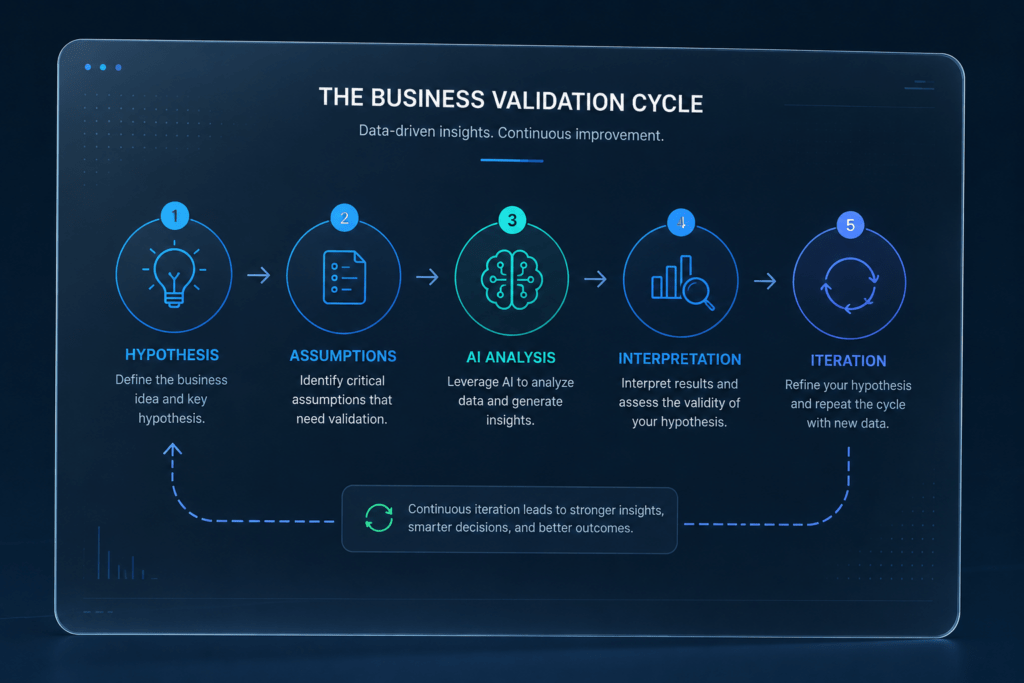
A Step-by-Step Guide: Validating Your Idea with AI
Ready to put these techniques into practice? Here is a simple framework for using an AI business idea validator.
Step 1: Formulate a Clear Hypothesis. Start with a clear, concise statement. For example: “Busy professionals aged 30-45 will pay a $20/month subscription for an AI-powered meal planning app that accommodates complex dietary restrictions because existing apps are too generic.”
Step 2: Identify Your Key Assumptions. What must be true for your idea to succeed? (e.g., “There is a large market of people with complex dietary needs,” “They are willing to pay for a premium solution,” “Competitors are not serving this niche well.”)
Step 3: Select Your AI Tools/Techniques. Choose the methods from the list above that best test your key assumptions. You’ll likely use a combination of market trend analysis, competitive mapping, and customer sentiment analysis.
Step 4: Input Your Data and Run the Analysis. Feed your hypothesis and keywords into the AI tool(s). Be as specific as possible. Instead of “meal planning app,” use terms like “keto meal planner for athletes” or “low-FODMAP recipe generator.”
Step 5: Interpret the Results Objectively. This is the most critical step. The AI will present you with data, not a final decision. Look for evidence that either supports or refutes your core assumptions. Be prepared to accept that your initial idea may have flaws.
Step 6: Iterate or Pivot. Use the insights to refine your idea. The AI might reveal that while your target audience is too small, a slightly different audience has a massive, unmet need. Validation is not a one-time event; it’s a continuous loop of testing, learning, and refining.
By embracing the power of an AI business idea validator, you fundamentally change your relationship with risk. You shift from gambling on a gut feeling to making a calculated investment based on a deep, data-driven understanding of the market. The future of entrepreneurship belongs to those who can partner with intelligence—both human and artificial—to build what the world truly needs.
AI Business Ideas: 7 Powerful AI Business Idea Validators to Predict Success 10
Frequently Asked Questions
How do you validate a business idea with AI?
You can validate a business idea with AI by using a multi-faceted approach. Start by using AI tools to conduct large-scale market trend analysis via search and social data. Then, perform an AI-driven competitive analysis to identify market gaps. Use natural language processing (NLP) to analyze customer sentiment on forums and review sites to build data-backed personas. Finally, leverage AI for predictive financial modeling to assess the idea’s viability. This creates a holistic, data-driven view of your concept’s potential.
Is there an AI that can generate business ideas?
Yes, many AI tools, particularly those based on large language models (LLMs) like GPT-4, can generate business ideas. You can provide them with prompts based on your interests, industry trends, or specific problems you want to solve, and they can brainstorm a list of potential concepts. However, these AI-generated ideas still require rigorous validation using the techniques described above.
How can AI help in business model generation?
AI can assist in business model generation by analyzing successful models within your chosen industry and identifying patterns. It can suggest various revenue streams (e.g., subscription, freemium, pay-per-use) and simulate their potential financial outcomes. AI can also help map out a value proposition canvas by analyzing customer needs and pain points, ensuring your business model is aligned with what the market actually wants.
What is the best AI for business analysis?
There is no single “best” AI for business analysis, as the ideal tool depends on the specific task. For broad analysis, platforms that integrate market, competitive, and customer data are powerful. For text-based tasks like sentiment analysis or copy critique, LLMs like OpenAI’s GPT-4 or Anthropic’s Claude are excellent. For financial forecasting, specialized predictive analytics software is often used. The best strategy is often to use a combination of tools to cover all analytical bases.
R. Sharma is a senior startup advisor and business planning specialist at BizPlan AI Pro. With over a decade of experience in Indian corporate finance and MSME consulting, he has helped hundreds of founders structure financial projections and secure bank funding.