AI Company Ideas: 15 Groundbreaking Ventures to Launch Now
The artificial intelligence revolution isn’t just coming; it’s here. Once the domain of tech giants and research labs, AI is now more accessible than ever, creating a fertile ground for entrepreneurs with vision. The barrier to entry has lowered dramatically, but the potential for impact and profit has skyrocketed. If you’re looking to build a future-proof business, you’re in the right place. This guide will unveil 15 innovative AI company ideas, moving beyond the generic to offer tangible, high-potential ventures you can start building today. We will explore everything from niche SaaS solutions to transformative service-based models, providing the spark you need to launch your own AI empire.
AI-Powered Niche SaaS Solutions
Software as a Service (SaaS) remains one of the most profitable business models. By infusing it with AI, you can create “smarter” products that solve hyper-specific problems with unparalleled efficiency. These tools don’t just perform tasks; they learn, adapt, and provide predictive insights.
1. AI-Driven Legal Tech for Contract Analysis
The Idea: A SaaS platform that uses Natural Language Processing (NLP) to scan, analyze, and flag key clauses, risks, and discrepancies in legal contracts. Small businesses and freelance lawyers often lack the resources for meticulous contract review. This tool would be their digital paralegal.
How it Works: Users upload contracts (NDAs, service agreements, leases). The AI instantly identifies non-standard clauses, potential liabilities, missing information, and language that deviates from industry best practices. It could also summarize long documents into a few key bullet points. The business model would be a tiered subscription based on the number of documents analyzed per month.
2. Hyper-Personalized E-commerce Retention Engine
The Idea: An AI tool that integrates with e-commerce platforms like Shopify or WooCommerce to predict customer churn and automate hyper-personalized retention campaigns. Instead of generic “we miss you” emails, this AI would analyze purchasing behavior, browsing history, and product interactions to send the perfect offer at the perfect time.
How it Works: The AI could identify a customer who buys running shoes every six months and automatically send them a curated list of new arrivals with a small discount five months after their last purchase. It could also trigger personalized pop-ups on the website or suggest unique product bundles based on an individual’s taste profile, drastically increasing customer lifetime value (CLV).
3. AI-Powered Mental Health & Wellness Companion
The Idea: A subscription-based mobile app that acts as a personalized mental wellness coach. This is not a replacement for therapy but a supportive tool for daily life. It uses AI to provide guided meditations, cognitive behavioral therapy (CBT) exercises, and journaling prompts based on the user’s mood and stated goals.
How it Works: The AI learns from user inputs (mood tracking, journal entries, completed exercises) to tailor its recommendations. If a user frequently reports feeling anxious before meetings, the app could proactively suggest a 5-minute breathing exercise 15 minutes before their next calendar event. The focus is on proactive, personalized support.
AI Company Ideas: 15 Groundbreaking Ventures to Launch Now 6
AI-Enabled Services & Consulting
Not every AI business needs to be a standalone software product. A massive opportunity lies in providing AI-powered services and consulting to businesses that lack the in-house expertise to leverage this technology themselves. This model combines human expertise with AI efficiency.
4. AI Implementation & Strategy Consulting
The Idea: A consulting firm that helps small and medium-sized enterprises (SMEs) identify and integrate the right AI tools into their existing workflows. Many business owners hear about AI but have no idea where to start. You become their guide.
How it Works: You would conduct an operational audit of a client’s business (e.g., marketing, customer service, logistics) and then recommend and help implement specific AI solutions—from AI-powered CRMs to automated customer support chatbots. The revenue model is based on project fees and ongoing retainers for support and optimization.
5. Custom AI Model Development Agency
The Idea: For businesses with unique data sets and specific needs, off-the-shelf AI solutions aren’t enough. This agency would specialize in building bespoke AI and machine learning models tailored to a client’s specific challenges.
How it Works: A real estate firm might hire you to build a predictive model for housing prices based on their proprietary neighborhood data. A healthcare provider might need a custom model to predict patient no-show rates. This is a high-ticket service requiring deep technical expertise in data science and machine learning engineering.
6. AI-Powered SEO & Content Strategy Service
The Idea: A marketing agency that uses a suite of proprietary and public AI tools to deliver superior SEO and content marketing results. This goes beyond just using AI to write articles; it involves using AI for deep keyword research, competitive analysis, topic clustering, and performance prediction.
How it Works: The service would use AI to analyze SERPs at scale, identify content gaps with the highest probability of ranking, and create data-driven content briefs. It could also use predictive analytics to forecast the traffic impact of a content campaign before a single word is written, offering clients a clear ROI.
AI in Creative & Media Industries
Generative AI has unleashed a tidal wave of possibilities in creative fields. While some fear replacement, the smart entrepreneur sees an opportunity to build tools and platforms that augment human creativity, making content creation faster, cheaper, and more accessible.
7. Automated Video Highlight Reel Generation
The Idea: A service or platform for content creators, marketers, and event organizers that automatically generates short, engaging highlight reels from long-form video content. Think of a tool that can watch a 2-hour podcast and instantly clip the 10 most shareable moments for TikTok and Instagram.
How it Works: The AI would be trained to identify key moments based on emotional cues (laughter, excitement in voice), visual action, and keyword mentions. Users could upload their long videos, and the platform would deliver a dozen social-media-ready clips, complete with auto-generated captions.
8. AI-Generated Niche Stock Media Platform
The Idea: A stock photo and video platform powered entirely by generative AI, focusing on niche or hard-to-capture concepts. Traditional stock photo sites often lack diversity or specific imagery (e.g., “a female software engineer of South Asian descent working on a quantum computer in a futuristic lab”).
How it Works: Users could purchase pre-generated images or use a credit system to generate their own highly specific, royalty-free images and video clips. This solves a major pain point for marketers and designers who need the perfect image and can’t find it anywhere else.
AI Company Ideas: 15 Groundbreaking Ventures to Launch Now 7
9. Personalized AI Storytelling Assistant
The Idea: An advanced writing tool for authors and screenwriters that goes beyond grammar checks. This AI assistant helps with plot development, character creation, and overcoming writer’s block. It acts as a creative sparring partner.
How it Works: A writer could input their premise, and the AI could suggest potential plot twists, generate detailed character backstories, or even write dialogue in a specific character’s voice. It wouldn’t write the book for them but would provide creative prompts and structural suggestions to keep the momentum going.
AI for Physical & Operational Industries
AI’s impact extends far beyond the digital realm. In sectors like manufacturing, agriculture, and logistics, AI can optimize physical processes, predict failures, and create immense efficiency gains.
10. Predictive Maintenance SaaS for Manufacturing
The Idea: A platform that uses AI to predict when industrial machinery is likely to fail. Unplanned downtime is a massive cost for manufacturers. This tool helps them move from reactive to proactive maintenance.
How it Works: IoT sensors are placed on factory equipment to monitor variables like temperature, vibration, and energy consumption. The AI model analyzes this data stream in real-time to detect subtle anomalies that precede a failure, sending an alert to the maintenance team to schedule a repair before the machine breaks down.
11. AI-Optimized Agricultural Crop Monitoring
The Idea: A service that uses drone imagery and AI analysis to help farmers increase crop yields and reduce waste. This company would provide “precision agriculture” as a service.
How it Works: Drones fly over fields capturing multispectral images. The AI platform analyzes these images to identify issues like pest infestations, irrigation problems, or nutrient deficiencies on a plant-by-plant basis. This allows farmers to apply water, fertilizer, or pesticides only where needed, saving money and improving sustainability.
12. Smart Logistics and Supply Chain Routing
The Idea: An AI platform for logistics companies that optimizes delivery routes in real-time. It goes beyond standard GPS by factoring in dozens of variables to save fuel and time.
How it Works: The AI considers traffic patterns, weather conditions, vehicle capacity, delivery time windows, and even the probability of delays to calculate the most efficient route for an entire fleet of vehicles. The system can dynamically re-route drivers mid-journey if a new, more optimal path becomes available.
Beyond the Idea: Validation and Launch
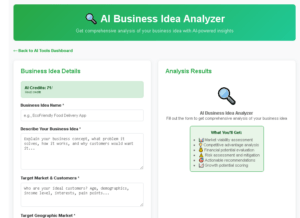
An idea is only the first step. The critical next phase is validation. Before investing significant time and capital, you must determine if your idea has real market potential. Does it solve a painful enough problem that people are willing to pay for a solution? This is where rigorous testing and analysis come in. A structured Read our complete guide on business idea analysis ai → can help you systematically evaluate your concept against market data, competitive landscapes, and potential revenue models, preventing you from pursuing a dead end.
Many entrepreneurs fall in love with their initial concept and suffer from confirmation bias. To counteract this, it’s essential to use objective tools. Employing an Read our complete guide on ai business idea validator → can provide an unbiased second opinion, using algorithms to score your idea’s viability based on a range of critical business factors. This data-driven approach is invaluable for refining your strategy and ensuring you’re building a company that people actually need.
AI Company Ideas: 15 Groundbreaking Ventures to Launch Now 8
13. AI-Powered Personal Finance & Debt Reduction Coach
The Idea: A mobile app that connects to a user’s bank accounts and credit cards to provide highly personalized advice on budgeting, saving, and paying off debt. It’s like having a fiduciary financial advisor in your pocket.
How it Works: The AI analyzes spending patterns and identifies opportunities for savings (e.g., “You’ve spent $75 on coffee this month. Here are three ways to cut that by 30%”). It could also run simulations to show the fastest way to pay off credit card debt using the avalanche or snowball method, tailored to the user’s specific financial situation.
14. AI-Enhanced Cybersecurity Threat Detection
The Idea: A security service for SMEs that uses AI to monitor network traffic and identify anomalous behavior indicative of a cyberattack. Traditional antivirus software relies on known threats, but AI can spot novel, zero-day attacks.
How it Works: The AI establishes a baseline of “normal” network activity for a business. It then monitors the network 24/7, flagging any deviations from this baseline in real-time. For example, if a user account suddenly starts trying to access sensitive files at 3 AM from an unusual location, the system would immediately lock the account and alert an administrator.
The Idea: A next-generation recruitment platform that goes beyond keyword matching on resumes. It uses AI to assess a candidate’s soft skills, cultural fit, and potential for growth.
How it Works: The platform could analyze a candidate’s publicly available work (like code on GitHub or design portfolios) or use AI-powered video interviews to assess communication skills and problem-solving approaches. For companies, it would provide a ranked shortlist of candidates who are not just qualified on paper but are also highly likely to succeed and thrive within the company’s specific culture.
Frequently Asked Questions (FAQ)
What is the best AI business to start?
The “best” AI business depends heavily on your skills, resources, and market knowledge. However, high-potential areas include niche B2B SaaS solutions that solve a specific industry problem (e.g., AI for legal contract analysis), AI-powered consulting services for SMEs, and platforms that use generative AI to augment creative workflows (e.g., automated video editing).
Is an AI company profitable?
Yes, AI companies can be extremely profitable. Profitability hinges on the business model. SaaS models offer recurring revenue, while high-ticket consulting can be lucrative from day one. The key is to solve a valuable problem that saves customers money, increases their revenue, or provides a unique capability they can’t get elsewhere.
What AI can I start with no money?
Starting with absolutely zero money is challenging, but you can begin by focusing on services. Offer AI strategy consulting by leveraging your expertise. You can use free tiers of existing AI tools to build a portfolio. Another option is to create a content-based business (blog, newsletter, YouTube channel) focused on a specific AI niche, monetizing through affiliate marketing or ads once you build an audience.
How do I start my own AI business?
First, identify a specific problem that AI can solve better than existing solutions. Second, validate your idea by talking to potential customers. Third, build a Minimum Viable Product (MVP) using existing AI APIs (from OpenAI, Google, etc.) to test your concept quickly. Fourth, acquire your first pilot customers, even if they’re non-paying, to gather feedback. Finally, use that feedback to iterate on your product and develop a go-to-market strategy.
R. Sharma is a senior startup advisor and business planning specialist at BizPlan AI Pro. With over a decade of experience in Indian corporate finance and MSME consulting, he has helped hundreds of founders structure financial projections and secure bank funding.