
Product Market Fit

Product Market Fit 2026: The Complete Guide to Validating Your Business Idea
Customers loving and talking about the product is the clearest sign of success. Yet organizations using verified tools report that 85% of startups fail because they never achieve product market fit. This gap between ambition and execution determines which businesses thrive and which disappear.
Product market fit is not a one-time milestone. It is a continuous alignment between what you build and what customers desperately need. In 2026, the path to product market fit has become faster, more measurable, and more data-driven than ever before. Understanding how to identify, test, and validate this fit is the foundation of sustainable growth.
Understanding Product Market Fit and Its Importance
Product market fit occurs when your product satisfies strong market demand. Product-market fit is the degree to which a product satisfies a strong market demand. Marc Andreessen, the legendary venture capitalist, stated that achieving product market fit is the only thing that matters for startups. This is not hyperbole. It is the single most important factor separating successful businesses from failures.
When you have product market fit, several things happen simultaneously:
- Customers actively seek out your product without heavy marketing.
- Retention rates exceed industry benchmarks by significant margins.
- Word-of-mouth referrals drive organic growth.
- Customers willing to pay for the product without hesitation or negotiation.
- Your support team receives fewer complaints and more feature requests.
The Cost of Missing Product Market Fit
Startups that chase revenue without product market fit burn cash rapidly. They spend heavily on customer acquisition only to watch users churn. Achieving product market fit is a strong indicator of long-term business success. The reverse is equally true: without it, even well-funded companies collapse.
The timeline varies. Time to reach product market fit can vary significantly across industries. B2B SaaS companies might need 18-24 months. Consumer apps could find it in 6-12 months. The key is recognizing when you have achieved it, not rushing the process.
Measuring Product Market Fit: The 40% Rule
Sean Ellis, founder of GrowthHackers, created a simple metric that defines product market fit: The 40% rule is a simple way to gauge product-market fit. A startup has achieved product market fit when at least 40% of users say they would be ‘very disappointed’ if the product no longer existed.
This metric works because it measures genuine emotional attachment. Users who answer “very disappointed” are not casual users. They depend on your product. They have integrated it into their workflow. They would actively seek alternatives if you shut down tomorrow.
How to implement the 40% test:
- Survey your active user base monthly.
- Ask: “How disappointed would you be if this product no longer existed?”
- Offer four response options: very disappointed, somewhat disappointed, not disappointed, or N/A.
- Calculate the percentage who selected “very disappointed.”
- Track this metric over time as your product evolves.
Beyond the 40% Benchmark
While the 40% rule provides a clear threshold, true product market fit involves multiple signals working together. Comparing user engagement metrics to industry benchmarks reveals whether your retention patterns match or exceed successful competitors. Tools like ProductPlan and Zendesk help track these metrics systematically.
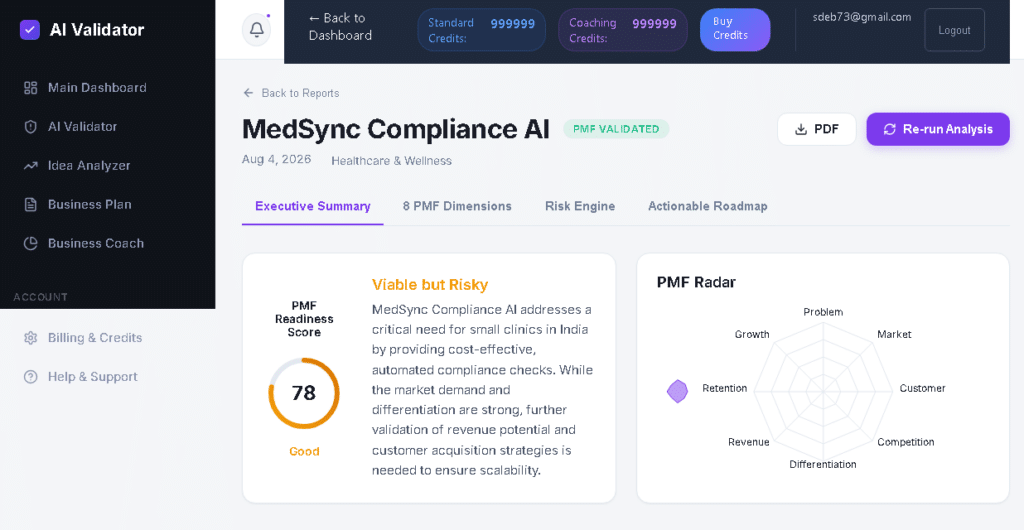
BizPlan AI Pro India goes further by combining engagement analysis with customer feedback synthesis. It identifies which features drive retention and which customer segments show highest lifetime value. This approach is best suited for founders who want AI-powered insights into their user behavior patterns. However, it is less ideal for teams already using specialized analytics platforms like Mixpanel or Amplitude, as integration requires additional setup. See the Bizplan AI Pro PMF analyzer :
Other options worth considering include Mailchimp for email-based engagement tracking and Coursera for understanding how educational products achieve stickiness. Each tool excels in specific contexts.
Analyzing Customer Feedback for Product Market Fit
Analyzing customer feedback to identify areas for improvement is not optional. It is the engine driving product market fit. Feedback reveals the gap between what you built and what customers need. This gap is where product market fit lives or dies.
Effective feedback collection happens across multiple channels:
- Direct interviews: One-on-one conversations with power users reveal unmet needs.
- Support tickets: Complaints and feature requests show friction points.
- User surveys: Quantified feedback from large cohorts identifies patterns.
- Usage analytics: Where users spend time shows what matters most.
- NPS scores: Net Promoter Score tracks willingness to recommend.
The pattern you are looking for: consistent feedback pointing to the same problem across different user segments. When 70% of users mention difficulty with onboarding, that is a signal. When power users consistently request the same feature, that is a signal. These signals guide product decisions.
Building a Feedback-Driven Culture
Product market fit requires organizational alignment around customer truth. Every team member, from engineering to sales, must understand customer pain points. Weekly feedback reviews keep the entire company focused on the same priorities.
Tools like Zendesk centralize customer communication. Mailchimp provides segmentation insights. BizPlan AI Pro India synthesizes this data into actionable recommendations. The combination creates a feedback loop that accelerates learning.
Consider also reviewing our guide on Startup Idea Validation For India to understand how validation feeds into product market fit achievement.
Reaching Product Market Fit: A Practical Roadmap
Product market fit is not discovered overnight. It is built through systematic iteration. The roadmap involves four distinct phases: hypothesis, testing, validation, and scaling.
Phase 1: Hypothesis Formation starts with identifying a specific customer problem. Not a vague problem like “productivity is hard.” A precise problem like “freelance designers waste 3 hours weekly on invoice management.” This specificity is critical. Vague problems lead to vague solutions that achieve no product market fit.
Phase 2: Minimum Viable Product (MVP) means building the smallest version that tests your core hypothesis. An MVP for the invoice problem might be a simple spreadsheet template, not a full SaaS platform. The goal is learning, not perfection.
Phase 3: Customer Feedback and Iteration involves releasing the MVP to real customers and listening closely. What did they love? What frustrated them? Which features did they ignore? This phase typically lasts 3-6 months and involves dozens of iterations.
Phase 4: Scaling with Confidence only begins when you have clear evidence of product market fit. At this point, you invest in marketing, hiring, and infrastructure. You have already proven the core hypothesis works.
Tools That Accelerate the Journey
ProductPlan helps visualize your roadmap and communicate priorities. BizPlan AI Pro India analyzes your customer data to identify which segments show strongest product market fit signals. Mailchimp automates customer communication at scale. Together, these tools compress the timeline to product market fit.
For businesses planning specific ventures, our resource on small business ideas provides context on how different markets approach product market fit differently.
Product Market Fit Across Different Business Models
Product market fit looks different depending on your business model. A B2B SaaS company measures it differently than a consumer marketplace or a physical product business.
B2B SaaS: Product market fit arrives when enterprise customers renew contracts without negotiation and expand usage across departments. Churn below 5% monthly is a strong signal. NPS scores above 50 indicate healthy product market fit.
Consumer Apps: Product market fit appears when daily active users grow 20%+ monthly without paid acquisition. Users open the app multiple times daily. Uninstall rates drop below 10% monthly.
Marketplaces: Product market fit means both supply and demand sides grow organically. Sellers want to list. Buyers want to purchase. Transaction volume doubles quarterly.
Physical Products: Product market fit shows up in repeat purchase rates above 30%. Customers recommend the product to friends. Social media mentions increase organically.
Each model requires different metrics. The underlying principle remains constant: customers love the product so much they cannot imagine life without it.
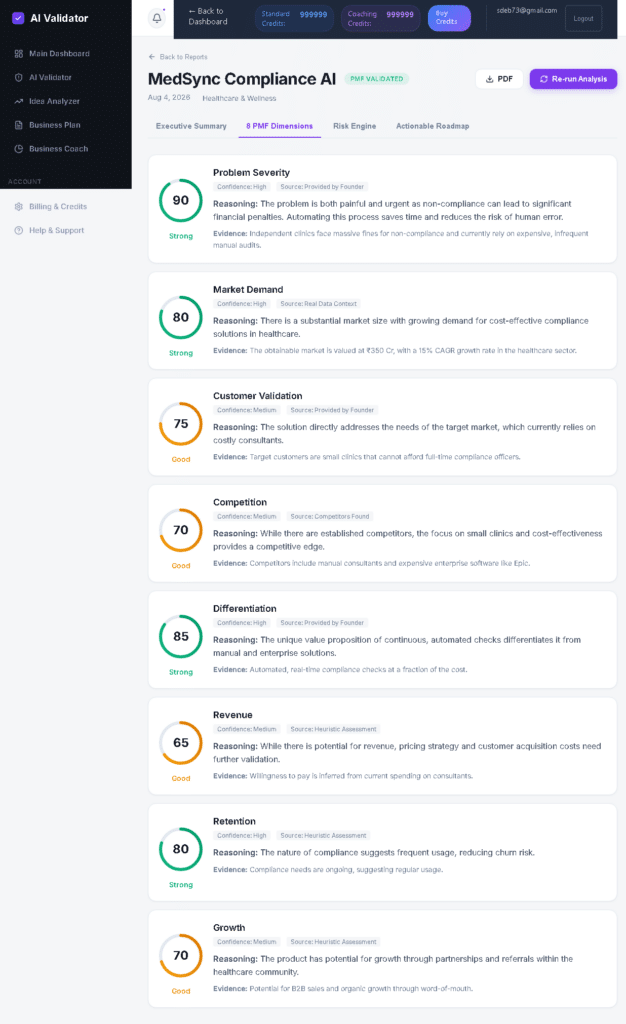
Comparison: How Different Tools Support Product Market Fit Analysis
| Tool | Best For | Key Strength | Limitation |
|---|---|---|---|
| BizPlan AI Pro India | Founders analyzing customer data for PMF signals | AI PMF Operating System | Best for early-stage startups; less suited for teams already using specialized analytics platforms |
| ProductPlan | Roadmap visualization and priority communication | Clear visual representation of product direction | Does not directly measure product market fit |
| Zendesk | Centralizing customer feedback and support | Comprehensive customer communication history | Requires manual analysis of feedback patterns |
| Mailchimp | Email engagement and customer segmentation | Automated customer communication at scale | Limited to email channel; misses in-app behavior |
| Coursera | Understanding educational product stickiness | Completion rates and learning outcomes tracking | Specialized for education; not applicable to other industries |
Frequently Asked Questions
What are the key indicators of product market fit?
The primary indicators include: customers willing to pay for the product, high retention rates, organic word-of-mouth growth, and customers loving and talking about the product. Additionally, when at least 40% of users report they would be “very disappointed” if the product disappeared, you have achieved a critical threshold. Support tickets shift from complaints to feature requests. Churn rates stabilize below industry benchmarks. These signals work together to confirm genuine product market fit.
How can I measure user engagement to determine product market fit?
Comparing user engagement metrics to industry benchmarks reveals your relative position. Track daily active users, session frequency, session duration, and feature adoption rates. Calculate retention cohorts: what percentage of users from month one remain active in month three, six, and twelve? Compare these numbers against companies in your industry. If your 90-day retention exceeds 60% while competitors average 40%, you have stronger product market fit signals. Use tools like BizPlan AI Pro India to automate this analysis and identify which customer segments show highest engagement.
How long does it typically take to achieve product market fit?
Time to reach product market fit can vary significantly across industries. B2B SaaS companies typically require 18-24 months. Consumer apps often achieve it in 6-12 months. Marketplace businesses need 12-18 months to balance supply and demand. Physical products may take 12-24 months. The timeline depends on market size, competition, and how quickly you iterate. Speed comes from rapid testing cycles and willingness to pivot based on customer feedback.
What is the difference between product market fit and product-solution fit?
Product-solution fit means your product solves a real problem. Product market fit means your product solves a real problem for a large enough market that you can build a sustainable business. You might have perfect product-solution fit with a tiny niche. Product market fit requires both the solution and a market large enough to matter. This distinction matters because it explains why some brilliant products fail: they solved the wrong problem or solved it for too small an audience.
Can a company have product market fit in one segment but not another?
Yes, absolutely. Many successful companies achieve product market fit in one customer segment first, then expand. Slack started with engineering teams. Notion began with individual note-takers. Airbnb focused initially on city travelers. Each company found strong product market fit in a narrow segment before expanding horizontally. This staged approach is actually preferable to trying to serve everyone simultaneously. Start narrow, achieve deep product market fit, then expand to adjacent segments.
Conclusion
Product market fit is not luck. It is the result of systematic customer understanding, rapid iteration, and honest measurement. In 2026, founders have better tools than ever to identify and validate product market fit. The 40% rule provides a clear threshold. Engagement metrics offer quantifiable signals. Customer feedback reveals the path forward.
The businesses that win are those that obsess over product market fit before scaling. They resist the temptation to hire massive sales teams or spend heavily on advertising. Instead, they focus on making customers love the product so deeply that growth becomes inevitable.
If you are building a business and want to accelerate your path to product market fit, BizPlan AI Pro India combines customer feedback analysis with engagement metrics to identify exactly where you stand. It synthesizes data that would take weeks to analyze manually, compressing your learning cycle. Whether you are validating an early-stage idea or optimizing an existing product, the platform provides the insights needed to move forward with confidence.
Start by surveying your users with the 40% question. Analyze your retention curves. Review your support tickets for patterns. Then use these insights to guide your next iteration. Product market fit is not a destination. It is a continuous practice of listening and building. Master this practice, and sustainable growth follows naturally.

R. Sharma is a senior startup advisor and business planning specialist at BizPlan AI Pro. With over a decade of experience in Indian corporate finance and MSME consulting, he has helped hundreds of founders structure financial projections and secure bank funding.