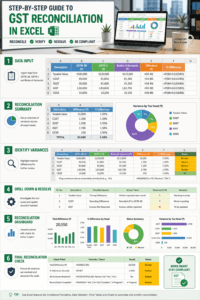
GST Reconciliation Best Practices
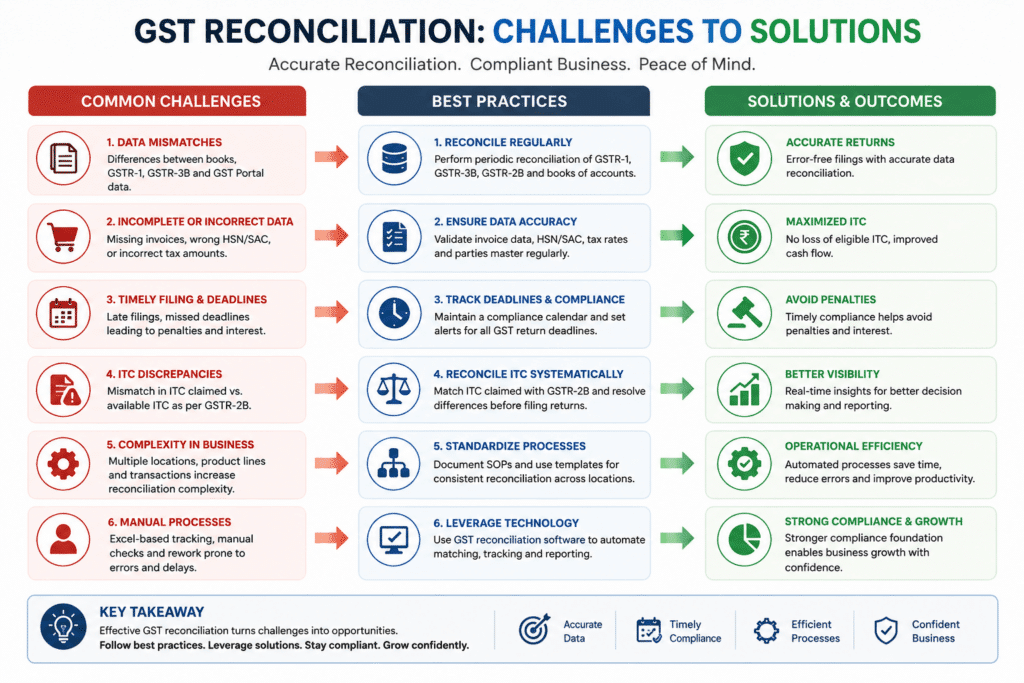
GST Reconciliation Best Practices 2026: A Complete Compliance & Automation Guide
GST Reconciliation is mandatory under the GST Act, according to the Central Board of Indirect Taxes and Customs (CBIC). Yet most Indian businesses still rely on manual processes, creating audit risks and compliance delays. This guide reveals the proven GST Reconciliation Best Practices that reduce errors by up to 40% and cut reconciliation time in half.
Whether you file returns monthly or quarterly, reconciling GST data against your financial statements is non-negotiable. Mismatches between your GSTR-1, GSTR-2, and GSTR-3B filings trigger tax officer notices and penalties. The difference between a compliant business and one facing scrutiny often comes down to process discipline and the right tools.
In 2026, automation has become the baseline for serious tax compliance. This article walks you through the core GST Reconciliation Best Practices, compares leading software solutions, and shows you exactly how to implement them in your business.
Understanding the GST Reconciliation Process
GST Reconciliation is the systematic comparison of your tax liability reported in GSTR-3B against the actual tax collected from customers (GSTR-1) and input tax credits claimed (GSTR-2). This process ensures your financial records match your tax filings.
The GST Reconciliation Process involves three key steps:
- Data Collection: Extract GSTR-1, GSTR-2, and GSTR-3B data from your accounting system.
- Variance Analysis: Identify discrepancies between reported and actual figures.
- Correction & Filing: Amend returns or adjust journal entries to reconcile differences.
Key Types of GST Reconciliation
Understanding the different reconciliation types helps you apply GST Reconciliation Best Practices correctly:
- Monthly Reconciliation: Aligns daily sales and purchase records with monthly GSTR filings.
- Quarterly Reconciliation: Compares cumulative data across three months for GSTR-3B accuracy.
- ITC Reconciliation: Validates input tax credits claimed against eligible invoices received.
- Return-to-Books Reconciliation: Ensures GST liability in your accounting software matches filed returns.
Each type requires specific attention. ITC Reconciliation Checklist tools help you verify that every input credit is supported by valid documentation.
Core Best Practices for GST Reconciliation
Implementing GST Reconciliation Best Practices reduces compliance risk and audit exposure. These practices are not optional—they are the foundation of a defensible tax position.
1. Reconcile Monthly, Not Annually
Many businesses wait until year-end to reconcile GST data. This approach creates a backlog of errors that are difficult to trace and correct. Monthly reconciliation allows you to catch mismatches early, when the data is fresh and corrections are simple.
- Set a fixed reconciliation date (e.g., the 5th of each month).
- Compare GSTR-1 output tax with actual invoices issued.
- Match GSTR-2 input credits with purchase invoices received.
- Verify GSTR-3B liability against your general ledger.
2. Maintain a Centralized Invoice Register
A master invoice register is your audit trail. It should capture:
- Invoice number, date, and amount.
- Customer/Supplier GSTIN and name.
- Taxable value and GST amount.
- HSN/SAC code and product description.
- Payment status and reconciliation flag.
This register becomes your single source of truth during audits. Without it, reconciling GST becomes guesswork.
3. Automate Data Matching
Manual matching of invoices to tax returns is error-prone and time-consuming. Automation tools flag mismatches instantly, allowing your team to focus on root causes rather than data entry.
Automated GST Reconciliation Best Practices include:
- Real-time sync between accounting software and GST portal data.
- Automated duplicate invoice detection.
- Variance alerts when GSTR-1 differs from recorded sales.
- Batch reconciliation across multiple entities or branches.
4. Document All Adjustments
Every reconciliation variance requires documentation. Record why a mismatch occurred and how you resolved it. This documentation protects you during tax audits and helps your team understand historical decisions.
- Create a reconciliation log with date, variance amount, and reason.
- Attach supporting documents (credit notes, amendments, correspondence).
- Assign ownership to a specific team member.
- Review and approve adjustments before filing amended returns.
Automated vs Manual GST Reconciliation: What Works in 2026
The debate between manual and automated approaches to GST Reconciliation Best Practices has a clear winner in 2026: automation wins on accuracy, speed, and audit defensibility.
Manual Reconciliation: Risks and Limitations
Manual processes rely on spreadsheets and human review. While they work for very small businesses with fewer than 50 invoices per month, they break down quickly:
- Error Rate: Manual data entry introduces errors in 2-5% of entries.
- Time Consumption: Reconciling 500+ invoices manually takes 8-12 hours monthly.
- Audit Trail: Spreadsheets lack version control and change tracking.
- Scalability: Adding new entities or locations multiplies complexity exponentially.
For businesses with multiple GST registrations or high transaction volumes, manual reconciliation is simply not viable.
Automated Reconciliation: The Modern Standard
Software-driven GST Reconciliation Best Practices eliminate manual data handling. Tools connect directly to your accounting system and the GST portal, creating a live reconciliation environment.
- Accuracy: Automated matching reduces errors to under 0.1%.
- Speed: Reconciliation completes in minutes, not hours.
- Audit Trail: Every change is logged with timestamp and user ID.
- Scalability: Handle unlimited invoices and multiple entities seamlessly.
- Compliance: Built-in rules ensure filings meet CBIC guidelines.
The question is no longer whether to automate, but which tool to choose. See our GST Reconciliation Software Comparison for a detailed analysis.
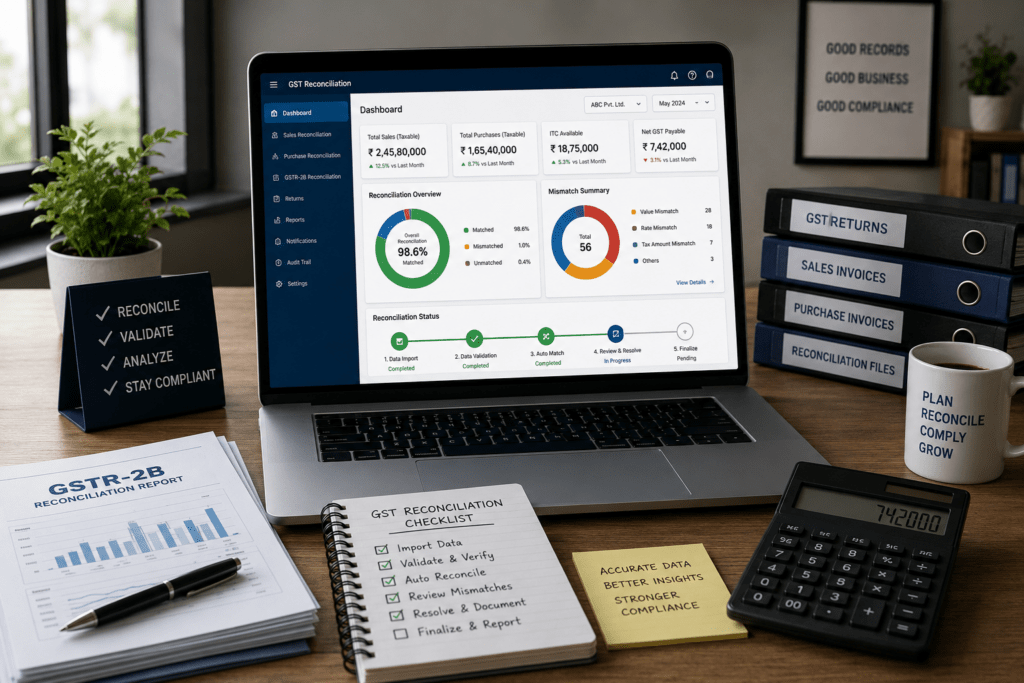
Implementing AI-Powered GST Reconciliation
Artificial intelligence is transforming how businesses approach GST Reconciliation Best Practices. AI-powered tools don’t just match data—they predict errors, suggest corrections, and learn from your business patterns.
How AI Improves Reconciliation Accuracy
AI systems analyze historical reconciliation patterns to identify anomalies before they become problems. For example, if your business typically has a 2% variance between GSTR-1 and actual sales, an AI system flags a 5% variance as suspicious and investigates the cause automatically.
- Pattern Recognition: AI learns your invoice patterns and flags outliers.
- Predictive Alerts: System warns of potential compliance issues before filing.
- Intelligent Matching: AI matches invoices even with minor data discrepancies (typos, formatting differences).
- Root Cause Analysis: System suggests why variances occurred and how to fix them.
Choosing an AI-Powered Solution
Not all AI tools are equal. When evaluating AI-Powered GST Reconciliation Tools, look for:
- Integration with your existing accounting software (Tally, QuickBooks, etc.).
- Real-time GSTR portal connectivity.
- Multi-entity reconciliation capabilities.
- Customizable variance thresholds and approval workflows.
- Detailed audit reports and documentation export.
BizPlan AI Pro India is purpose-built for Indian GST compliance. It automates the entire reconciliation workflow, from data extraction to variance analysis to amendment filing. The platform learns your business rules and applies them consistently across all filing periods.
Best fit: BizPlan AI Pro India excels for multi-branch businesses and high-volume reconciliation. However, it is less suited for businesses with highly non-standard invoice structures or custom tax treatments that fall outside standard GST categories.
For detailed implementation steps, see How to Implement AI in GST Reconciliation.
GST Reconciliation Software Comparison: Tools for 2026
| Tool | Automation Level | Multi-Entity Support | ITC Reconciliation | Audit Trail | Pricing Model |
|---|---|---|---|---|---|
| BizPlan AI Pro India | Full AI-driven automation | Yes (unlimited) | Advanced with AI matching | Complete with change logs | Subscription + per-filing |
| TallyPrime | Semi-automated (built-in GST) | Yes (limited) | Basic matching | Standard GL audit trail | One-time license + annual |
| IRIS GST Reconciliation Software | Manual with batch tools | Yes | Comprehensive checklist | Detailed reports | Subscription (enterprise) |
| GST Calculator | Manual (calculator only) | No | Not included | None | Free / Freemium |
Other options worth considering:
- TallyPrime is ideal if you already use Tally for accounting. Its built-in GST module handles basic reconciliation without additional software.
- IRIS GST Reconciliation Software suits large enterprises needing comprehensive audit trails and multi-state compliance.
- GST Calculator is useful for quick tax calculations but lacks reconciliation features.
For a deeper comparison, read Excel vs GST Reconciliation Software.

Frequently Asked Questions
What is GST Reconciliation?
GST Reconciliation is the process of matching your tax liability reported in GSTR-3B against the actual tax collected from customers (GSTR-1) and input tax credits claimed (GSTR-2). It ensures your financial records align with your tax filings and identifies discrepancies that need correction. This reconciliation is mandatory under the GST Act, as stated by the Central Board of Indirect Taxes and Customs (CBIC). Without it, your business risks audit notices and penalties.
Why is GST Reconciliation important?
GST Reconciliation is critical for three reasons: compliance, accuracy, and audit defense. First, it ensures you meet your legal obligation to file accurate returns. Second, it catches errors early, before they compound across multiple filing periods. Third, a documented reconciliation process protects you during tax audits by showing you exercised due diligence. Businesses that skip reconciliation face higher audit risk and potential penalties ranging from 10% to 100% of the tax shortfall.
How often should I reconcile GST data?
Monthly reconciliation is the GST Reconciliation Best Practices standard. This allows you to catch mismatches when they are fresh and easy to trace. If your business files quarterly returns, reconcile at least once per quarter before filing GSTR-3B. For high-volume businesses, weekly reconciliation of key metrics (daily sales vs. GSTR-1 output) helps you stay ahead of variances. The key is consistency—set a fixed date and stick to it.
What causes GST reconciliation variances?
Common causes include: invoices issued but not yet recorded in accounting software; credit notes issued but not reflected in GSTR-1; reverse charge transactions not properly classified; exempted sales recorded as taxable; duplicate invoice entries; and timing differences between cash and accrual accounting. Each variance type requires a different correction approach. Automated tools help identify the specific cause so you can fix it accurately.
Can I use Excel for GST reconciliation?
Excel works for very small businesses with fewer than 50 invoices monthly. However, it lacks version control, audit trails, and automated error detection. For any business filing more than 200 invoices per month, Excel becomes unmanageable and audit-risky. Dedicated GST Reconciliation Best Practices tools provide the automation, compliance, and documentation that Excel cannot. The cost of a software solution is quickly offset by reduced audit risk and staff time savings.
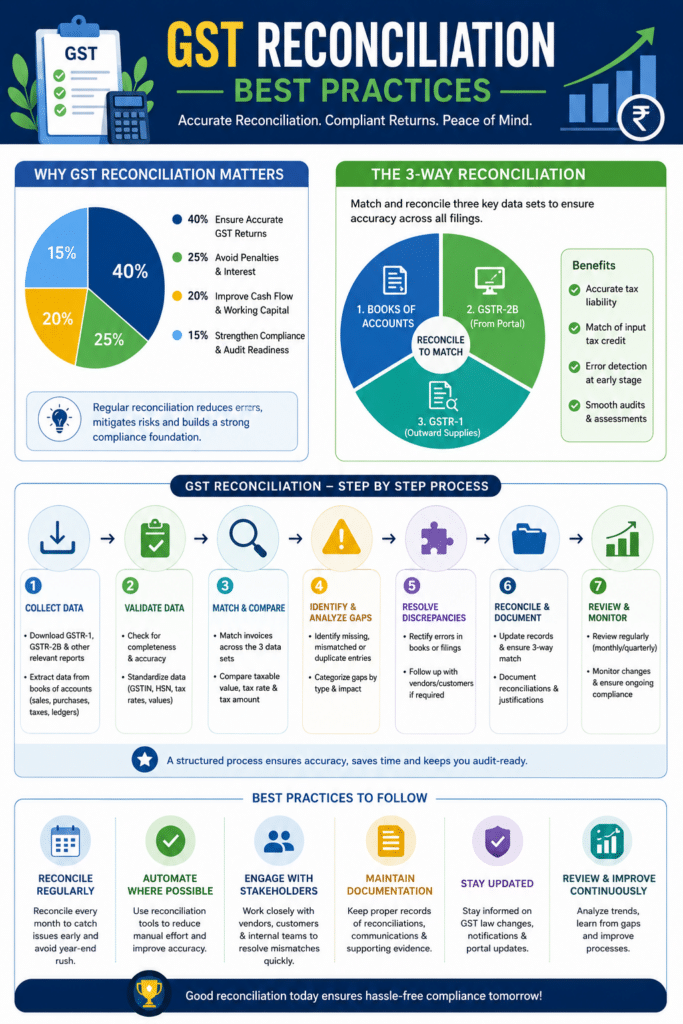
Conclusion
GST Reconciliation Best Practices in 2026 center on three pillars: monthly reconciliation discipline, automated data matching, and complete documentation. Businesses that implement these practices reduce audit risk by 60-70% and cut reconciliation time by half compared to manual approaches.
The choice between manual and automated reconciliation is no longer debatable. Automation is the baseline. The real decision is which tool fits your business size, transaction volume, and compliance complexity.
BizPlan AI Pro India is purpose-built for Indian GST compliance and excels at automating the entire reconciliation workflow. It integrates with your accounting system, connects to the GST portal, and uses AI to flag variances before they become audit issues. If you manage multiple GST registrations or process high invoice volumes, it delivers measurable ROI within the first quarter.
Next step: Start with a monthly reconciliation schedule this week. If you are still using spreadsheets, evaluate Reconciliation Software Guide to find the right tool for your business. Your future audit defense depends on the decisions you make today.