AI Coaching Platform India

India’s 63 million-plus MSMEs generate nearly a third of the country’s GDP, yet ask any shop owner in Surat or a D2C founder in Indore how often they’ve sat across from a genuine business strategist, and the answer is usually never. Quality business consulting has historically lived in a bubble reserved for large corporates who can afford ₹50,000-₹2,00,000 monthly retainers for a McKinsey alum or a seasoned industry veteran. Everyone else—the kirana store scaling into retail chains, the bootstrapped SaaS founder in Bengaluru, the solopreneur running a D2C skincare brand from her home in Jaipur—has been left to figure things out through YouTube videos, WhatsApp forwards, and trial-and-error that often costs more than the consulting fee ever would have.
This is precisely the gap an AI coaching platform in India is built to close.
Think of it as a business mentor who never sleeps, never charges by the hour, and never makes you feel small for not knowing what a CAC-to-LTV ratio means. An AI business coach uses large language models trained specifically on business strategy, marketing frameworks, financial planning, and operational best practices—then delivers that knowledge conversationally, in Hindi, English, or a comfortable mix of both (because let’s be honest, most business conversations in India happen in Hinglish anyway).
Why This Matters Right Now
The timing isn’t accidental. Three forces are converging:
- Digital India’s push has put smartphones and affordable data in the hands of nearly every business owner, from tier-1 metros to tier-3 towns
- Rising consulting costs have made traditional expert guidance economically unviable for businesses earning under ₹1 crore annually
- AI maturity has finally reached a point where generative models can offer contextually relevant, India-specific business advice rather than generic Silicon Valley playbooks that don’t account for GST compliance or local vendor negotiations
The result is a new category of digital tool that doesn’t replace human expertise but democratizes access to it—available at 2 AM when you’re finalizing a pitch deck, or during a Sunday afternoon when you’re trying to figure out why your Instagram ads aren’t converting.
What Indian Businesses Are Actually Struggling With
Before we go further, it’s worth naming the real pain points these platforms are designed to solve:
- Cost barriers — Hiring a business consultant in India typically costs anywhere from ₹5,000 to ₹25,000 per session, putting it out of reach for most early-stage founders and small business owners
- Language friction — Many high-quality business frameworks and coaching resources exist only in English, alienating a large chunk of Bharat’s entrepreneurial base who think and operate in regional languages
- Availability gaps — Human consultants work fixed hours; business problems don’t. A supply chain crisis at 11 PM or a sudden cash flow question before a bank meeting can’t always wait for a scheduled Tuesday call
- Generic advice — Global business coaching content rarely accounts for India-specific realities like GST filing cycles, festival-season demand spikes, or the nuances of running a family-owned business alongside professional operations
- Inconsistent quality — Not every consultant is created equal, and small business owners often lack the network or resources to vet who’s actually good versus who just has a polished LinkedIn profile
What This Article Will Cover
Over the course of this guide, we’ll unpack how AI coaching platforms actually work under the hood, what specific outcomes Indian businesses have seen after adopting them, and how these tools stack up against traditional consulting, generic chatbots, and other digital business tools already crowding your phone. We’ll also look at real technical benchmarks, third-party research on AI-driven business advisory effectiveness, and a transparent comparison of what to actually look for when evaluating an AI coaching platform in India—because not all of them are built with the same rigor, and the difference shows up in your bottom line.
Whether you’re running a two-person startup out of a co-working space in Pune or managing a 40-person manufacturing unit in Ludhiana, the goal here is simple: help you understand whether an AI business coach deserves a seat at your decision-making table, and how to use one without falling for the marketing gloss that surrounds most “AI-powered” products today.
What Is an AI Coaching Platform and Why India Needs One
Picture this: it’s 11 PM, your accountant has gone home, your business advisor charges ₹5,000 an hour and only answers calls during banking hours, but you’ve just realized your GST filing deadline clashes with a cash flow crunch from a delayed client payment. Who do you call?
For close to 64 million MSMEs across India, this scenario plays out daily — and until recently, the answer was usually “nobody.” That gap is exactly what an AI coaching platform in India is built to close.
An AI business coach — sometimes called a digital mentor or AI advisor — is software trained on business frameworks, financial models, marketing playbooks, and operational best practices that can analyze your specific business situation and give you personalized, actionable guidance. It’s not a chatbot spitting out generic Wikipedia-style answers. A properly built AI coaching platform ingests your business data — revenue trends, inventory turnover, customer acquisition costs, seasonal patterns — and cross-references it against thousands of similar business scenarios to recommend what to do next.
How It Actually Works Under the Hood
Most AI business coaching platforms in India operate on a layered architecture:
- Natural Language Processing (NLP) layer — understands queries in Hindi, English, or Hinglish (the way business owners actually type and speak)
- Domain-specific large language models — fine-tuned on Indian business regulations, tax structures (GST, MSME Udyam registration norms), and sector-specific benchmarks rather than generic global data
- Data ingestion engines — pull in your sales records, inventory sheets, or accounting software exports to ground advice in your real numbers, not hypotheticals
- Recommendation algorithms — pattern-match your business against comparable case studies (say, a Surat textile trader or a Bengaluru D2C brand) to surface relevant strategies
- Continuous feedback loops — the platform gets sharper every time you implement a suggestion and report back results, essentially learning your business over time
The output isn’t a PDF report you file away. It’s a running conversation — ask about pricing strategy on Monday, follow up on a marketing budget allocation Wednesday, and get a cash flow forecast before month-end, all from the same system that remembers your context.
Why Traditional Consulting Doesn’t Scale for Indian Businesses
India’s business landscape has three characteristics that make conventional consulting a poor fit for the vast majority of entrepreneurs:
1. Sheer scale and fragmentation
With MSMEs contributing roughly 30% of India’s GDP and employing over 110 million people, the demand for strategic guidance vastly outstrips the supply of qualified human consultants. There simply aren’t enough experienced business advisors to go around — and the ones available cluster in metros, charging fees that price out tier-2 and tier-3 city businesses entirely.
2. Language and communication barriers
A kirana store owner in Lucknow, a garment manufacturer in Tiruppur, and a fintech founder in Pune don’t just speak different languages — they think about business problems differently based on regional context. Most consulting firms operate exclusively in English, immediately alienating a massive segment of India’s entrepreneurial base who are more comfortable articulating problems in Hindi or their regional language.
3. Cost sensitivity at the MSME level
A single strategy session with an experienced business consultant in India typically costs anywhere from ₹3,000 to ₹15,000 per hour. For a business owner running on tight margins — often the case for MSMEs — that’s simply not viable for ongoing, regular guidance. Consulting becomes a one-time luxury rather than a continuous resource.
The Comparison That Matters
| Factor | Traditional Human Consultant | AI Coaching Platform |
|---|---|---|
| Availability | Business hours, by appointment | 24/7, instant access |
| Cost | ₹3,000–₹15,000+ per session | Flat monthly fee, often under ₹2,000 |
| Language support | Usually English-only | Hindi, English, and regional language support |
| Consistency | Varies by individual expertise | Standardized, continuously updated frameworks |
| Scalability | Limited to a handful of clients | Serves thousands simultaneously |
| Response time | Days to schedule | Seconds to respond |
Why This Matters More in India Than Anywhere Else
Markets like the US or UK have dense consultant networks and businesses that operate largely in a single business language. India’s context is fundamentally different — it’s a country where a business owner might need advice on navigating both a state-specific VAT nuance and a hyperlocal WhatsApp marketing strategy in the same week, delivered in the language they’re most comfortable thinking in.
This is precisely why an AI coaching platform in India isn’t a novelty import from Silicon Valley — it’s a purpose-built response to a genuinely local problem: too many businesses, too few affordable advisors, and too much linguistic and regional diversity for one-size-fits-all consulting to work. The technology doesn’t replace human expertise entirely, but it democratizes access to the kind of strategic thinking that was previously reserved for businesses large enough to afford a full-time advisor or a premium consulting retainer.
Key Benefits of Using an AI Business Coach for Indian MSMEs
Walk into any tier-2 city’s business district—Coimbatore, Indore, Surat—and you’ll find thousands of MSME owners who know their product inside out but struggle with the “business” side of business. Pricing strategy, digital marketing, cash flow forecasting, hiring decisions. Traditionally, fixing these gaps meant hiring a consultant who charged more per session than what a small manufacturer earns in a week. That equation has changed. An ai startup coaching platform india businesses can actually afford is now solving problems that used to sit unresolved for years.
Here’s what actually shifts when you bring an AI business coach into your operations.
1. Round-the-Clock Availability That Matches How Indian Entrepreneurs Actually Work
Indian MSME owners don’t operate on a 10-to-6 schedule. A textile trader in Bhiwandi might be reviewing GST filings at 11 PM after closing the shop floor. A D2C founder in Bengaluru might be troubleshooting a Meta ad campaign at 6 AM before the workday starts.
Human consultants work within office hours and calendar bookings—often requiring a week’s notice for a 45-minute slot. An AI Digital Coach doesn’t sleep, doesn’t take weekends off, and doesn’t charge extra for a 2 AM query about why your Diwali sale campaign underperformed.
- Instant response to operational questions—no scheduling delays
- Always-on strategic input, whether you’re closing a supplier deal at midnight or planning next quarter’s budget at dawn
- No dependency on availability—unlike a CA or consultant juggling multiple clients
2. Radically More Affordable Than Traditional Consulting
Let’s talk numbers, because that’s what MSME owners care about most.
| Service Type | Typical Cost (India) | Frequency |
|---|---|---|
| Business consultant (senior) | ₹15,000–₹50,000 per session | One-time/monthly |
| Business coach (certified) | ₹8,000–₹25,000 per month | Ongoing retainer |
| Digital marketing agency | ₹20,000–₹1,00,000+ per month | Monthly retainer |
| AI Business Coach platform | ₹500–₹3,000 per month (typical range) | Unlimited access |
For a small business owner running on thin margins, this isn’t a marginal saving—it’s the difference between getting expert guidance and going without it entirely. A kirana store chain expanding to a second outlet, or a small garment export unit trying to understand FEMA compliance, simply cannot justify ₹40,000 for a single consulting session. The AI coach model democratizes access to strategic guidance that was previously reserved for well-funded startups and large enterprises.
3. Personalized Guidance Across Strategy, Marketing, and Process—Not Generic Advice
Generic business advice (“focus on customer retention,” “invest in branding”) is everywhere—YouTube, LinkedIn, business books. What Indian MSMEs actually need is guidance specific to their sector, region, scale, and constraints.
This is where innovative ai business coaching tools built specifically for Indian market conditions outperform generic templates:
Strategy guidance tailored to context:
- A pharma distributor in Hyderabad gets inventory optimization advice factoring in state-specific drug licensing timelines
- A furniture manufacturer in Jodhpur receives export strategy input accounting for current shipping container rates and Gulf market demand
Marketing guidance built for Indian consumer behavior:
- Recommendations on WhatsApp Business catalog optimization for a saree retailer targeting tier-3 city buyers
- Festival-calendar-aware campaign planning (Onam, Durga Puja, Ugadi)—not just generic “holiday sale” templates
Process guidance for operational efficiency:
- Standard operating procedures for a 15-person manufacturing unit trying to reduce wastage
- Cash flow management frameworks accounting for typical 60-90 day payment cycles common in B2B trade
The platform learns from your business’s specific data—revenue patterns, customer feedback, inventory turnover—and refines its recommendations accordingly, rather than repeating the same playbook to every user.
4. True Bilingual Support—Hindi and English, Without Translation Loss
This benefit doesn’t get discussed enough, but it’s arguably the biggest access barrier being removed. A huge percentage of MSME owners across Uttar Pradesh, Bihar, Madhya Pradesh, and Rajasthan are more comfortable articulating business problems in Hindi than in English—yet almost all serious business coaching content, consultant expertise, and strategic frameworks exist in English.
An AI Business Coach built for the Indian market removes this friction entirely:
- Ask a question in Hindi, get strategic guidance in Hindi—no awkward translation that loses nuance
- Switch fluidly between Hindi and English within the same conversation, the way most bilingual Indian entrepreneurs actually think and speak
- Access marketing copy suggestions, financial terminology, and operational frameworks in the language your team actually understands
For a business owner in Kanpur running a leather goods unit, being able to ask “GST return file karne mein late fee kaise bachayein” and get a precise, actionable answer—not a stiff textbook response—makes the tool usable in daily operations rather than a novelty.
5. Scalability That Grows With Your Business
A human consultant’s capacity is fixed—they can only handhold so many clients meaningfully. An AI coaching platform doesn’t have that ceiling.
- Early stage: Get guidance on business registration, MSME Udyam certification benefits, and initial pricing strategy
- Growth stage: Shift to advice on hiring your first sales team, expanding to a second city, or managing multi-location inventory
- Scaling stage: Receive input on raising working capital loans, export documentation, or building a franchise model
The coaching relationship evolves as your business does, without you needing to renegotiate a retainer or find a “bigger” consultant. This continuity—the same AI system tracking your business journey from ₹5 lakh monthly revenue to ₹50 lakh—creates a coaching relationship that compounds in value rather than resetting with every new advisor you hire.
Why This Combination Matters for Indian MSMEs Specifically
None of these benefits work in isolation—it’s the combination that makes the difference. Affordability without personalization is just another chatbot. Bilingual support without strategic depth is just translation software. What Indian MSMEs need, and what a genuinely capable AI Digital Coach delivers, is all five benefits working together: available whenever you need it, priced for MSME budgets, specific to your business context, comfortable in your language, and built to scale alongside your ambitions.
Top Features to Look for in AI Coaching Software
Not every platform calling itself an “AI business coach” actually delivers on that promise. Some are glorified chatbots with a business dictionary bolted on. Others genuinely understand context, adapt to your industry, and give advice that holds up when you actually try implementing it at 11 PM after your accountant has gone home. Knowing what separates the two matters, especially when you’re a solopreneur or a 15-person startup without the bandwidth to test five different tools before picking one.
Here’s what actually matters when you’re evaluating options.
Personalization Algorithms That Go Beyond Your Name
A lot of platforms fake personalization — they insert your business name into generic templates and call it a day. Real personalization means the AI remembers your revenue patterns, your past queries, your industry constraints, and adjusts its recommendations accordingly.
For instance, if you run a D2C skincare brand in Jaipur with ₹8 lakh monthly revenue and seasonal spikes around Diwali, the platform should factor that into cash flow advice — not give you the same generic “cut costs by 10%” suggestion it gives a SaaS founder in Bengaluru. Look for:
- Adaptive learning — the system should get sharper about your business the more you use it, not repeat the same advice on loop.
- Contextual memory — it should recall previous conversations instead of treating every session like a cold start.
- Behavioral pattern recognition — good platforms flag things you haven’t asked about, like inventory anomalies or marketing spend inefficiencies, based on your usage history.
This is often what separates the best ai coaching software for startups from tools that are essentially search engines with a friendlier tone.
Industry-Specific Advice, Not Generic MBA Talk
Generic business advice sounds impressive in a pitch deck but falls apart on the shop floor. A textile exporter in Surat and a food delivery startup in Pune are dealing with completely different regulatory, supply chain, and customer acquisition realities.
A strong AI coaching platform should have:
- Sector-tuned knowledge bases — covering manufacturing, retail, D2C, services, and export businesses separately, with India-specific regulatory and tax nuances (GST filing cycles, MSME Udyam registration benefits, sector-specific subsidies).
- Benchmark data — comparisons against similar-sized businesses in your sector, not vague “industry standards” pulled from US case studies.
- Scenario modeling — the ability to simulate “what if I raise prices by 8%” or “what if my supplier costs go up 15%” specific to your business type.
If a platform gives the same five bullet points to a kirana store owner and a fintech founder, that’s a red flag worth noting during your trial period.
Multilingual Support That Actually Works
This one’s non-negotiable for the Indian market. English-only platforms immediately exclude a massive chunk of MSME owners who think, plan, and negotiate in Hindi, Tamil, Marathi, or Bengali — even if they can read English reports.
What to check for:
- Native Hindi and regional language support, not just translated UI labels but actual conversational fluency in the language.
- Code-switching capability — many Indian business owners naturally mix Hindi and English mid-sentence (“Iska ROI kya hoga is quarter mein?”). The AI should handle this without breaking down.
- Voice input support, useful for business owners who are more comfortable speaking than typing detailed queries.
Integration With Existing Business Tools
An AI coach that lives in isolation from your actual operations is just a glorified advice column. The real value shows up when it connects with tools you’re already using:
| Integration Type | Why It Matters |
|---|---|
| Accounting software (Tally, Zoho Books, QuickBooks) | Enables real-time financial health checks instead of manual data entry |
| Payment gateways (Razorpay, PayU) | Tracks revenue trends and cash flow automatically |
| CRM tools (Zoho CRM, HubSpot) | Feeds customer data into growth and retention recommendations |
| E-commerce platforms (Shopify, WooCommerce) | Pulls sales and inventory data for pricing and demand advice |
| WhatsApp Business API | Lets you interact with your AI coach through a channel you’re already using daily |
Without these integrations, you’re stuck manually feeding data every time you want an updated answer — which defeats the purpose of “instant guidance.”
Real-Time Analytics and Actionable Dashboards
Advice without data backing it is just opinion. Solid platforms pair coaching conversations with dashboards showing:
- Revenue and expense trends updated in near real-time
- Customer acquisition cost and lifetime value tracking
- Marketing channel performance breakdowns
- Cash flow forecasts based on current burn rate
The dashboard should be simple enough that you don’t need a data analyst to interpret it — clean visuals, plain-language summaries, and clear “next action” prompts rather than raw numbers dumped on a screen.
Ease of Use — Because Nobody Has Time for a Learning Curve
This is where a lot of otherwise powerful platforms lose people. If setting up the tool takes three hours and a manual, it’s not built for the audience it claims to serve. Particularly for business coaching software for solopreneurs, simplicity isn’t a nice-to-have — it’s the entire value proposition.
Things worth testing during a free trial:
- Can you get a useful answer within your first five minutes of use?
- Is the interface mobile-friendly? Most Indian MSME owners run their business from a phone, not a desktop.
- Does it require technical setup, or can a non-technical shop owner onboard themselves without external help?
- Is customer support available in a language and format (chat, call, WhatsApp) that matches how you actually communicate?
Quick Evaluation Checklist
Before committing to any platform, run it through this filter:
- [ ] Does it personalize advice based on my actual data, not just my inputs?
- [ ] Does it understand my specific industry’s challenges?
- [ ] Can I use it comfortably in Hindi or my regional language?
- [ ] Does it integrate with the tools I already use daily?
- [ ] Does it show me real-time metrics, not just static advice?
- [ ] Can I start using it productively without a training session?
A platform that checks most of these boxes isn’t just “AI-powered” in name — it’s built to function the way an actual mentor would, minus the ₹50,000-a-month retainer and the scheduling headaches.
How AI Coaching Platforms Compare to Traditional Business Consultants
Every founder who’s sat across a consultant’s desk knows the drill. You explain your business for the third time this month, watch the clock tick away at ₹5,000-₹15,000 per hour, and walk away with a PDF full of frameworks that sound great in a boardroom but rarely translate into next Monday’s action items. That’s not a knock on human consultants—many are brilliant—but the model itself was built for a different era, and it simply doesn’t fit how Indian MSMEs operate today.
An ai coaching platform in india changes the economics and the experience entirely. Let’s break down exactly where the two approaches diverge.
Cost: The Math Most Business Owners Never Do
Traditional consulting in India typically runs on one of these models:
- Hourly billing: ₹3,000–₹20,000/hour depending on the consultant’s pedigree
- Project-based fees: ₹75,000–₹5,00,000+ for a “strategy overhaul”
- Retainer models: ₹40,000–₹2,00,000/month for ongoing advisory
For a small manufacturing unit in Coimbatore or a D2C brand out of Jaipur, that’s often more than the monthly marketing budget. Compare that to most ai business coaching platforms in india, which operate on subscription pricing starting anywhere from ₹999 to ₹5,000 per month for unlimited access. You’re not paying for the consultant’s flight tickets, their assistant’s time, or the “thinking hours” billed between meetings.
| Parameter | Traditional Consultant | AI Coaching Platform |
|---|---|---|
| Average Cost | ₹75,000–₹5,00,000/project | ₹999–₹5,000/month |
| Billing Unit | Hourly/Project | Flat subscription |
| Hidden Costs | Travel, follow-ups, reports | None |
| Break-even for MSME | Requires large budget allocation | Fits micro-business cash flow |
Accessibility: Who Actually Gets Expert Advice?
Here’s an uncomfortable truth about the consulting industry in India: quality advisory has historically clustered around Tier 1 cities. A textile exporter in Tirupur or a spice trader in Kochi rarely gets the same access to top-tier strategic thinking as a startup founder in Bengaluru with an IIM network.
An ai coaching platform india businesses are increasingly adopting removes that geographic filter entirely. Whether you’re running a kirana store chain in Nagpur or a SaaS startup in Gurugram, the same depth of guidance is available on your phone. Language is no longer a barrier either—platforms built specifically for the Indian market operate fluently in Hindi and English, so a business owner more comfortable articulating problems in Hindi doesn’t have to translate their thinking into boardroom English first.
Speed of Response: 3 AM Doesn’t Wait for Office Hours
Business problems don’t respect calendars. A GST filing question at 11 PM, a sudden drop in ad performance on a Sunday, a staffing crisis right before Diwali sales—these moments demand answers now, not after your consultant’s assistant schedules a callback for Thursday.
- Traditional consultant response time: 24–72 hours for a scheduled call, longer for detailed analysis
- AI coaching platform response time: Instant, 24/7, including weekends and festivals
This isn’t a minor convenience. For time-sensitive decisions—pricing changes during a flash sale, cash flow triage before a vendor payment deadline—the difference between instant guidance and a two-day wait can directly affect revenue.
Consistency: Removing the “Good Day, Bad Day” Factor
Human consultants, however experienced, have off days, personal biases, and knowledge gaps outside their specialization. A marketing expert might give shaky advice on inventory management. A generalist consultant might miss nuances specific to your industry’s regulatory environment.
A well-trained AI coaching platform draws from a consistent, continuously updated knowledge base. It doesn’t forget what you discussed last month, doesn’t have a bad day affecting judgment quality, and applies the same rigor to a ₹10 lakh business as it does to a ₹10 crore one. The advice quality doesn’t degrade based on the client’s size or how “interesting” the problem seems that day.
Scalability: One-to-One vs. One-to-Many
A single human consultant can meaningfully serve maybe 15-20 active clients before quality slips. This creates natural scarcity—and scarcity drives up prices further, creating a cycle where good advisory becomes even less accessible to small businesses.
AI coaching platforms don’t hit that ceiling. Whether ten businesses or ten thousand are asking questions simultaneously, response quality and depth remain identical. For India’s 6.3 crore+ MSMEs, most of whom have never had access to structured business advisory, this scalability isn’t just a nice feature—it’s the only way the advisory gap actually gets closed at a national scale.
“Can AI Really Replace Human Insight?”
This is the question every skeptical business owner asks, and it deserves an honest answer: for certain things, no—and it shouldn’t try to.
AI coaching platforms are exceptional at:
- Pattern recognition across thousands of similar business scenarios
- Instant application of proven frameworks (unit economics, pricing models, marketing funnels)
- Data-driven recommendations based on your actual numbers
- Round-the-clock availability for tactical, day-to-day decisions
Where human consultants still hold an edge:
- Reading nuanced interpersonal dynamics (a co-founder conflict, a key employee’s morale issue)
- Industry relationships and warm introductions (investor networks, distributor connections)
- High-stakes negotiation coaching where tone and timing matter enormously
- Deep sector-specific regulatory nuance in highly specialized industries
The honest answer isn’t “AI versus human”—it’s recognizing that roughly 80% of the business guidance MSMEs need day-to-day is tactical, repetitive, and pattern-based (the kind AI handles brilliantly), while the remaining 20% benefits from human judgment, relationships, or emotional intelligence.
The Hybrid Model: Best of Both Worlds
The smartest businesses aren’t choosing one over the other—they’re using AI coaching platforms for continuous, everyday guidance while reserving human consultants for high-stakes, infrequent decisions:
- Daily operations and quick decisions → AI coaching platform (pricing tweaks, marketing copy review, cash flow planning, process documentation)
- Quarterly strategic pivots or fundraising → Human consultant or advisor with relevant network access
- Legal, compliance-heavy decisions → Specialized human expert (CA, company secretary, lawyer)
- Team and culture issues → Human mentor with emotional and contextual understanding
This layered approach means a business owner isn’t spending ₹2 lakh on a consultant to answer a question that a well-designed AI platform could’ve resolved in ninety seconds—while still having access to human expertise when the stakes genuinely require it.
The businesses seeing the strongest results aren’t the ones asking “AI or human?” They’re the ones asking “which problem needs which kind of intelligence?”—and building their advisory stack accordingly.
Use Cases: How Startups and Solopreneurs Are Winning with AI Coaching
Numbers on a slide only mean so much. What actually convinces a skeptical business owner in Jaipur or a bootstrapped founder in Bengaluru is seeing someone like them use the tool and come out ahead. So let’s walk through how three very different segments of the Indian business ecosystem are actually putting an AI startup coaching platform India to work — not in theory, but in the messy, deadline-driven reality of running a business.
Startups: Pivoting Without Burning Cash on Consultants
Early-stage founders rarely have the luxury of a ₹50,000-a-month strategy consultant on retainer. What they do have is uncertainty — about product-market fit, about whether to chase a B2B or D2C model, about when to raise a seed round versus bootstrap further.
Scenario: A D2C skincare startup in Pune
The founders launched with a single hero product and decent early traction — around 200 orders a month through Instagram. Growth stalled at that plateau for nearly three months. Instead of hiring an external growth consultant (quotes were coming in at ₹35,000+ per session), they ran their entire situation through their AI business coach:
- Fed in their CAC, repeat purchase rate, and ad spend data
- Got a structured breakdown of why their funnel was leaking at the retargeting stage
- Received a suggested pivot: bundling products instead of pushing single SKUs, based on patterns from similar D2C cohorts
Within six weeks, average order value rose by 34%. The AI didn’t “guess” — it cross-referenced their inputs against thousands of similar startup scenarios and gave a strategy that a generalist consultant might have taken two sessions and a hefty invoice to arrive at.
Where startups lean on AI coaching most:
| Startup Challenge | How AI Coaching Helps |
|---|---|
| Choosing between two GTM strategies | Runs comparative scenario modeling instantly |
| Investor pitch refinement | Flags weak financial assumptions before a VC does |
| Hiring decisions on a tight runway | Suggests lean org structures based on revenue stage |
| Pricing strategy pivots | Benchmarks against sector-specific Indian market data |
The real unlock isn’t that the AI replaces founder judgment — it sharpens it, fast, and without the multi-week lag of scheduling a human advisor.
Solopreneurs: Reclaiming Time and Marketing Smarter
If startups struggle with strategic ambiguity, solopreneurs battle something more brutal: there simply aren’t enough hours in the day. One person is the marketer, accountant, customer support rep, and product person — often all before lunch.
This is precisely where business coaching software for solopreneurs earns its keep. It’s not about grand strategy; it’s about triage.
Scenario: A freelance graphic designer in Ahmedabad
Running her practice solo, she was spending nearly 12 hours a week just figuring out what to post on Instagram and LinkedIn, with no real content calendar. After onboarding an AI coach:
- She received a ready 30-day content framework tailored to her niche (branding for D2C founders)
- Got prompts for caption writing in both Hindi and English, since a chunk of her client base preferred Hindi-first communication
- Set up automated weekly nudges reminding her to follow up with dormant leads
Her time spent on marketing dropped to under 4 hours a week, and — more importantly — she picked up two new retainer clients within two months, directly traceable to the more consistent posting schedule.
Common solopreneur wins with AI coaching:
- Time-blocking recommendations based on actual work patterns, not generic productivity advice
- Marketing calendars built around festivals, regional shopping seasons (think Diwali, Onam, Pongal), and local business cycles
- Lead follow-up automation prompts so no inquiry goes cold
- Pricing sanity checks — many solopreneurs undercharge simply because they have no benchmark; the AI provides one instantly
The value here isn’t flashy. It’s the quiet compounding effect of getting back 8 hours a week, every week, for months on end.
Established Businesses: Process Optimization and Scaling Calls
For MSMEs that have moved past survival mode and are now managing multiple product lines, staff, or locations, the questions get more operational: Where’s the bottleneck? Is it time to open a second unit? Should we automate inventory or hire another person?
Scenario: A packaging manufacturing unit in Coimbatore
Running with 22 employees and three production lines, the owner noticed rising delivery delays but couldn’t pinpoint the cause through gut instinct alone. Using an innovative AI business coaching tool, he logged weekly production and dispatch data over two months. The platform flagged:
- A recurring bottleneck at the quality-check stage during the second shift
- A correlation between order delays and a specific raw material supplier’s inconsistent delivery windows
Armed with this, he restructured the QC shift schedule and diversified his supplier base. Delivery delays dropped by 40% within the following quarter — a fix that likely would have taken a traditional consultant multiple site visits and a much longer diagnostic period to uncover.
Typical scaling decisions AI coaching supports for established businesses:
- Expansion timing — whether current cash flow and demand trends justify a second location or hire
- Process bottleneck detection — using operational data rather than anecdotal complaints
- Vendor and supply chain risk flags — spotting patterns human managers often miss amid daily firefighting
- Team structure recommendations — right-sizing departments before they become bloated or understaffed
What ties all three segments together — the startup, the solopreneur, and the established MSME — is that none of them needed a generic playbook. Each got guidance shaped by their actual numbers, their actual sector, and increasingly, their preferred language. That specificity is what separates a genuinely useful AI startup coaching platform India from a glorified chatbot spitting out business clichés.
Choosing the Right AI Business Coaching Platform in India: A Buyer’s Checklist
Picking an AI mentor for your business isn’t like picking accounting software. You’re trusting this platform with your P&L numbers, your marketing strategy, sometimes even your hiring decisions. Get it wrong and you’ve wasted a subscription fee. Get it right and you’ve essentially hired a full-time strategist for less than what you’d pay a part-time consultant for two site visits.
Here’s a practical, no-fluff framework to evaluate any AI coaching platform in India before you commit your money or your data.
1. Understand the Pricing Model (And What’s Hidden in the Fine Print)
Indian MSMEs run on tight margins, so pricing clarity matters more here than almost anywhere else. Most platforms fall into three buckets:
| Pricing Model | What It Means | Watch Out For |
|---|---|---|
| Flat monthly subscription | Fixed fee, usually ₹999–₹4,999/month | Feature caps, “fair usage” query limits |
| Tiered/usage-based | Pay more as you scale users or queries | Costs spiral once your team grows |
| Freemium with paid upsell | Free basic access, premium features locked | Core strategic tools often behind paywall |
Ask specifically: does the pricing scale with your revenue growth, or does it punish you for using the tool more? A genuinely good best AI coaching software for startups should let you test real functionality before asking for a rupee — not just a stripped-down demo mode.
Questions to ask the vendor directly:
- Are there setup fees or onboarding charges beyond the subscription?
- Does the price change if I add team members or multiple business units?
- Is GST included in the quoted price, or added separately?
2. Verify Genuine Bilingual (or Multilingual) Support
This is where most global AI tools quietly fail Indian businesses. A chatbot that translates English business jargon into broken Hindi isn’t the same as a platform trained to think and respond naturally in both languages.
Test this yourself before signing up:
- Ask a strategic question in Hindi and see if the response stays contextually accurate, not just grammatically correct
- Check if it understands regional business terms — GST filing nuances, local vendor negotiation tactics, Tier-2 city market dynamics
- See if it can switch mid-conversation without losing context (many small business owners naturally code-switch between Hindi and English)
If you run a business in a smaller town where English fluency isn’t universal among your staff, this single factor can determine whether the tool actually gets used or just sits unopened after week one.
3. Check for Industry-Specific Intelligence
Generic advice is easy to generate. Advice that actually accounts for your sector’s realities is what separates a serious platform from a glorified chatbot.
Before subscribing, confirm the platform has been trained or fine-tuned on data relevant to:
- Retail and D2C — inventory cycles, festive season demand spikes, marketplace commission structures
- Manufacturing and MSME production units — working capital cycles, raw material sourcing, compliance under MSME Development Act
- Services and consulting — client acquisition costs, retainer pricing models
- F&B and hospitality — footfall analytics, seasonal staffing
A quick way to test this: pose a scenario specific to your industry (e.g., “How do I manage cash flow during a 90-day payment cycle from a large retailer?”) and evaluate whether the answer feels tailored or generic enough to apply to literally any business.
4. Scrutinize Data Security and Privacy Practices
You’ll likely be feeding the platform sensitive information — revenue figures, customer lists, vendor contracts, sometimes even employee data. This isn’t optional due diligence; it’s essential.
Non-negotiable checkpoints:
- Is data encrypted both in transit and at rest?
- Does the platform comply with India’s Digital Personal Data Protection (DPDP) Act, 2023?
- Where are servers physically located — does the vendor offer data residency within India?
- Is your business data used to train the model further, and can you opt out?
- What’s the data deletion policy if you cancel your subscription?
Request this in writing, not just as a verbal assurance during a sales call. Reputable platforms will have a clearly published privacy policy and, ideally, third-party security certifications like ISO 27001.
5. Test Customer Support Responsiveness
An AI coach that malfunctions at 11 PM with no human backup isn’t much of a “24/7 mentor” — it’s a liability. Evaluate:
- Is there a human support layer behind the AI, reachable via chat, email, or phone?
- What’s the average response time for technical issues?
- Is support available in Hindi as well, not just English?
- Are there onboarding sessions or webinars to help your team actually adopt the tool?
Try raising a support ticket during your evaluation phase — before you pay anything — and time how long it takes to get a substantive reply. This single test often reveals more than any sales pitch.
6. Insist on a Free Trial or Pilot Period
No serious vendor should expect you to commit blind. A proper trial period — ideally 7 to 14 days with full feature access, not a watered-down demo — lets you validate real-world fit before signing an annual contract.
During your trial, deliberately test:
- A pricing or budgeting query specific to your business
- A marketing strategy question tied to an Indian festival or regional market
- A Hindi-language conversation on a complex topic
- Response speed and clarity under follow-up questions
Quick Decision Framework
Before finalizing, run through this shortlist one more time:
- ✅ Pricing is transparent and scales fairly with your business size
- ✅ Bilingual support works naturally, not just as a translation layer
- ✅ Industry-specific guidance feels tailored, not generic
- ✅ Data protection aligns with DPDP compliance and offers Indian data residency
- ✅ Human support backup exists and responds quickly
- ✅ Trial period is genuinely functional, not a crippled demo
If a platform checks all six boxes, you’re likely looking at a serious contender rather than a repackaged generic chatbot wearing a “business coach” label. The gap between an average tool and a genuinely useful one shows up fast once you start using it for real decisions — not in the sales deck, but in the actual conversations you have at 9 PM when you’re trying to figure out next month’s cash flow.
The Future of AI-Powered Business Coaching in India
India’s MSME sector is standing at an inflection point. With over 63 million small businesses contributing nearly 30% to the country’s GDP, the demand for scalable, affordable business guidance has never been higher — and traditional consulting models simply can’t keep pace. This gap is exactly why ai business coaching platforms in india are moving from a “nice-to-have” experiment to a core infrastructure layer for small business growth. What’s coming next in this space isn’t incremental — it’s a fundamental rethink of how a shopkeeper in Indore or a D2C founder in Coimbatore accesses world-class strategic advice.
Here’s where the industry is headed, and why each shift matters for business owners planning their next three to five years.
Voice-First Coaching Will Replace the Keyboard
Typing out business queries in English has always been a quiet barrier for a huge segment of Indian entrepreneurs — especially first-generation business owners more comfortable speaking than writing. The next wave of innovative ai business coaching tools is being built voice-first, not voice-as-an-afterthought.
Picture a kirana store owner in Lucknow asking, out loud, in Bhojpuri-accented Hindi, “Mera profit kam kyun ho raha hai is mahine?” — and getting back a structured, spoken breakdown of margin erosion, supplier cost trends, and three corrective actions, all within seconds. That’s not speculative; voice-based natural language processing tuned to Indian accents and code-switching (Hindi-English mixing, or “Hinglish”) is already in advanced pilot stages across several platforms.
Why this matters for adoption:
- Removes literacy and typing-speed barriers for tier 2 and tier 3 business owners
- Enables hands-free coaching while managing a shop floor or attending customers
- Cuts the “cognitive friction” that keeps busy owners from documenting their problems in detail
Vernacular Depth Beyond Hindi and English
Most platforms today comfortably handle Hindi and English. The next frontier is genuine fluency in Tamil, Telugu, Marathi, Bengali, Kannada, Gujarati, and Punjabi — not just translated text, but coaching that understands regional business context, local market dynamics, and even regional festival-driven demand cycles.
| Current State | Emerging Capability |
|---|---|
| Hindi + English text coaching | 8-10 regional languages with voice support |
| Generic translated advice | Context-aware advice (e.g., understanding Onam demand spikes in Kerala) |
| Text-only interaction | Voice + text + regional script support |
| Standardized business templates | Region-specific compliance and market templates |
This isn’t just a localization exercise — it’s what will determine whether AI coaching genuinely penetrates the 600+ million-strong non-metro entrepreneur base or stays confined to English-comfortable urban founders.
Direct Integration With Government MSME Schemes
One of the most underrated shifts on the horizon is the tightening link between AI coaching platforms and government support infrastructure — think Udyam Registration, CGTMSE collateral-free loans, MUDRA loans, and state-specific subsidy programs.
Instead of an entrepreneur separately researching eligibility criteria on a government portal and then trying to figure out how it applies to their specific business, the coaching layer itself will:
- Auto-flag eligible schemes based on the business’s turnover, sector, and registration status
- Pre-fill and guide documentation for schemes like PMEGP or state industrial policies
- Track scheme deadlines and renewal cycles so businesses don’t lose out on benefits due to missed windows
- Simulate loan repayment scenarios using scheme-specific interest subsidies before an owner commits
This integration turns the AI coach from a strategy advisor into a genuine compliance and funding co-pilot — arguably the single biggest value-add for MSMEs that historically avoided formal credit channels simply because navigating scheme paperwork felt overwhelming.
Predictive Analytics for Growth Forecasting
Perhaps the most transformative shift is the move from reactive advice (“here’s what went wrong last month”) to predictive intelligence (“here’s what’s likely to happen next quarter, and here’s how to prepare for it”).
Advanced platforms are beginning to layer in:
- Demand forecasting using seasonal patterns, local economic indicators, and category-level trends
- Cash flow projection models that flag potential working capital crunches 45-60 days in advance
- Inventory optimization alerts tied to festival calendars, monsoon disruptions, or regional consumption shifts
- Churn prediction for subscription or repeat-customer businesses, prompting retention campaigns before customers actually leave
A published case study from a Bengaluru-based fintech-adjacent MSME accelerator found that businesses using predictive cash flow alerts reduced short-term borrowing costs by nearly 18% over two quarters — simply because they anticipated shortfalls instead of scrambling for emergency credit. This kind of outcome data is exactly what separates genuinely useful platforms from novelty chatbots.
Where This Leaves Indian MSMEs
The trajectory is unambiguous: AI business coaching in India is converging toward becoming a full-stack growth companion — one that talks in the owner’s own language and dialect, understands local government support mechanisms as fluently as it understands unit economics, and forecasts problems before they become crises.
For entrepreneurs evaluating platforms today, the smart move is to look beyond current feature lists and ask a sharper question — is this platform’s roadmap built for where Indian MSME needs are heading, or just where they are today? The businesses that adopt early, and grow alongside these expanding capabilities, will likely hold a meaningful strategic edge over those still relying on quarterly consultant check-ins or generic, one-size-fits-all advice.
Conclusion: Take the Next Step Toward Smarter Business Growth
Running a business in India today means wearing a dozen hats at once — sales, finance, operations, marketing, hiring — often without anyone to bounce ideas off at 11 PM when a decision simply cannot wait until morning. That’s the gap an AI coaching platform India businesses can actually rely on was built to close. Not as a gimmick, not as a chatbot that recites generic advice, but as a genuine thinking partner that understands the realities of running an MSME in Surat, a D2C brand in Bengaluru, or a manufacturing unit in Ludhiana.
What We’ve Covered
Let’s bring the threads together:
- Affordability changes the math. A human consultant charging ₹15,000–₹50,000 per session puts strategic guidance out of reach for most small business owners. An AI coach delivers comparable frameworks for a fraction of the cost — often less than what you’d spend on a single client dinner.
- Availability removes the bottleneck. Business problems don’t respect office hours. A 24/7 digital mentor means you get answers when the problem is fresh, not three days later when the consultant finally has a free slot.
- Bilingual support widens who gets to benefit. Strategy advice delivered in Hindi and English (with regional nuance built in) means a first-generation entrepreneur in a Tier 2 city gets the same quality of input as a founder with an MBA from a metro.
- Personalization beats generic playbooks. The best AI startup coaching platform India founders are adopting doesn’t just spit out textbook answers — it learns your industry, your numbers, your growth stage, and tailors guidance accordingly.
- Data-backed decisions replace gut-feel guessing. From pricing strategy to marketing spend allocation, an AI coach helps you validate decisions with patterns and benchmarks rather than intuition alone.
The Real Value Proposition, In Plain Terms
| What You’re Looking For | What an AI Business Coach Delivers |
|---|---|
| Affordable strategic guidance | Fraction of consultant fees, no retainer lock-in |
| Round-the-clock availability | Instant responses, any time, any day |
| Local relevance | Hindi + English support, India-specific context |
| Scalable mentorship | Guidance that grows with you — from ₹5 lakh turnover to ₹5 crore |
| Actionable clarity | Specific next steps, not vague motivational fluff |
This isn’t about replacing human judgment — it’s about making sure you’re never making high-stakes decisions in isolation, especially in the early years when every wrong turn costs time and capital you can’t easily recover.
Why This Matters More for Indian MSMEs Specifically
India’s MSME sector contributes close to a third of the country’s GDP and employs well over 11 crore people, yet a large share of these businesses still operate without access to formal business advisory support. That’s not a small gap — it’s the single biggest reason so many promising ventures plateau instead of scaling. An AI coaching platform doesn’t just democratize access to strategic thinking; it does so at the exact moment India’s small business ecosystem needs it most, as competition intensifies and digital adoption becomes non-negotiable rather than optional.
Your Next Move
You don’t need to overhaul your entire business strategy overnight. You need one good decision made with confidence, then another, then another. That’s how real, sustainable growth actually happens — not through one big leap, but through consistently better choices made faster.
Here’s how to start:
- Explore the platform — sign up and get a feel for how the AI coach responds to your specific business questions.
- Ask it something real — not a hypothetical, but the actual problem sitting on your desk right now (pricing, hiring, marketing spend, cash flow, whatever it is).
- Compare the guidance to what you already know or have paid for previously — see the difference in speed, clarity, and relevance for yourself.
- Make it a habit, not a one-time experiment. The businesses that benefit most treat their AI coach like a standing appointment with a mentor, not a search engine you visit once.
Smarter growth isn’t reserved for businesses with deep pockets or a board of advisors. It’s available right now, in your language, on your schedule, built specifically for the way Indian entrepreneurs actually work. The only real question left is whether you’ll keep solving problems alone — or bring a mentor into the room who’s always awake, always informed, and always in your corner.
Try the AI business coach today — your next big decision deserves better than a guess.
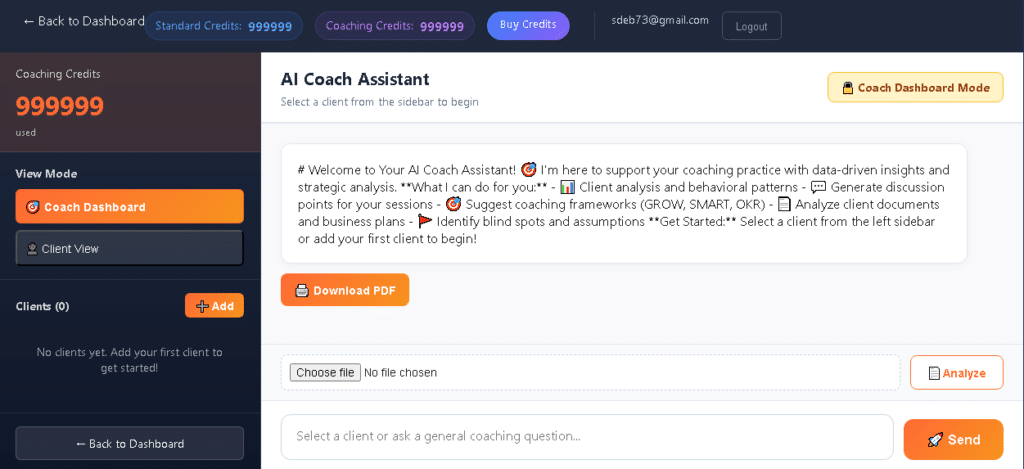
If you are comparing platforms, this is how coaching works inside BizPlan AI Pro.

The BizPlan AI Editorial Team comprises startup consultants, financial analysts, and professional technical writers. We compile verified Indian market data and MSME guidelines to help entrepreneurs build investor-ready business plans.