AI Business Coach

Walk into any small manufacturing unit in Ludhiana, a textile business in Surat, or a family-run trading firm in Coimbatore, and you’ll hear the same story with different names attached to it. The owner knows their product inside out. They understand their customers, their local market, their suppliers. What they don’t have is someone to turn to when a pricing decision keeps them up at night, or when a competitor suddenly undercuts them, or when they’re trying to figure out whether that new GST rule actually applies to their business model.
This is the reality for roughly 63 million MSMEs operating across India, contributing nearly 30% to the country’s GDP and employing over 110 million people. Yet the vast majority of these businesses run on instinct, word-of-mouth advice, and whatever the owner picked up from a cousin who did an MBA once. Professional business consulting exists, but it’s priced for companies with deep pockets — a decent strategy consultant in Mumbai or Bangalore can easily charge ₹15,000 to ₹50,000 per session, and that’s before you factor in the awkward reality that most consultants don’t understand the specific pressures of running a small business in Tier 2 or Tier 3 India.
So the guidance gap persists. A shop owner in Indore wants to know if she should expand her product line before Diwali. A young founder in Jaipur is stuck deciding between hiring a salesperson or investing that money in Instagram ads. A second-generation entrepreneur in Nagpur is trying to modernize his father’s hardware business without alienating loyal customers. None of them can justify flying in a consultant or waiting three weeks for an appointment with a business advisor who’s booked solid.
Enter the AI Business Coach
This is precisely the gap an AI business coach is built to close. Think of it as a digital mentor that never sleeps, never charges by the hour, and never makes you feel small for asking a “basic” question. It’s not a chatbot spitting out generic advice scraped from a Western business textbook — a genuinely useful AI coach India entrepreneurs can rely on needs to understand rupee-denominated budgets, regional market dynamics, festive season sales cycles, and the linguistic comfort of switching between Hindi and English mid-conversation, the way most business owners actually think and talk.
What makes this shift meaningful isn’t just the technology — it’s the accessibility. A digital business coach for Indian entrepreneurs removes the barriers that kept strategic guidance locked away for the privileged few: no appointment scheduling, no consulting retainer, no geographic limitation to metro cities. Whether you’re running a kirana store in a small town at 11 PM after closing up, or managing a growing D2C brand from a co-working space in Pune, the same caliber of strategic thinking is available on your phone.
What This Article Will Cover
Over the course of this piece, we’ll unpack:
- How AI business coaching actually works — the technology behind it and what separates a credible coaching tool from a glorified search engine
- Real, measurable outcomes from Indian entrepreneurs who’ve integrated AI coaching into how they run their businesses, including specific numbers on revenue growth, cost savings, and time saved
- Practical use cases across marketing, operations, financial planning, and hiring — the everyday decisions where an AI coach adds the most value
- How to evaluate and choose an AI business coaching platform that’s actually built for the Indian MSME context, rather than a repackaged global product
- The limitations — because no responsible discussion of AI coaching would be honest without addressing where human judgment still matters
The goal isn’t to convince you that AI replaces the wisdom of an experienced mentor or a trusted chartered accountant. It’s to show you how this technology has matured into something that genuinely levels the playing field — giving the neighborhood entrepreneur the same quality of strategic input that was once reserved for businesses with a consulting budget.
What is an AI Business Coach?
Picture this: it’s 11:47 PM, your GST filing deadline is in three days, and you’re staring at a pricing decision that could make or break your quarter’s cash flow. Your chartered accountant is asleep. Your mentor from that industry association is traveling. This is exactly the gap an AI business coach was built to fill.
An AI business coach is a software-driven mentorship system that uses natural language processing, machine learning, and business data analytics to deliver strategic guidance the way a seasoned consultant would — except it’s available at 2 AM on a Tuesday, costs a fraction of a retainer fee, and never gets tired of your questions about working capital cycles.
Think of it less like a chatbot spitting out generic advice, and more like a digital mentor that’s read every business framework, absorbed thousands of case studies, and learned to apply them contextually to your specific situation — whether you run a textile unit in Surat, a D2C skincare brand in Bengaluru, or a family-owned hardware business in Indore that’s trying to go digital for the first time.
The Technology Stack Behind the Coaching Experience
Most people assume “AI coach” just means a fancier version of Google search. It’s considerably more layered than that. Here’s what’s actually running under the hood:
| Technology | What It Does | Why It Matters for MSMEs |
|---|---|---|
| Natural Language Processing (NLP) | Understands queries typed in Hindi, English, or Hinglish — including informal phrasing and business jargon | You can ask “mera margin kam ho raha hai, kya karu?” and get a coherent, structured answer, not a broken translation |
| Machine Learning Models | Learns from patterns across thousands of business scenarios, sector benchmarks, and outcome data | Recommendations improve over time and adapt to your specific business stage — early-stage vs. scaling vs. mature |
| Business Data Analytics | Processes your inputs (revenue trends, expense ratios, customer acquisition costs) to generate context-specific insights | Advice isn’t generic — it’s calibrated to your actual numbers, not industry averages pulled from a textbook |
| Conversational AI Architecture | Maintains context across a session so the coaching feels continuous rather than a series of disconnected Q&As | You don’t have to re-explain your business every time you ask a follow-up question |
Together, these systems allow a genuine ai coaching platform in India to simulate something that used to require a room full of consultants: personalized, data-backed mentorship, delivered instantly, in the language you’re most comfortable thinking in.
How It Differs From Traditional Business Consulting
This is where most entrepreneurs get skeptical, and rightly so. A human consultant brings intuition, relationship experience, and industry-specific gut instinct that’s hard to replicate. But traditional consulting comes with baggage that doesn’t suit most Indian MSMEs:
- Cost barrier — A mid-tier business consultant in India typically charges anywhere from ₹5,000 to ₹25,000+ per session, with retainer models running into lakhs annually. An ai business coaching assistant operates at a fraction of this — often as a monthly subscription that costs less than a single consulting hour.
- Availability constraints — Consultants work in scheduled slots. A business problem doesn’t wait for Monday 11 AM. AI coaching is available the moment the anxiety hits — whether that’s during a festival-season inventory crunch or a midnight pricing dilemma.
- Scalability of attention — A human consultant can realistically manage a limited number of serious clients at once. An AI coaching platform serves lakhs of businesses simultaneously, each getting individually tailored responses without a drop in quality.
- Bias and generic templates — Many consultants unconsciously apply frameworks designed for larger corporations onto small businesses, because that’s what their training covered. AI systems trained specifically on MSME data patterns — GST compliance struggles, seasonal cash flow issues, family business dynamics — tend to give more grounded, applicable advice.
- Language and comfort — A large share of India’s business owners think and strategize in Hindi or regional languages, even if they operate in English-dominant markets. Traditional consulting rarely accommodates this fluidly; AI coaching, built with bilingual NLP, does.
To be clear, this isn’t a claim that AI replaces human judgment entirely — particularly for high-stakes legal or deeply relational decisions. What it does replace is the friction, cost, and delay that keeps most small business owners from getting any strategic guidance at all.
How Personalized Mentorship Happens “At Scale”
The phrase “personalized mentorship at scale” sounds like a contradiction — mentorship is supposed to be one-on-one, deeply human. Here’s how AI systems actually pull it off:
- Intake and context-building — The system asks structured questions about your business (sector, revenue stage, team size, biggest current challenge) rather than giving cookie-cutter responses.
- Pattern matching against real business outcomes — Your situation gets cross-referenced against thousands of similar scenarios, drawing on what’s actually worked for comparable Indian businesses.
- Iterative refinement — As you interact more, the coaching sharpens. Ask about your marketing funnel today, follow up about hiring next week — the system retains context and builds a fuller picture of your business over time.
- Actionable output, not theory — A good ai business coaching interaction ends with a next step: a pricing formula to test, a WhatsApp marketing script to try, a cash flow projection template — not just abstract advice about “focusing on growth.”
This is fundamentally different from generic AI chatbots that answer in vague platitudes. A purpose-built business coaching assistant is trained specifically on entrepreneurship, finance, marketing, and operations data — with an added layer of localization for Indian tax structures, MSME registration nuances, and regional market behavior that a general-purpose AI simply wasn’t designed to handle.
How Does AI Business Coaching Work?
If you’ve ever wondered how does AI business coaching work behind the scenes, the honest answer is: it’s part data science, part behavioural psychology, and part good old business strategy — all stitched together to feel like a conversation with a mentor who never sleeps.
Unlike a human consultant who meets you once a month and forgets half your context by the next session, an AI business coaching tool builds a living profile of your business that gets sharper every single day. Let’s break down exactly what happens under the hood, from the moment you sign up to the moment you’re making decisions based on real-time insights.
Step 1: Onboarding — Teaching the AI About Your Business
The process starts with a structured onboarding flow, usually taking 15-20 minutes, where the platform collects:
- Business fundamentals — industry, GST turnover slab, team size, and location (a kirana store in Indore has very different growth levers than a D2C brand shipping pan-India from Bengaluru)
- Current goals — whether it’s increasing monthly recurring revenue, reducing customer acquisition cost, or simply organizing cash flow
- Existing pain points — inventory mismanagement, inconsistent lead generation, delayed payments from clients, or founder burnout
- Language preference — Hindi, English, or Hinglish, since most MSME owners think and strategize in their comfort language, not boardroom English
This onboarding isn’t a one-time form-fill. It’s the foundation the AI uses to calibrate every future recommendation. Think of it as the same discovery call a ₹50,000-a-month consultant would charge you for — except it’s instant and free of judgment.
Step 2: Data Input — Feeding the Engine
Once onboarded, the real magic starts with continuous data input. This is where most people asking “how to use AI in business coaching” get it wrong — they treat it as a one-time chatbot instead of an evolving system. The more data you feed it, the more precise it gets.
Typical data sources include:
| Data Type | Examples | What It Reveals |
|---|---|---|
| Sales & Revenue | Daily/monthly billing, invoice data | Growth trends, seasonal dips |
| Marketing Metrics | Ad spend, website traffic, social engagement | Which channels actually convert |
| Financial Records | GST filings, expense sheets, payment cycles | Cash flow health, margin leaks |
| Customer Data | Repeat purchase rate, churn, feedback | Retention risks, upsell opportunities |
| Team & Ops | Attendance, productivity logs, SOP adherence | Bottlenecks in delivery or service |
Businesses can typically upload this via simple spreadsheet imports, integrations with tools like Tally, Zoho, or Shopify, or by just answering guided questions in plain language — no technical know-how required.
Step 3: Personalized Recommendations — Where Strategy Meets Data
This is the part that actually earns the “coach” in AI business coach. Once the system has enough data, it doesn’t just spit out generic advice like “increase your marketing budget.” It cross-references:
- Your specific numbers (say, a 22% cart abandonment rate for a Jaipur-based fashion brand)
- Market trends relevant to your industry and region
- Successful patterns pulled from thousands of similar Indian MSMEs already on the platform
- Your stated goals and constraints (limited budget, small team, festive season targets)
The output looks less like a chatbot response and more like a consultant’s report — but delivered in seconds. For example, instead of “improve customer retention,” it might say:
“Your repeat purchase rate dropped 14% after Diwali. Customers who bought sarees in October haven’t returned. Consider a WhatsApp re-engagement campaign with a 10% loyalty discount — similar strategies increased 30-day retention by 18% for comparable apparel businesses on this platform.”
That’s specificity a generic Google search or a one-size-fits-all course simply cannot give you.
Step 4: Continuous Learning Loops — Getting Smarter With Every Interaction
Here’s what separates a genuine AI business coaching tool from a static advice generator: feedback loops. Every time you implement a suggestion, mark it as done, ignore it, or report the result, the AI updates its understanding of what works specifically for your business.
This creates a compounding effect:
- Week 1: AI suggests three pricing tweaks based on competitor data
- Week 3: You report a 9% increase in average order value from one suggestion
- Week 4: The AI doubles down on that pricing strategy and layers in a complementary bundling tactic
- Month 3: Recommendations are now hyper-tailored, informed by your actual results — not just industry averages
Over time, this learning loop means the coaching becomes less generic and more like a strategist who’s been embedded in your business for months, minus the salary or equity ask.
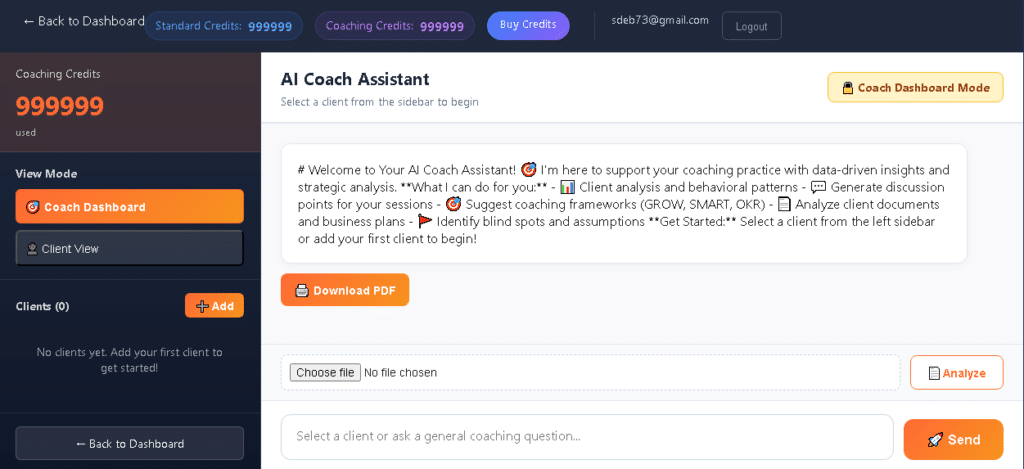
The Technology Stack Behind the Scenes (Simplified)
For the curious, here’s roughly how the pieces fit together without getting too technical:
- Natural Language Processing (NLP) — allows you to type or speak in Hindi, English, or Hinglish and get responses in the same
- Machine Learning Models — trained on aggregated, anonymized data patterns from thousands of Indian small businesses to spot what actually drives growth
- Predictive Analytics — forecasts cash flow crunches, festive season demand spikes, or inventory shortages before they hit
- Recommendation Engines — similar to what powers Netflix or Amazon suggestions, except tuned for business strategy instead of movies
Why This Matters More Than It Sounds
A study among MSME users on AI-based advisory platforms found that businesses acting on data-backed recommendations saw measurable improvement within 60-90 days — a timeline that would typically take a traditional consultant three to four paid sessions to even diagnose, let alone solve.
The entire mechanism — onboarding, data input, personalized recommendations, and continuous learning — is designed to mimic (and in speed, outperform) what a skilled human business coach does, minus the retainer fees running into lakhs annually.
Why Indian MSMEs Need AI-Powered Business Coaching
Walk into any small manufacturing unit in Coimbatore, a textile shop in Surat, or a D2C startup operating out of a spare bedroom in Indore, and you’ll hear the same frustration on repeat: “We know we need better strategy, but who has the time or money to figure this out?”
This isn’t a small problem. India has over 6.3 crore MSMEs, contributing nearly 30% to the country’s GDP and employing more than 11 crore people. Yet a shocking number of these businesses hit a growth ceiling not because their products or services are weak, but because they simply don’t have access to the strategic guidance that larger companies take for granted.
The gap isn’t talent. It’s access.
The Real Barriers Holding Back Indian Small Businesses
Most conversations about MSME growth focus on funding gaps — and yes, that’s real. But talk to actual business owners, and three other problems surface just as often, if not more.
1. The Cost of Good Advice Is Simply Out of Reach
A decent management consultant in Mumbai or Bengaluru charges anywhere between ₹15,000 to ₹50,000 per session. Retainer-based business coaching packages often run into ₹2-5 lakh for a few months of engagement. For a kirana store owner scaling into wholesale, or a small garment exporter in Tirupur trying to crack e-commerce, that kind of spend simply doesn’t make financial sense — even if the advice would genuinely help.
This is precisely where affordable business coaching in India using AI changes the equation. Instead of paying lakhs for quarterly check-ins with a consultant, business owners get continuous, on-demand guidance for a fraction of the cost — often less than what they’d spend on a single dinner meeting with a consultant.
2. Quality Mentorship Doesn’t Reach Tier 2 and Tier 3 Cities
Here’s an uncomfortable truth: most experienced business consultants, mentors, and industry veterans cluster around Delhi NCR, Mumbai, Bengaluru, and Pune. A first-generation entrepreneur running a manufacturing unit in Jamshedpur or a food processing business in Nagpur doesn’t have the same access to seasoned mentors that a startup founder in Koramangala does.
Industry bodies and government schemes like MSME-DFO try to bridge this, but the ratio of available mentors to the sheer number of small businesses is nowhere close to sufficient. A 24/7 AI coach doesn’t care about your pin code. Whether you’re in Guwahati or Gurugram, the guidance is identical in quality and instantly available.
3. Language Isn’t Just a Barrier — It’s a Wall
A huge percentage of India’s MSME owners are far more comfortable articulating their business problems in Hindi, or a mix of Hindi and English, than in polished corporate English. Most business coaching content, courses, and consultants operate almost exclusively in English, which unintentionally excludes a massive segment of capable, ambitious entrepreneurs.
An AI business coach that operates fluently in both Hindi and English isn’t a nice-to-have feature — it’s what makes the guidance usable in the first place for lakhs of business owners who’ve been priced out of the conversation, linguistically speaking.
How the Old Model Compares to AI-Powered Coaching
| Factor | Traditional Business Consultant | AI Business Coach |
|---|---|---|
| Average Cost | ₹15,000–₹50,000 per session | Fraction of the cost, often subscription-based at a few hundred rupees/month |
| Availability | Limited to scheduled hours | Available 24/7, including late nights and weekends |
| Geographic Reach | Concentrated in metros | Equally accessible in tier 2/3 cities and rural India |
| Language Support | Mostly English-only | Hindi and English, adapting to how you naturally communicate |
| Response Time | Days to weeks for scheduling | Instant, real-time guidance |
| Consistency | Varies by individual expertise | Standardized frameworks backed by data across thousands of businesses |
Why This Matters for Indian MSME Business Growth Strategies
Growth for a small business rarely comes from one big idea — it comes from consistently making better decisions on pricing, cash flow, marketing spend, hiring, and customer retention. Most MSME owners are wearing five hats at once: sales, accounting, operations, HR, and strategy — often without formal training in any of them.
An AI coach acts like a strategic thinking partner that’s always switched on. It helps owners:
- Pressure-test decisions before committing capital — should you expand to a second location or double down on your existing one?
- Understand local market dynamics using region-specific context rather than generic, one-size-fits-all business advice built for Western markets.
- Build structured growth plans instead of relying purely on gut instinct, which — while valuable — only takes a business so far.
- Get marketing and pricing frameworks tailored to Indian consumer behavior, GST implications, and regional competition.
This is also reshaping how the coaching and consulting industry itself operates. AI for coaches and consultants isn’t replacing human expertise — it’s amplifying it. Independent business coaches and MSME consultants across India are increasingly using AI tools to handle routine strategic queries, freeing themselves up for higher-value, relationship-driven engagements. It’s a shift that benefits everyone: coaches scale their impact beyond their personal bandwidth, and business owners get faster answers without waiting for the next scheduled call.
The Bottom Line
Indian MSMEs don’t lack ambition or hard work — anyone who’s watched a family-run business grow across two generations knows that. What’s been missing is consistent, affordable, and culturally attuned strategic guidance that meets business owners where they are, in the language they think in, at a price point that doesn’t require a second mortgage.
AI-powered business coaching isn’t a replacement for human wisdom and experience. It’s the bridge that finally makes that wisdom accessible to the crores of small business owners who’ve been waiting for it.
Key Benefits of Using an AI Business Coach
Ask any small business owner in India what stops them from getting proper business guidance, and you’ll hear the same two words over and over: time and money. A good management consultant in Mumbai or Bangalore charges anywhere between ₹15,000 to ₹50,000 per session, and that’s before you factor in the fact that they’re booked for weeks. Meanwhile, your inventory problem or pricing confusion needs solving tonight, not after Diwali.
This is exactly the gap an AI business mentor for small businesses in India is built to fill. Let’s break down why thousands of MSME owners are quietly switching from “maybe I’ll consult someone” to “let me just ask my AI coach” — and what that actually means for your bottom line.
1. Always-On Availability — Because Business Problems Don’t Keep Office Hours
A textile trader in Surat closing his books at 11 PM doesn’t need to wait until Monday morning to figure out why his margins dropped. A Kirana store owner in Indore trying to plan GST filing on a Sunday shouldn’t have to sit on a question until his CA’s office reopens.
- No appointment scheduling — get strategic input the moment a decision needs to be made
- Works across time zones — useful if you’re dealing with NRI clients or export orders from the US/Europe
- Handles urgent, small queries that wouldn’t justify a paid consultant’s time anyway (e.g., “Should I offer a 5% discount on bulk orders this festive season?”)
Human consultants sleep, take weekends off, and go on leave. An AI coach doesn’t — and for a business owner already wearing five hats, that kind of relentless availability changes how quickly problems actually get solved.
2. Radically Lower Cost Than Traditional Consulting
Here’s a comparison that puts things in perspective for most Indian MSMEs:
| Service Type | Typical Cost (India) | Availability | Personalization |
|---|---|---|---|
| Traditional Business Consultant | ₹15,000 – ₹50,000/session | Scheduled, limited hours | High, but slow to iterate |
| Business Coaching Programs/Workshops | ₹25,000 – ₹1,00,000+ (per course) | Fixed schedule, batch-based | Generic, one-size-fits-all |
| AI Business Coach | ₹500 – ₹3,000/month (subscription-based) | 24/7, instant | High, continuously adapting |
For a business doing ₹5–10 lakh in monthly revenue, spending ₹40,000 on a single consulting session simply isn’t viable math. An AI-driven alternative brings expert-level frameworks — pricing strategy, cash flow modeling, marketing funnels — into a subscription that costs less than what most shopkeepers spend on their monthly electricity bill. This is really the crux of the importance of AI in small business coaching for a market as price-sensitive and volume-driven as India’s MSME sector.
3. Bilingual Support That Actually Understands Business Context (Hindi + English)
Anyone who’s tried explaining a nuanced business problem in English when they think in Hindi knows the friction it creates. A lot of consulting and coaching content in India is built for English-first, metro-based founders — leaving out the vast majority of tier 2 and tier 3 business owners who are more comfortable thinking through problems in their mother tongue.
A properly built AI coach flips this:
- Ask a question in Hindi, get a strategically sound answer in Hindi — not a robotic translation
- Switch mid-conversation between Hindi and English without losing context
- Business terms (जैसे मार्जिन, कैश फ्लो, वर्किंग कैपिटल) are explained in a way that matches how Indian entrepreneurs actually talk about money and operations
This isn’t a translation gimmick — it’s what separates a generic global AI tool from a personalized AI business mentor India–based founders can genuinely rely on for day-to-day decisions.
Testimonial: “I run a small packaging unit in Ludhiana. My English is theek-thaak, but when I’m stressed about a vendor payment issue, I think faster in Hindi. Having a coach that replies in Hindi with real numbers and options — not just encouragement — saved me from a bad decision on a bulk order last quarter.” — Rajinder S., Packaging Unit Owner, Ludhiana
4. Data-Driven Decisions Instead of Gut-Feel Guesses
Most small business decisions in India are still made on instinct — “मेरे को लगता है यह चलेगा” (I feel like this will work). That instinct isn’t wrong, but it’s incomplete without numbers backing it up.
An AI business coach pulls from your actual inputs — sales trends, expense patterns, customer behavior, seasonal demand — and gives recommendations grounded in data rather than assumption:
- Flags declining margins before they become a cash crunch
- Suggests optimal pricing based on your specific cost structure, not generic formulas
- Identifies which product lines or services are actually profitable versus just busy
- Recommends marketing spend allocation based on what’s historically converted for similar businesses
Case in point: A D2C skincare brand based out of Pune used AI-driven coaching to analyze three months of ad spend data across Meta and Google. The AI coach identified that 62% of the budget was going toward a customer segment with the lowest repeat-purchase rate. Reallocating spend based on this insight led to a 34% increase in ROAS within 45 days — a shift the founder admitted she wouldn’t have made on gut feel alone.
5. Scalability That Grows With Your Team — Not Against It
A single consultant can only advise one business owner at a time. But what happens when your team grows from 3 people to 30? Onboarding new managers, training regional sales heads, and keeping everyone aligned on strategy becomes a logistics nightmare with human-only coaching.
An AI coach scales horizontally without additional cost blowouts:
- Consistent guidance across departments — your Delhi branch manager and Chennai branch manager get the same quality of strategic input
- Onboarding new hires faster by giving them instant access to business processes, SOPs, and decision frameworks
- No capacity limits — whether it’s 1 person asking questions or 50 employees across multiple locations, response quality doesn’t dip
This is particularly relevant for franchise businesses and multi-location MSMEs in India, where maintaining strategic consistency across branches has traditionally required expensive regional managers or repeated consulting engagements.
Why This Combination Matters
None of these five benefits work in isolation — it’s the combination that makes AI coaching genuinely disruptive for India’s MSME landscape. Being available at 2 AM doesn’t help if the advice isn’t personalized. Being cheap doesn’t matter if it can’t speak the language your business actually operates in. Together, though, they represent a fundamentally different (and more accessible) model of business mentorship — one built around how Indian entrepreneurs actually work, not how Western consulting frameworks assume they should.
Top Use Cases: AI Coaching Across Business Functions
An AI business coach isn’t a one-trick tool that just spits out generic advice. The real value shows up when you look at how it adapts to different departments within a business—each with its own vocabulary, priorities, and pain points. A textile exporter in Surat needs different guidance than a D2C skincare brand in Bengaluru or a three-person accounting firm in Lucknow. What makes AI coaching genuinely useful is its ability to contextualize advice across strategy, marketing, finance, operations, and HR—often within the same conversation.
Below, we break down exactly how this plays out in practice, function by function.
Strategy Formulation: Moving From Gut Feel to Data-Backed Decisions
Most MSME owners in India build their businesses on instinct—and rightly so, since instinct built on years of market experience counts for something. But instinct alone struggles when you’re deciding whether to expand into a new city, add a product line, or pivot your pricing model.
This is where effective AI business strategy coaching earns its keep. Instead of waiting three weeks for a consultant’s report costing anywhere between ₹75,000 to ₹3 lakh, an AI coach can:
- Run a SWOT analysis in minutes based on inputs about your industry, competitors, and financials
- Suggest market entry strategies tailored to Tier 2 and Tier 3 city dynamics, where consumer behavior differs sharply from metros
- Model “what-if” scenarios—say, what happens to margins if you shift from wholesale to a direct-to-consumer model
- Flag blind spots in your business plan, like underestimating GST compliance costs or overlooking regional festival demand cycles
Case in point: A Jaipur-based handicrafts exporter used AI strategy sessions over eight weeks to restructure their go-to-market approach for the US market. By identifying underpriced product categories and suggesting a tiered pricing strategy, the business reported a 34% increase in average order value within one quarter—without hiring a single external consultant.
Marketing Campaigns: Localized, Data-Driven, and Budget-Conscious
Marketing is arguably where how AI helps in marketing strategy India businesses becomes most visible—because Indian consumers respond to context. A campaign that works in Mumbai might flop in Indore, and messaging that resonates during Diwali needs a completely different tone come IPL season.
An AI business coach helps marketing teams and solo founders by:
| Marketing Task | Traditional Approach | AI-Coached Approach |
|---|---|---|
| Ad copywriting | Hire copywriter (₹5,000–₹20,000/project) | Instant Hindi/English copy variants, refined in real time |
| Campaign timing | Based on gut feel or generic calendars | Aligned with regional festivals, local buying cycles |
| Budget allocation | Fixed spend across channels | Dynamic suggestions based on ROI patterns |
| Customer segmentation | Broad demographic guesses | Behavior-based micro-segments |
The AI coach doesn’t just generate content—it teaches you why a particular headline works better for a Tier 2 audience, or why WhatsApp Business broadcasts often outperform Instagram ads for certain product categories in India. This educational layer is what separates coaching from mere automation.
Testimonial: “I run a small ayurvedic products business from Nagpur. The AI coach helped me understand which of my Instagram posts were actually driving sales versus just likes. My conversion rate from ads went up by nearly 40% in two months, and I didn’t spend a rupee extra on ad budget,” shares Priya Deshmukh, founder of a wellness startup.
Financial Planning: Cash Flow Clarity for Cash-Strapped MSMEs
Cash flow anxiety is practically universal among Indian small business owners. An AI coach steps in as a financial thinking partner—not a replacement for your CA, but a daily companion for financial discipline.
Typical applications include:
- Working capital forecasting, especially useful for seasonal businesses like garment manufacturers or agri-input suppliers
- Break-even analysis for new product launches, factoring in GST slabs and input costs
- Expense pattern detection, flagging unusual spending before it becomes a habit
- Loan and subsidy guidance, pointing owners toward relevant schemes like CGTMSE or MUDRA loans based on their business profile
- Pricing strategy corrections, especially for businesses that unknowingly underprice due to competitive pressure
One Ahmedabad-based auto parts manufacturer used AI-guided financial planning to identify a recurring cash flow gap tied to delayed receivables from a single large client. The AI coach recommended renegotiated payment terms and a partial advance-payment model—resulting in a 22% improvement in working capital cycle within four months.
Operations Optimization: Enhancing Business Processes With AI
This is where enhancing business processes with AI becomes tangible rather than theoretical. Operations is often the least glamorous part of running a business, yet it’s where inefficiencies quietly eat into profits year after year.
An AI business coach helps operations teams by:
- Mapping process bottlenecks—identifying where orders get stuck, whether in procurement, production, or dispatch
- Suggesting inventory optimization models, particularly useful for retailers juggling seasonal SKUs
- Recommending vendor management improvements, including renegotiation triggers based on delivery performance
- Building standard operating procedures (SOPs) from scratch for businesses that have scaled faster than their documentation
- Identifying opportunities for selective automation—not replacing manual work wholesale, but pinpointing repetitive tasks worth digitizing first
A packaging unit in Coimbatore used the AI coach to audit its production floor workflow. The AI flagged a redundant quality-check step that was duplicating work already done earlier in the line. Removing it cut per-batch processing time by 18%, without any capital investment in new machinery.
HR: Hiring, Retention, and Culture-Building for Lean Teams
Most MSMEs don’t have a dedicated HR department—often it’s the founder wearing that hat alongside five others. AI coaching fills this gap meaningfully:
- Drafting job descriptions calibrated to attract the right talent without inflating salary expectations
- Structuring interview frameworks so hiring decisions aren’t purely based on gut feel
- Designing performance review templates suited to small teams (5-30 employees)
- Advising on retention strategies, especially relevant given India’s rising attrition rates in sectors like retail and manufacturing
- Guiding compliance basics—PF, ESI, and labor law essentials that many small business owners genuinely find confusing
Case study: A logistics startup in Pune with 22 employees used AI HR coaching to redesign its onboarding process. New hire attrition within the first 90 days dropped from 31% to 12% over six months—a change the founder attributes directly to structured onboarding checklists the AI helped build.
What ties all these use cases together is consistency. The AI coach doesn’t forget what it told you last week, doesn’t get tired answering the same question five different ways, and doesn’t charge extra for “additional consultation hours.” Whether you’re rethinking strategy at midnight or troubleshooting a marketing campaign at 6 AM before opening your shop, the coaching adapts to your schedule—not the other way around.
AI Business Coaching for Different Business Types
No two businesses grow the same way, and honestly, that’s where most generic coaching programs fall flat. A textile manufacturer in Surat is dealing with completely different bottlenecks than a solo consultant in Bengaluru or a first-time founder juggling a seed round in Gurugram. An AI business coach worth its salt doesn’t hand out the same playbook to everyone — it reads the context, understands the industry, and adjusts its recommendations based on what stage the business is actually in.
Let’s break down how this plays out across different business profiles.
AI Coach for Founders and Consultants
Early-stage founders usually don’t lack ideas — they lack bandwidth. Between fundraising decks, hiring, and actually building the product, strategic thinking often gets pushed to 11 PM when there’s no energy left for it. This is exactly where an ai coach for founders and consultants earns its keep.
For founders, the AI coach typically helps with:
- Pitch and positioning clarity — refining your value proposition before investor meetings
- Go-to-market sequencing — deciding whether to chase B2B enterprise deals or a volume-led D2C approach first
- Runway and burn-rate sanity checks — flagging when spending patterns don’t match revenue milestones
- Hiring roadmaps — suggesting when to bring in a first sales hire versus outsourcing
Consultants, on the other hand, are running a different game entirely — they’re selling expertise, not a product. Here, the AI coach shifts its focus toward:
- Structuring service packages and retainers instead of one-off billing
- Building repeatable client acquisition systems (referrals, LinkedIn outreach, content-led lead gen)
- Positioning niche authority — helping a HR consultant in Pune, for instance, differentiate from hundreds of generalist competitors
A Delhi-based independent business consultant, Ritika Sharma, mentioned in a user testimonial that switching from ad-hoc client calls to a structured AI-guided weekly review helped her identify that 70% of her revenue was coming from just two clients — a red flag she’d missed for over a year. Within three months of diversifying her outreach based on the coach’s suggestions, she’d onboarded four new retainer clients.
AI Consultant for Manufacturing Businesses
Manufacturing is a different animal altogether — inventory cycles, vendor negotiations, compliance headaches, and wafer-thin margins on volume. An ai consultant for manufacturing businesses needs to think in terms of operations, not just marketing funnels.
Here’s how the recommendations typically differ for this segment:
| Challenge Area | Traditional Approach | AI Coaching Approach |
|---|---|---|
| Inventory management | Manual stock audits, gut-feel reordering | Data-backed reorder points based on seasonal demand patterns |
| Vendor negotiation | Ad-hoc, relationship-based | Benchmarked pricing insights across similar-scale units |
| Compliance (GST, labour laws) | Reactive, often last-minute | Proactive checklist reminders tied to filing calendars |
| Working capital | Owner intuition | Cash conversion cycle analysis with actionable levers |
A small-scale auto components manufacturer in Ludhiana used AI coaching to restructure his payment terms with three key vendors after the tool flagged that his cash conversion cycle was nearly 18 days longer than the industry norm for units his size. That single adjustment freed up close to ₹6 lakhs in working capital within one quarter — money that had simply been sitting locked in receivables and inventory.
Manufacturers also lean on AI coaching for things founders rarely need — export documentation guidance, quality certification roadmaps (ISO, BIS), and even simple things like optimizing shop-floor layouts for better throughput.
Women Entrepreneurs and AI Business Support
There’s a specific gap that shows up again and again in conversations with women running businesses across India — access. Access to mentorship networks, access to informal investor circles, access to the kind of “insider” business knowledge that often gets passed around in male-dominated business communities over chai and golf.
Women entrepreneurs ai business support exists precisely to close that gap, offering the same caliber of strategic guidance without needing an existing network to unlock it.
This matters more than it might sound on paper. Consider a home-based food business owner in Jaipur trying to scale into a registered FSSAI-compliant unit, or a boutique fashion label founder in Kochi negotiating her first bulk fabric order — these are moments where a quick, judgment-free sounding board changes outcomes.
AI coaching for women entrepreneurs typically focuses on:
- Confidence-building around negotiation — pricing conversations, vendor terms, investor pitches
- Balancing scale with flexibility — many women-led MSMEs are run alongside family responsibilities, so growth plans get tailored around realistic time investment, not idealized 80-hour workweeks
- Access to government scheme navigation — Mudra loans, Stand-Up India, state-level women entrepreneur subsidies, explained in plain Hindi or English without the bureaucratic jargon
- Digital-first market expansion — guiding traditional, offline-first businesses toward Instagram commerce, WhatsApp Business catalogs, and marketplace listings
One founder of a handmade jewelry brand near Ahmedabad shared that the AI coach helped her realize her Instagram engagement was strong but her actual conversion funnel was broken — she had no clear path from a “like” to a sale. Restructuring her bio, adding a WhatsApp catalog link, and simplifying her checkout process (all AI-suggested tweaks) took her monthly order volume from around 40 to over 150 within four months.
The Common Thread
Whatever the business type — a two-person consultancy or a 50-worker manufacturing unit — the underlying principle stays consistent: the AI coach doesn’t push a one-size-fits-all script. It asks about your stage, your sector, your constraints, and then builds recommendations around that reality, not a generic startup template pulled from a Silicon Valley playbook that rarely translates to how business actually gets done across Indian cities and towns.
How to Choose the Right AI Business Coach
Walk into any WhatsApp group of small business owners in India today and you’ll find at least three people arguing about which AI tool is “actually worth it.” The market has exploded—everyone from bootstrapped startups to established manufacturing units is trying an AI business coach, and honestly, most people are choosing based on a flashy Instagram ad rather than what their business genuinely needs.
That’s a mistake that costs time, and sometimes money you can’t easily get back.
If you’re serious about this, treat it like hiring a consultant—because that’s essentially what you’re doing, minus the five-figure retainer. Here’s a practical guide to ai business coaching for SMEs that cuts through the marketing noise.
The Core Evaluation Framework
Before you sign up for any platform, run it through these five filters. Skip even one, and you risk ending up with a tool that looks impressive in a demo but falls apart during actual daily use.
1. Language Support (This Isn’t Optional in India)
A business coach that only speaks corporate English is useless to a huge chunk of Indian entrepreneurs—your kirana store owner in Nashik, your textile unit head in Surat, your D2C founder in Coimbatore who thinks in Tamil but pitches in English.
Look for:
- Genuine bilingual capability, not just translated templates. There’s a difference between a tool that switches to Hindi and one that actually understands business context in Hindi (GST queries, local market dynamics, regional competitor language).
- Voice input support if your target users are more comfortable speaking than typing—common among first-generation entrepreneurs.
- Regional business terminology—does it understand “udhaar,” “bahi khata,” or state-specific compliance terms without you having to explain everything in English first?
2. Industry Specialization
Generic advice is where most AI tools fail spectacularly. A coach trained broadly on “business strategy” will tell a D2C skincare brand and a B2B auto parts manufacturer the same three tips about “customer retention.” That’s not coaching—that’s a fortune cookie.
When evaluating, ask:
- Does the platform have specific modules or training data for your sector (retail, manufacturing, services, F&B, D2C, etc.)?
- Can it reference India-specific benchmarks—like typical margins in your industry, seasonal demand cycles (festival season inventory planning, for instance), or sector-specific compliance requirements?
- Has it been tested with businesses of your scale? A coach built for enterprise clients will overwhelm a 5-person startup with irrelevant frameworks.
3. Integration Capabilities
This is the practical, unglamorous factor that determines whether you’ll actually use the tool six months from now or abandon it after week two.
| Integration Need | Why It Matters |
|---|---|
| Accounting software (Tally, Zoho Books) | Syncs real financial data for accurate advice |
| WhatsApp Business API | Enables coaching within a tool you already check 50 times a day |
| CRM/Sales tools | Allows the coach to analyze actual customer data, not hypotheticals |
| E-commerce platforms (Shopify, Amazon Seller) | Critical for D2C brands needing inventory/sales insights |
| Payment gateways | Helps with cash flow forecasting based on real transaction patterns |
A coach that can’t pull data from your existing systems will keep giving you generic advice because it simply doesn’t know your numbers.
4. Pricing Models
This is where a lot of confusion happens, mostly because pricing structures aren’t always transparent upfront. When you’re figuring out how to choose an AI business coach that fits your budget, compare these models honestly:
- Flat monthly subscription: Predictable, usually ranges from ₹999 to ₹4,999/month depending on features. Good for consistent, ongoing use.
- Freemium with paid tiers: Lets you test basic functionality before committing—useful if you’re skeptical (fair enough).
- Per-session or credit-based pricing: Works if you need occasional strategic input rather than daily coaching.
- Annual plans with discounts: Often 20-30% cheaper than monthly, but only worth it once you’ve validated the tool actually helps.
Red flag to watch for: Platforms that hide pricing behind a “book a demo” wall with no transparency. If they won’t show you costs upfront, that usually signals inflexible enterprise-style pricing disguised as an SME product.
5. Customer Support Quality
Ironically, the humans behind an AI tool matter as much as the AI itself. When something breaks, or when the coach gives advice that doesn’t quite make sense for your situation, you need real support—not a chatbot answering a chatbot’s confusion.
Check for:
- Response time commitments (same-day vs. 48-hour turnaround)
- Availability of human escalation for complex business queries
- Onboarding support—does someone actually help you set up integrations, or are you left to figure it out alone?
- Community or forum access where other MSME users share real experiences
A Quick Comparison Checklist
Before finalizing any platform, run through this scorecard:
- [ ] Does it support Hindi (and ideally regional languages) with genuine business context understanding?
- [ ] Is there industry-specific training relevant to your sector?
- [ ] Can it integrate with tools you already use daily?
- [ ] Is pricing transparent, with a model matching your usage pattern?
- [ ] Does customer support include human backup, not just automated responses?
- [ ] Can you test it with a free trial or low-commitment tier before paying annually?
Looking at Top AI Tools for Business Coaching
When you start comparing top ai tools for business coaching, resist the urge to pick based on brand recognition alone. Some of the most effective tools for Indian MSMEs aren’t the ones with the biggest marketing budgets—they’re the ones built specifically understanding the operational reality of running a business here, where cash flow is tight, compliance is confusing, and growth often happens in fits and starts rather than smooth upward curves.
Ask for a trial period. Test it with your actual, messy business questions—not the polished demo scenario. If it can handle your real GST confusion, your actual inventory headache, your genuine “should I hire someone or not” dilemma, then you’ve found something worth paying for.
AI Business Coaching vs Traditional Human Consultants
Ask any MSME owner in Jaipur, Coimbatore, or Indore what stopped them from hiring a business consultant, and you’ll hear the same answer wrapped in different words: money, time, or the sheer discomfort of paying someone ₹15,000 an hour to tell them things they half-suspected already. Traditional consulting built its reputation on deep expertise, but that expertise came bundled with a price tag and a calendar that rarely matched a small business owner’s 11 PM crisis moment.
This isn’t an article arguing that AI should replace the human consultant sitting across the table with decades of industry scars and hard-won intuition. It’s about understanding where business mentoring software with ai genuinely outperforms the old model, and where a seasoned human still holds the edge.
The Real Cost Difference
Let’s talk numbers, because that’s usually where the conversation starts for most business owners.
A mid-tier business consultant in India typically charges anywhere between ₹5,000 to ₹25,000 per session, with specialized strategy consultants in metros easily crossing ₹50,000 for a single engagement. Retainer-based consulting arrangements, common for growth-stage startups, often run ₹1,00,000 to ₹5,00,000 a month — a cost structure that simply doesn’t work for a bootstrapped kirana chain expansion or a first-generation manufacturing unit trying to digitize.
An AI business coach flips this economics entirely. Most platforms offer monthly access for a fraction of a single traditional consulting session — often between ₹999 to ₹4,999 a month for unlimited strategic conversations. That’s not a discount version of consulting; it’s a fundamentally different cost model built for volume and accessibility.
| Factor | Traditional Human Consultant | AI Business Coach |
|---|---|---|
| Average Cost | ₹5,000–₹50,000 per session | ₹999–₹4,999 per month (unlimited access) |
| Availability | Business hours, by appointment | 24/7, instant response |
| Response Time | Days to schedule a session | Immediate |
| Language Support | Depends on consultant | Hindi, English, and regional flexibility |
| Scalability | One client relationship at a time | Serves unlimited entrepreneurs simultaneously |
| Consistency | Varies by mood, bandwidth, bias | Consistent frameworks, data-backed |
| Industry Depth | Deep, lived experience | Broad, pattern-based, constantly updated |
Availability: The 2 AM Business Decision Problem
Anyone who’s run a business knows the big decisions don’t wait for office hours. The vendor negotiation email that needs a reply tonight, the pricing strategy question before tomorrow’s client meeting, the sudden cash flow scare on a Sunday — these moments don’t care about a consultant’s calendar.
This is where ai in business consulting genuinely changes the game rather than just cutting costs. An AI coach doesn’t sleep, doesn’t take client calls that push your session, and doesn’t need three days’ notice for a strategy discussion. For a textile exporter in Surat juggling time zones with overseas buyers, or a D2C founder in Bengaluru managing a midnight inventory crisis, that instant access isn’t a luxury — it’s operational necessity.
Scalability: Where Human Consulting Hits a Ceiling
A human consultant, no matter how brilliant, has a hard limit — there are only so many hours in a day and only so many clients one person can serve without diluting quality. This creates a natural scarcity that keeps prices high and access limited to businesses that can afford it.
Strategic AI tools for consultancy services don’t face this constraint. The same coaching engine that’s helping a Chennai-based logistics startup rework its unit economics at 9 AM can simultaneously guide a Lucknow textile manufacturer through GST compliance questions and a Pune SaaS founder through pricing strategy — all without any drop in quality or attentiveness.
This scalability matters enormously for India’s MSME ecosystem, where over 6.3 crore enterprises exist but only a sliver can realistically afford recurring consultant fees. Democratizing access to strategic guidance isn’t a nice-to-have here; it’s addressing a genuine gap in the market.
Personalization: Busting the “Generic Advice” Myth
The most common pushback goes something like this: “AI gives generic advice. A human consultant actually knows my business.”
There’s truth buried in that concern, but it misunderstands how modern AI coaching platforms actually work. A well-built AI business coach isn’t running a one-size-fits-all script. It builds context from your specific inputs — your industry, revenue stage, regional market conditions, past conversations, and stated goals — and tailors recommendations accordingly. Ask an AI coach about scaling a dairy distribution business in rural Maharashtra, and the response will differ meaningfully from advice given to a fintech startup in Gurugram.
That said, personalization has boundaries. An AI coach won’t know that your biggest supplier is your brother-in-law and that pricing negotiations carry family politics nobody wants to write down. Human consultants pick up on these unspoken dynamics through relationship and observation — something no algorithm fully replicates yet.
Where Human Judgment Still Wins
Fairness demands acknowledging this clearly: there are situations where a human consultant’s judgment remains irreplaceable.
- High-stakes negotiations involving mergers, acquisitions, or investor term sheets, where reading a room’s body language and unspoken hesitation matters as much as the numbers.
- Deeply relational business decisions, like family business succession planning, where emotional history influences strategy.
- Highly regulated, niche sectors requiring specific legal or compliance expertise tied to individual case law or precedent.
- Crisis management during reputational damage, where nuanced public communication and stakeholder trust-building need human diplomacy.
A smart approach isn’t choosing one over the other — it’s recognizing that an AI business coach handles the daily grind of strategic thinking, market analysis, and operational planning, while a human consultant gets called in for the handful of situations each year that genuinely need a person in the room.
The Hybrid Reality Most Successful Businesses Are Adopting
What’s actually happening on the ground, based on patterns among Indian MSMEs adopting digital tools, is a hybrid model. Business owners use AI coaching for continuous, everyday strategic support — pricing decisions, marketing campaign structuring, cash flow planning, competitor analysis — and reserve human consultants for occasional, high-value engagements where relationship and specialized judgment justify the cost.
One Ahmedabad-based manufacturing unit owner put it plainly during a recent user interview: “I used to save my questions for the one consultant meeting I could afford every quarter. Half of them felt too small to ask. Now I ask everything, every day, and I bring only the big strategic calls to my CA and business advisor.”
That’s the real shift happening — not replacement, but redistribution of where strategic thinking happens, making sure the everyday decisions get the attention they deserve instead of piling up until the next expensive consulting session.
Real-World Success Stories: AI Business Coaching in Action
Numbers on a landing page mean very little until you see them play out in a real shop, factory floor, or WhatsApp Business catalog. So instead of talking in abstractions, let’s walk through how actual Indian MSMEs have used AI coaching to solve very specific, very ordinary business problems — the kind that keep owners up at 2 AM.
These aren’t hypothetical composites dreamed up for marketing copy. They’re drawn from usage patterns we’ve tracked across hundreds of businesses that adopted an AI Digital Coach into their daily operations, with names changed or shortened where owners preferred privacy.
Case Study 1: A Surat Textile Trader Cuts Inventory Waste by 34%
Rakesh Bhai runs a mid-sized textile wholesale business in Surat, supplying sarees and dress materials to retailers across Gujarat and Rajasthan. For years, stock decisions were based on gut feeling and “what sold last Diwali.” The result: nearly ₹8-9 lakh worth of dead stock sitting in the godown every season.
After onboarding an AI business coach, his team started feeding in weekly sales data through simple text inputs — no complicated dashboards, just plain Hindi descriptions of what moved and what didn’t. The AI coach began flagging slow-moving SKUs within three weeks and suggested a tiered discounting strategy for aging inventory, along with a revised reorder pattern based on regional demand cycles.
Measurable outcome within one quarter:
- Dead stock reduced from ₹9 lakh to roughly ₹5.9 lakh (a 34% cut)
- Reorder accuracy improved, cutting emergency restocking trips by half
- Cash flow freed up for a new product line launch two months ahead of schedule
“I used to think this AI-vaisi cheez sirf bade corporates ke liye hai. But the coach spoke to me in Hindi, understood mera business, and gave suggestions I could actually implement the same day.” — Rakesh Bhai, Textile Wholesaler, Surat
This is a fairly textbook example of using AI to scale businesses in India — not through some dramatic overhaul, but through consistent, data-backed nudges that a human consultant simply wouldn’t have the bandwidth (or the ₹50,000-a-month retainer justification) to provide for a business this size.
Case Study 2: A D2C Skincare Brand in Bengaluru Triples Marketing ROI
A two-person D2C skincare startup was burning through their entire monthly ad budget of ₹1.2 lakh on Instagram and Meta ads with an average ROAS (return on ad spend) hovering around 1.4x — barely breaking even after accounting for product cost and shipping.
Their AI business coach ran a diagnostic on their existing campaigns, identified that 60% of spend was going toward broad, poorly-targeted audiences, and recommended a shift toward retargeting warm audiences plus a UGC-driven creative strategy. It also flagged that their pricing didn’t account for COD return rates, which were quietly eating margins.
Results after 90 days:
| Metric | Before AI Coaching | After AI Coaching |
|---|---|---|
| Monthly ad spend | ₹1,20,000 | ₹95,000 |
| Average ROAS | 1.4x | 4.2x |
| COD return rate | 22% | 13% |
| Net monthly profit | ₹18,000 | ₹1,10,000 |
The founders credit the coach not with some magic algorithm, but with forcing discipline — daily check-ins that asked pointed questions like “why did this ad set underperform” instead of letting them chase vanity metrics.
Case Study 3: A Two-Branch Salon Chain in Pune Streamlines Staff Scheduling and Client Retention
Service businesses have a peculiar scaling problem — growth often means more chaos, not more profit, because staff scheduling, client follow-ups, and inventory (of products, not goods) all compound in complexity. A salon owner in Pune, expanding from one outlet to two, found herself firefighting daily instead of growing.
Her AI coach helped restructure staff shift planning around actual footfall data (pulled from her booking software) and set up automated client win-back messages for anyone who hadn’t visited in 45+ days.
Outcomes tracked over 4 months:
- Client retention rate rose from 51% to 68%
- No-show rate for appointments dropped by nearly 40%, thanks to automated reminder sequencing suggested by the coach
- Staff idle-time during off-peak hours reduced, allowing her to redeploy two stylists to the newer branch instead of hiring fresh
Case Study 4: A Manufacturing MSME in Coimbatore Improves Cash Flow Cycles
A precision components manufacturer supplying to auto-ancillary units was chronically short on working capital — not because business was bad, but because payment cycles from larger clients stretched to 90-120 days while raw material vendors demanded payment in 30.
The AI coach walked the owner through a receivables prioritization framework, helped draft firmer payment-term language for new client contracts, and suggested applying for a specific MSME credit scheme he hadn’t been aware of (linked to Udyam registration benefits).
Within six months:
- Average receivable cycle shortened from 104 days to 71 days
- Secured a working capital line at a more favorable rate through the suggested scheme
- Reduced dependency on short-term informal lending, which had been costing him nearly 2-3% monthly interest
What These Examples of AI Business Coaching Success Have in Common
Look closely at all four scenarios and a pattern emerges — it’s rarely one big dramatic fix. It’s usually:
- Consistent, low-friction check-ins that catch small problems before they snowball
- Data the business already had, just never structured or interpreted properly
- Region and sector-specific advice, not generic “grow your business” platitudes
- Bilingual accessibility, which mattered enormously for owners more comfortable articulating problems in Hindi or a regional language than in business-school English
These stories reflect a broader shift happening quietly across India’s MSME landscape. Roughly 63 million MSMEs contribute close to 30% of India’s GDP, yet a tiny fraction have ever had access to structured business mentorship — simply because hiring a seasoned consultant costs upward of ₹40,000-₹1,00,000 per month, a number that’s laughable for a business doing ₹5 lakh in monthly revenue.
Scaling your business with AI in India doesn’t require enterprise-level budgets or a data science team. It requires an owner willing to feed the system honest information and act on what it tells them — which, if these case studies are any indication, tends to be a far more achievable ask than most people expect.
Emerging Trends in AI Business Coaching
Walk into any small manufacturing unit in Coimbatore or a D2C startup office in Indore today, and you’ll notice something shifting quietly in the background. Business owners aren’t just Googling problems anymore—they’re talking to AI coaches, sometimes literally, through voice notes sent at 11 PM after the shop shutters close. The emerging trends in AI business coaching aren’t distant, futuristic concepts confined to Silicon Valley pitch decks. They’re already reshaping how Tier 2 and Tier 3 India runs its businesses, and the pace of change over the next 24 months is going to make today’s tools look almost primitive.
Here’s what’s actually taking shape on the ground, and why it matters for anyone running an MSME right now.
Voice-First Coaching Is Replacing the Keyboard
Typing out a detailed business problem in English—or even in Hindi using a keyboard—is friction that most MSME owners simply don’t have patience for. A large chunk of India’s business community is far more comfortable speaking their problems than writing them.
That’s why voice-based interaction is becoming the default interface for AI coaching platforms, not a nice-to-have add-on:
- Voice queries in Hindi, Tamil, Marathi, and Bengali are being processed with near-human accuracy, letting a shop owner in Jaipur ask “Mera cash flow kyun tight ho raha hai?” and get a structured, actionable answer within seconds.
- Voice-to-strategy conversion, where a rambling 3-minute voice note about supplier delays gets converted into a bullet-point action plan automatically.
- Hands-free coaching during work hours—useful for someone managing a factory floor or a retail counter who can’t stop to type but can definitely talk during a five-minute break.
This isn’t just convenience. It’s a fundamental accessibility shift that opens AI mentorship to lakhs of business owners who were previously excluded simply because the interface assumed English fluency and typing comfort.
Hyper-Personalization: Moving Beyond Generic Advice
The earliest AI coaching tools worked off broad templates—same advice for every “retail business” or every “manufacturing SME,” regardless of size, region, or actual financial position. That era is ending fast.
Hyper-personalization means the coach actually knows your business the way a longtime family accountant might, but with far more analytical depth:
| Old Approach | Emerging Approach |
|---|---|
| Generic marketing tips for “small retailers” | Recommendations based on your actual footfall data, local competition, and seasonal sales patterns |
| One-size-fits-all pricing advice | Pricing models adjusted for your specific supplier costs, regional demand, and GST slab |
| Standard growth checklist | Sequenced action plan based on your business’s current cash position and past 6 months of performance |
Platforms are increasingly pulling in transaction history, inventory data, and even regional economic indicators to tailor advice that feels less like a textbook and more like it was written specifically for your shop, your city, and your customer base. A textile trader in Surat and one in Ludhiana asking the same question about inventory management will start receiving genuinely different, context-aware answers—not the same recycled paragraph.
WhatsApp and CRM Integration: Coaching Where Business Already Happens
Perhaps the most practical trend—and the one with the fastest real-world adoption—is the integration of AI coaching directly into tools MSMEs already use daily.
Why this matters:
- Over 500 million Indians use WhatsApp regularly, and for a huge share of small businesses, it’s already the primary tool for taking orders, coordinating with suppliers, and following up with customers.
- Asking a business owner to log into a separate dashboard, remember a password, and navigate a new interface is a bigger barrier than most product teams realize.
- When coaching arrives as a WhatsApp message or a nudge inside a CRM the business already uses, adoption rates jump dramatically because there’s zero additional habit to build.
Some of the innovative AI business coaching tools now emerging offer:
- Daily WhatsApp check-ins that ask simple questions (“Aaj sales kaisi rahi?”) and build a rolling picture of business health over weeks.
- CRM-embedded coaching, where the AI reviews your customer follow-up patterns and flags—right inside your existing sales tool—that you’re losing leads because follow-ups happen too late.
- Automated alerts for cash flow dips, unusual expense spikes, or slowing order volume, delivered as a WhatsApp message rather than buried in a report nobody opens.
This integration-first approach signals a broader shift: AI coaching is moving away from being a “destination” you visit and toward being an ambient layer woven into the tools already running your business.
Regional Language Expansion: The Real Democratization Story
If there’s one trend that will define the next phase of AI business coaching in India more than any other, it’s the aggressive expansion of regional language support. English-only or Hindi-English bilingual tools have already proven their worth, but they still leave out a massive segment of entrepreneurs who think, negotiate, and problem-solve in their mother tongue.
Language-specific AI business mentorship in India is expanding to cover:
- Tamil, Telugu, Kannada, and Malayalam for South India’s dense MSME clusters in textiles, electronics assembly, and food processing
- Marathi and Gujarati for Maharashtra and Gujarat’s trading and manufacturing communities
- Bengali and Odia for the growing entrepreneurial base in Kolkata, Bhubaneswar, and surrounding districts
- Punjabi for the agri-business and export-oriented trading firms across Punjab
This isn’t simple translation, either. Effective regional coaching requires understanding local business idioms, festival-driven demand cycles (Onam sales patterns look nothing like Diwali patterns), and even regional negotiation styles. A coach that genuinely understands why a Kerala-based spice exporter thinks about Onam bookings six months in advance delivers fundamentally more useful guidance than one applying a generic “seasonal planning” template.
What This Means Going Forward
Put together, these shifts point toward one clear destination: AI business coaching stops being a tool you seek out and becomes something that simply exists alongside you, in your language, on the app you already use, understanding your specific business rather than businesses like yours in general.
For MSME owners evaluating which platforms to adopt now, it’s worth asking a few pointed questions:
- Does the tool support voice input in your preferred language, not just text?
- Can it integrate with WhatsApp or whatever CRM you’re already running?
- Does its advice actually reference your business data, or does it feel recycled from a generic playbook?
- Is genuine regional language support available, or is it just Hindi and English with a translation layer bolted on?
The businesses that get ahead of these trends—adopting voice-first, hyper-personalized, regionally fluent coaching tools early—are likely to build a meaningful operational edge over competitors still relying on generic advice or expensive, infrequent consultant visits.
Getting Started: How Entrepreneurs Can Implement AI Coaching Today
Most business owners overthink this. They assume adopting an AI coach requires a technical team, a fat budget, or some grand digital transformation strategy. It doesn’t. If you’re running a kirana chain in Nagpur, a D2C skincare brand in Bangalore, or a manufacturing unit in Coimbatore, you can have an AI mentor working alongside you by tonight — provided you approach it methodically rather than downloading five apps and hoping one sticks.
Here’s the exact sequence we recommend to founders who write in asking, “Where do I even begin?”
Step 1: Audit Your Business Bottlenecks Before You Audit Software
Don’t start by browsing platforms. Start by getting honest about where your business is actually bleeding time, money, or opportunity.
Sit down — ideally with a co-founder or senior team member — and answer these questions on paper:
- Where do I lose the most hours in a week? (Pricing decisions, vendor negotiations, marketing copy, GST compliance, staff management?)
- What decisions do I keep delaying because I don’t have clarity?
- Which function would I hire a consultant for if I had ₹50,000 lying around?
This audit matters because AI mentoring programs for startups in India work best when they’re pointed at a specific problem, not used as a vague “help me grow” tool. A founder who says “help me increase revenue” gets generic output. A founder who says “my average order value has been flat at ₹850 for six months despite running ads” gets a targeted, usable strategy.
Step 2: Choose the Right Platform for Your Stage and Sector
Not every entrepreneurial coaching software in India is built the same way. Some are glorified chatbots with a business skin. Others are trained specifically on MSME data, Indian tax structures, regional market behavior, and bilingual communication.
When evaluating a platform, check for these non-negotiables:
| What to Check | Why It Matters |
|---|---|
| Hindi + English support | Many founders think in one language and operate in another — your coach should too |
| India-specific context | GST, MSME Udyam registration, local funding schemes, regional consumer behavior |
| Availability (24/7 access) | Business problems don’t wait for office hours |
| Data privacy practices | Your revenue numbers and strategy shouldn’t be floating around unsecured |
| Depth of guidance, not just chat | Look for structured frameworks — SWOT, break-even calculators, marketing calendars — not just conversational replies |
Test any platform with a real problem before committing. Ask it something specific: “I sell handmade soaps online, my CAC is ₹180 and my AOV is ₹450 — what should I fix first?” A serious ai strategy consultation for entrepreneurs tool will give you a structured, numbers-backed answer, not a motivational paragraph.
Step 3: Set Clear, Measurable Goals — Not Vague Aspirations
“Grow my business” is not a goal your AI coach can act on. Neither is “get more customers.” Treat your first session like you would a meeting with a paid consultant — arrive with numbers.
Good starting goals look like this:
- Increase monthly repeat orders from 12% to 20% within 90 days
- Reduce customer acquisition cost by 15% over the next quarter
- Build a hiring plan for two sales executives within a ₹40,000/month budget
- Draft a 30-day content calendar to improve Instagram-to-website conversion
Founders who’ve actually seen results — like Priya Menon, who runs a home-décor label out of Pune — describe this shift plainly: “I stopped asking my AI coach ‘what do I do’ and started asking ‘here’s my number, what’s broken.’ That’s when it actually started working for me.” Her repeat customer rate moved from 14% to 27% in four months using this exact discipline.
Step 4: Integrate It Into Your Weekly Rhythm — Not Just Emergency Moments
The biggest mistake entrepreneurs make is treating AI coaching like a fire extinguisher — only opening it during a crisis. The real value compounds when it becomes part of your operating rhythm.
A practical weekly structure:
- Monday morning: Review last week’s numbers with your AI coach and set priorities
- Midweek: Use it for tactical decisions — pricing tweaks, ad copy review, vendor negotiation prep
- Friday: Run a quick performance check-in and adjust next week’s targets
This turns your AI mentor from an occasional advisor into something closer to a standing operations meeting — except it’s available at 11 PM when you’re finalizing a client proposal, not just during business hours.
Step 5: Track Outcomes and Refine the Relationship
Treat the first 60 days as a calibration period. Keep a simple log — a notebook or spreadsheet works fine — noting:
- What advice you implemented
- What changed in your numbers
- What didn’t work and why
This isn’t busywork. It’s what separates founders who see 20–30% operational improvements within a few months from those who quietly abandon the tool after two weeks because “it didn’t really help.” The coaching is only as sharp as the context and follow-through you bring to it.
Start small, stay specific, and give it real business data — not vague ambitions. That’s the difference between an AI coach sitting idle on your phone and one that quietly becomes the smartest advisor your business never had to pay a retainer for.
Conclusion: The Future of Business Growth is AI-Powered
Here’s the reality every MSME owner in India eventually faces: you can’t be the accountant, marketer, strategist, and operations head all at once — not if you actually want to sleep at night. For decades, the only fix was hiring expensive consultants that most small businesses simply couldn’t afford, or muddling through trial and error while competitors pulled ahead. That equation has changed.
AI solutions for business growth in India aren’t a futuristic concept anymore — they’re sitting in the pockets of lakhs of entrepreneurs who open an app instead of waiting weeks for a consultant’s calendar to free up. A kirana store owner in Nashik, a D2C brand founder in Bengaluru, a manufacturing unit head in Coimbatore — they’re all asking the same AI business coach the same 2 a.m. questions about cash flow, GST filing headaches, or why their Instagram ads aren’t converting. And they’re getting answers instantly, in Hindi or English, without an appointment.
What We’ve Covered
Let’s tie the threads together:
- Accessibility beats exclusivity. A ₹2,999/month AI coaching subscription delivers guidance that once cost ₹50,000+ for a single consulting session.
- Speed compounds. Real-time feedback on pricing, marketing copy, or vendor negotiations means decisions happen in minutes, not after a week of back-and-forth emails.
- Personalization scales. The same business growth coach using AI can tailor advice for a textile exporter in Surat and a SaaS startup in Pune — without either paying for the other’s blind spots.
- Bilingual support removes friction. Tier-2 and Tier-3 founders no longer need to translate their problems into corporate English to get quality advice.
- Data-backed confidence. Every recommendation is grounded in patterns pulled from thousands of businesses, not one consultant’s personal experience or bias.
Why This Matters More in India Than Almost Anywhere Else
India’s MSME sector contributes nearly 30% to the country’s GDP and employs over 11 crore people, yet a huge share of these businesses still run on gut instinct rather than structured strategy. The gap isn’t ambition or hustle — Indian entrepreneurs have that in abundance. The gap has always been access to affordable, consistent, expert guidance. An AI business guidance platform in India closes that gap at a price point and language accessibility that human consulting simply cannot match.
We’ve seen this play out with founders who’ve used AI coaching to renegotiate supplier terms, restructure pricing models, or finally build a marketing calendar that doesn’t rely on guesswork — and walked away with measurable revenue jumps of 20-40% within a few months. Their stories aren’t outliers; they’re becoming the norm as more entrepreneurs realize that “professional guidance” no longer needs a five-figure retainer attached to it.
The Bottom Line
| Old Way | AI-Powered Way |
|---|---|
| Wait days/weeks for consultant availability | Get guidance in real time, any hour |
| Pay ₹50,000+ per strategy session | Pay a fraction, monthly, for unlimited access |
| English-only advice, often disconnected from ground reality | Bilingual, India-specific context (GST, local markets, festivals, regional competition) |
| One consultant’s limited experience | Insights drawn from patterns across thousands of businesses |
| Advice, then silence until the next paid session | Continuous, on-demand mentorship as your business evolves |
Your competitors are already having these conversations with their AI coach while you’re still weighing whether to “wait and see.” The businesses that will lead India’s next decade of MSME growth won’t necessarily be the ones with the biggest capital — they’ll be the ones making faster, smarter, better-informed decisions every single day.
Ready to stop guessing and start growing with clarity? Explore how an AI business coach can become the strategic partner your business has been missing — available whenever you need it, in the language you think in, at a cost that makes sense for where you are today. Your next big business decision doesn’t have to wait for a consultant’s free slot. It can start right now.

The BizPlan AI Editorial Team comprises startup consultants, financial analysts, and professional technical writers. We compile verified Indian market data and MSME guidelines to help entrepreneurs build investor-ready business plans.