AI Business Ideas: 50+ Revolutionary Concepts for the Modern Entrepreneur
R. Sharma May 27, 2026 18 min read 2,139 views
AI Business Ideas: 50+ Revolutionary Concepts for the Modern Entrepreneur
We are living in the midst of an unprecedented technological gold rush. Artificial Intelligence, once the domain of science fiction and high-tech research labs, is now accessible to everyone. This democratization of AI has ignited a firestorm of innovation, creating a landscape ripe with opportunity for savvy entrepreneurs. But the real fortune isn’t just in using AI tools; it’s in building the businesses that leverage them. This comprehensive guide is your map to navigating this exciting new frontier. We will move beyond the hype to explore over 50 concrete, actionable AI business ideas, provide a framework for identifying and validating your own unique concepts, and lay out a step-by-step plan to get you started. Whether you’re a seasoned developer or a non-technical founder with a great idea, the age of AI entrepreneurship is here, and this is your starting line.
Understanding the AI Gold Rush: Why Now is the Perfect Time
The current AI boom isn’t just another tech trend; it’s a fundamental platform shift, much like the internet in the late 90s or mobile apps in the late 2000s. Several factors are converging to create this perfect storm of opportunity:
API Accessibility: Companies like OpenAI, Google, Anthropic, and Cohere have released powerful Application Programming Interfaces (APIs). This means you don’t need to build massive, complex AI models from scratch. You can simply “rent” their intelligence and build your unique application on top of it, drastically lowering the barrier to entry.
Maturity of Technology: AI, particularly in areas like Natural Language Processing (NLP), computer vision, and predictive analytics, has moved from experimental to incredibly capable. It can now perform tasks with a level of accuracy and speed that was unimaginable just a few years ago.
Market Acceptance: Both businesses (B2B) and consumers (B2C) are not only aware of AI but are actively seeking AI-powered solutions to their problems. There is a clear and growing demand for tools that save time, reduce costs, and create new efficiencies.
Data Availability: The digital world runs on data, and this data is the fuel for AI. With vast amounts of data being generated every second, the potential for training specialized AI models to solve niche problems is virtually limitless.
AI Business Ideas: 50+ Revolutionary Concepts for the Modern Entrepreneur 8
How to Find Your Winning AI Business Idea: A Practical Framework
The most successful businesses don’t start with a technology; they start with a problem. AI is a powerful tool, but it’s only valuable when applied to a real-world pain point. Here’s a framework for brainstorming and identifying high-potential AI business ideas.
1. Start with the Problem, Not the AI
Forget about “doing an AI startup.” Instead, think about industries you know well or problems you’ve personally experienced. Ask yourself:
What tasks are incredibly repetitive, tedious, and time-consuming?
Where are humans acting as a “human API,” simply moving information from one system to another?
Which processes are prone to human error?
Where could data-driven predictions provide a massive competitive advantage?
For example, instead of thinking “I want to build an AI for lawyers,” think “Lawyers spend hundreds of hours on tedious document review; I can build a tool to automate that.”
2. Focus on “Dull” and “Difficult”
The most lucrative opportunities often lie in solving problems that are dull, dirty, or difficult. These are the unglamorous back-office tasks that every business has to deal with. Think about processes like invoice processing, compliance checks, customer support routing, or inventory forecasting. These areas are ripe for AI-driven automation because the return on investment (ROI) is clear and immediate.
3. Leverage Existing Platforms (The “Wrapper” Model)
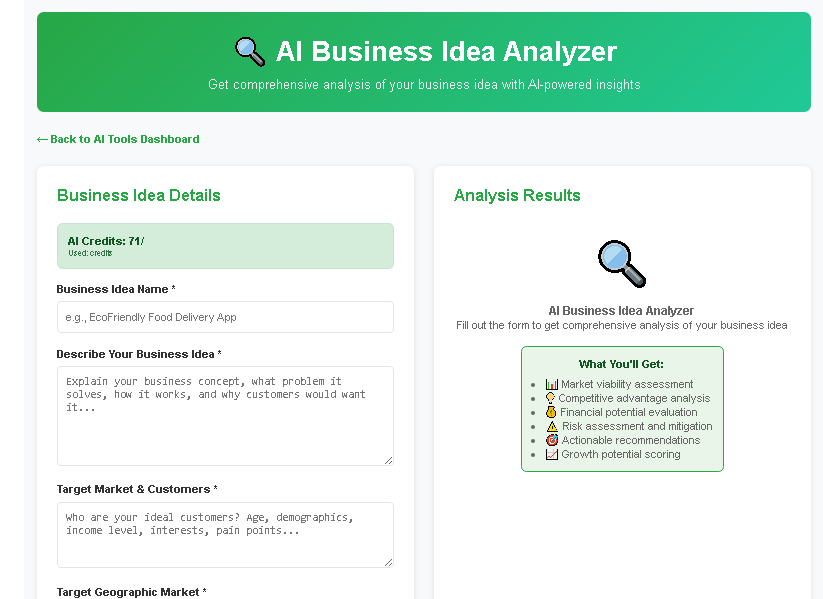
You don’t need a Ph.D. in machine learning to start an AI company. Many of the most successful new AI businesses are “wrappers” built on top of foundational models like GPT-4. These companies take the raw power of a large language model and package it into a user-friendly solution for a specific niche. A great idea can be as simple as creating a highly-tuned interface for real estate agents to write property descriptions or for doctors to summarize patient notes. Once you have a concept, using a Read our complete guide on business idea analysis ai → tool can help you assess its market fit and potential before you write a single line of code.
4. Identify Data-Rich Niches
AI thrives on data. Look for industries or niches where there is a large volume of available data, but it’s currently underutilized. This could be public records, industry-specific datasets, or customer interaction logs. Your business could be built around an AI model that ingests this data and extracts valuable, actionable insights that no one else can see.
50+ AI Business Ideas Across Key Industries
Here is a comprehensive list of ideas, broken down by industry, to spark your imagination. Many of these can be built as SaaS products, specialized agencies, or consulting services.
AI Business Ideas: 50+ Revolutionary Concepts for the Modern Entrepreneur 9
Marketing and Sales
This sector is all about personalization, optimization, and efficiency. AI can supercharge all three.
AI-Powered Content Generation Service: A niche agency that uses AI to create high-quality blog posts, social media updates, and ad copy for specific industries (e.g., for dentists, plumbers, or SaaS companies).
Hyper-Personalized Email Marketing Platform: A tool that analyzes customer data to write unique, one-to-one emails at scale, going far beyond simple “[FirstName]” mail merges.
Predictive Lead Scoring Tool: A SaaS that integrates with a company’s CRM to analyze past deals and predict which new leads are most likely to close, allowing sales teams to prioritize their efforts.
AI-Driven SEO Content Strategist: A platform that analyzes SERPs, competitor content, and search intent to generate complete content briefs and outlines for writers.
Social Media Sentiment Analysis Service: Monitor brand mentions across social media and use AI to classify them as positive, negative, or neutral, providing real-time PR insights.
AI Ad Creative Generator: A tool that generates hundreds of variations of ad images, videos, and copy for A/B testing on platforms like Facebook and Google.
Automated Market Research Reports: An AI that scours the web for industry trends, news, and competitor activities to generate daily or weekly market intelligence reports.
AI Sales Call Analysis: A tool that transcribes and analyzes sales call recordings to identify top-performer habits, common customer objections, and coaching opportunities.
Healthcare and Wellness
AI can improve diagnostics, streamline administration, and personalize patient care. Note: This sector has high regulatory hurdles.
AI Medical Scribe: A service or software that listens to doctor-patient conversations and automatically generates accurate clinical notes (SOAP notes).
Personalized AI Nutrition and Fitness Planner: An app that uses data on a user’s activity, dietary preferences, and goals to create and adapt a dynamic wellness plan.
AI-Powered Mental Health Chatbot: A supportive chatbot providing initial mental health support, coping strategies, and resource navigation (not a replacement for a therapist).
Radiology Image Analysis Assistant: An AI tool that acts as a “second opinion” for radiologists, highlighting potential anomalies in X-rays, MRIs, and CT scans.
Hospital Administrative Task Automation: A platform to automate patient scheduling, insurance claim processing, and billing, reducing administrative overhead.
Predictive Health Monitoring for Seniors: A system using wearables and home sensors to detect changes in routine that might indicate a health issue, alerting caregivers.
AI Business Ideas: 50+ Revolutionary Concepts for the Modern Entrepreneur 10
Finance and FinTech
From fraud detection to personalized financial advice, AI is revolutionizing how we manage money.
AI-Powered Personal Finance Advisor: An app that connects to a user’s bank accounts to analyze spending, identify savings opportunities, and offer automated financial advice.
Algorithmic Trading Bot Creator: A no-code/low-code platform that allows individuals to build, backtest, and deploy their own AI-powered trading strategies.
AI Fraud Detection Service for Small Businesses: A plug-and-play solution for e-commerce sites to analyze transactions in real-time and flag high-risk orders.
Automated Expense Report and Receipt Processing: A tool that uses computer vision to scan receipts and automatically categorize expenses for business reporting.
AI-Driven Loan Application Analysis: A service for small banks and credit unions to automate the initial analysis of loan applications, checking for completeness and flagging risks.
Real Estate Investment Analysis Tool: An AI that analyzes market data, neighborhood trends, and property details to predict a property’s potential rental income and appreciation.
Education and E-Learning
AI can create personalized learning paths and make education more accessible and effective.
Adaptive Learning Platform: A platform that adjusts the difficulty and content of lessons in real-time based on a student’s performance and learning style.
AI-Powered Tutor for Specific Subjects: A specialized AI tutor for subjects like math, chemistry, or learning a new language, available 24/7.
Automated Essay and Assignment Grader: A tool for teachers that can provide initial grading and feedback on student writing, saving hours of time.
Corporate Training Content Generator: An AI that takes a company’s internal documents and policies and automatically creates engaging training modules and quizzes.
AI Language Pronunciation Coach: An app that listens to a user speak a new language and provides instant, detailed feedback on their pronunciation and intonation.
Creative Industries
AI is not replacing creativity; it’s augmenting it, acting as a powerful co-pilot for artists, writers, and designers.
AI Music Generation for Content Creators: A service providing royalty-free, AI-generated background music for videos, podcasts, and presentations.
AI-Assisted Video Editing Software: A tool that can automatically identify the best takes, remove silences, add B-roll, and even suggest narrative structures for video editors.
Virtual Interior Design Staging: An AI tool for real estate agents and designers that can take a photo of an empty room and generate multiple, fully-furnished design concepts.
AI Game Asset Generator: A platform for indie game developers to quickly generate characters, environments, and textures based on text prompts.
Brand Logo and Style Guide Creator: An AI that takes a business description and generates multiple logo options, color palettes, and a complete brand style guide.
AI-Powered Storyboard Generator: A tool for filmmakers and advertisers that can turn a script into a visual storyboard with AI-generated images.
AI Business Ideas: 50+ Revolutionary Concepts for the Modern Entrepreneur 11
E-commerce and Retail
AI is the key to personalization and optimization in the competitive world of online retail.
Hyper-Personalized Product Recommendation Engine: A Shopify or WooCommerce plugin that goes beyond “customers also bought” to offer truly personalized recommendations based on deep behavioral analysis.
AI-Powered Inventory Management and Forecasting: A tool that predicts future demand for products based on historical sales, seasonality, and market trends to prevent stockouts and overstocking.
AI-Generated Product Descriptions: A service that automatically writes compelling, SEO-friendly product descriptions for large e-commerce catalogs.
Virtual Try-On for Fashion and Apparel: An AR/AI solution that allows customers to see how clothes would look on them using their phone’s camera.
Dynamic Pricing Optimization Tool: An AI that automatically adjusts product prices based on competitor pricing, demand, and inventory levels to maximize profit margins.
AI Customer Support Bot for E-commerce: A chatbot specialized in handling common e-commerce queries like “Where is my order?”, “What is your return policy?”, and processing returns/exchanges.
Niche and Local Services
AI can bring incredible efficiency to smaller, often overlooked, markets.
AI Local Service Lead Generation: A service for plumbers, electricians, and other tradespeople that uses AI to monitor local community groups and forums for people seeking services and automates initial outreach.
AI-Powered Resume and Cover Letter Builder: A tool specifically designed to help job seekers tailor their applications to specific job descriptions by highlighting relevant skills and keywords.
Automated Legal Document Creation for Small Businesses: A service providing AI-generated NDAs, service agreements, and privacy policies.
AI Event Planning Assistant: A tool that helps plan events by suggesting venues, vendors, and schedules based on budget, guest count, and event type.
AI-Optimized Restaurant Menu Engineering: A service that analyzes a restaurant’s sales data to suggest menu price adjustments, item placement, and descriptions to increase profitability.
Personalized Travel Itinerary Planner: An AI that creates custom travel plans based on a user’s interests, budget, and time constraints.
AI-Powered Grant Proposal Writer for Non-Profits: A specialized tool to help non-profits draft compelling grant proposals more efficiently.
Smart Recycling Sorter: A physical product idea using computer vision to automatically sort recyclables in homes or small businesses, increasing recycling rates.
AI-Powered Garden and Plant Care Advisor: An app that identifies plants, diagnoses diseases from photos, and provides personalized care schedules.
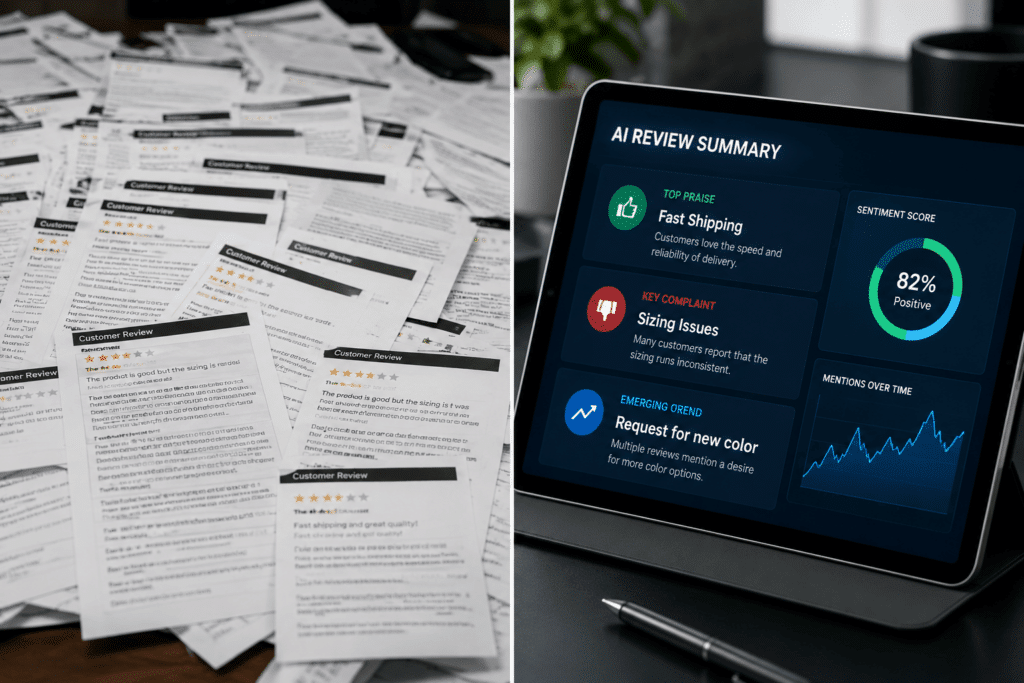
AI Customer Feedback Summarizer: A tool that ingests reviews from Yelp, Google, and other platforms and provides business owners with a summarized report of key themes and actionable feedback.
AI-Driven Recruitment for Niche Industries: A service that sources and vets candidates for highly specific roles (e.g., blockchain developers, biotech researchers) by analyzing portfolios and public contributions.
Personalized Gift Recommendation Service: An AI that suggests the perfect gift based on the recipient’s interests, age, and relationship to the user.
AI-Powered Home Energy Audit: A service that analyzes smart meter data and user inputs to recommend specific ways to reduce home energy consumption.
AI Business Ideas: 50+ Revolutionary Concepts for the Modern Entrepreneur 12
Getting Started: Your 4-Step Launch Plan
Having a great idea is only the beginning. Execution is everything. Here is a simplified, actionable plan to take your AI business idea from concept to reality.
Step 1: Validate, Validate, Validate
Before you invest significant time or money, you must confirm that people actually want what you’re planning to build. Don’t fall in love with your solution; fall in love with the problem. Talk to potential customers. Would they pay for this? How are they solving this problem now? What are their biggest frustrations? Before investing significant resources, it’s crucial to use an Read our complete guide on ai business idea validator → to test your assumptions against market data and user feedback.
Step 2: Build a Minimum Viable Product (MVP)
Your first product shouldn’t be perfect. It should be the simplest possible version that solves the core problem for a small group of early adopters. Leverage no-code and low-code tools like Bubble or Webflow for the front-end, and connect to an AI API like OpenAI for the back-end. Your goal is to get a functional product into users’ hands as quickly and cheaply as possible.
Step 3: Acquire Your First Users
Don’t worry about “scaling” at this stage. Focus on getting your first 10-20 users manually. Reach out to people you interviewed in the validation stage. Post in niche online communities where your target audience hangs out. Offer the product for free or at a steep discount in exchange for feedback. Your goal is learning, not revenue.
Step 4: Iterate Based on Feedback
Listen closely to your early users. What do they love? What do they find confusing? What features are they asking for? Use this feedback to continuously improve your product. This cycle of building, measuring, and learning is the engine of startup growth. Your initial idea will almost certainly evolve as it makes contact with reality, and that’s a good thing.
Common Mistakes to Avoid on Your AI Entrepreneurial Journey
The path to a successful AI business is fraught with potential pitfalls. Being aware of them can help you navigate more effectively.
Technology in Search of a Problem: This is the most common mistake. Starting with a cool AI capability and then trying to find a problem it can solve. Always start with a painful, valuable problem first.
Underestimating Data Needs: While you can leverage pre-trained models, for many unique applications, you’ll need specific data to fine-tune your AI. Don’t underestimate the difficulty and cost of acquiring, cleaning, and labeling this data.
Ignoring Ethics and Bias: AI models are trained on data, and if that data contains human biases, the AI will amplify them. Be mindful of the ethical implications of your business and proactively work to ensure fairness and transparency.
The “Build from Scratch” Fallacy: Resist the urge to build your own foundational AI model. It’s incredibly expensive and time-consuming. Stand on the shoulders of giants and use existing APIs to get to market faster.
Poor User Experience (UX): AI can be complex, but your product’s interface must be simple and intuitive. The magic of the AI should be in the background; the user experience should be effortless.
AI Business Ideas: 50+ Revolutionary Concepts for the Modern Entrepreneur 13
The Future is Artificially Intelligent
We are only at the very beginning of the AI revolution. The ideas listed here are just a starting point. As the technology continues to evolve, new business opportunities will emerge that we can’t even conceive of today. The key trends to watch are hyper-personalization, where every digital experience is tailored to the individual, and the rise of autonomous agents that can perform complex, multi-step tasks on our behalf.
The entrepreneurs who succeed in this new era will not necessarily be the most technical, but the most empathetic. They will be the ones who can deeply understand human problems and creatively apply AI as a solution. The tools are here. The market is ready. The only remaining question is: what will you build?
Frequently Asked Questions About AI Business Ideas
What business can you start with AI?
You can start a wide variety of businesses with AI, catering to different skills and investment levels. Some popular options include: an AI-powered copywriting service for businesses, a niche SaaS product that automates a specific industry task (like invoice processing for freelancers), an e-commerce store with a hyper-personalized recommendation engine, or an AI consulting agency that helps other companies implement AI solutions.
Which 3 jobs will survive AI?
While AI will transform many jobs, roles that rely heavily on complex human-centric skills are the most resilient. Three examples include:
Therapists and Mental Health Professionals: These roles require deep empathy, nuanced understanding of human emotion, and building trust, which AI cannot replicate.
Strategic Leaders and Innovators: Roles that involve setting vision, managing complex human dynamics, and making high-stakes creative judgments will remain critical.
Skilled Tradespeople (Plumbers, Electricians, Carpenters): These jobs require complex physical problem-solving, dexterity, and adaptability in unpredictable physical environments, skills that are very difficult to automate with current robotics and AI.
What are some good AI business ideas?
Good AI business ideas solve a specific, painful problem. Some strong examples include:
AI Medical Scribe: Automates clinical note-taking for doctors, saving them hours per day.
Predictive Lead Scoring: Helps sales teams focus on the leads most likely to convert into customers.
Automated Market Research: Provides businesses with real-time intelligence on their competitors and industry trends without manual effort.
What are the 12 AI startups in India?
India has a booming AI startup ecosystem. While the list is constantly changing, here are 12 notable AI startups from India that have gained attention: