
GST reconciliation automation
GST Reconciliation Automation 2026: Complete Guide to AI-Powered Tax Compliance
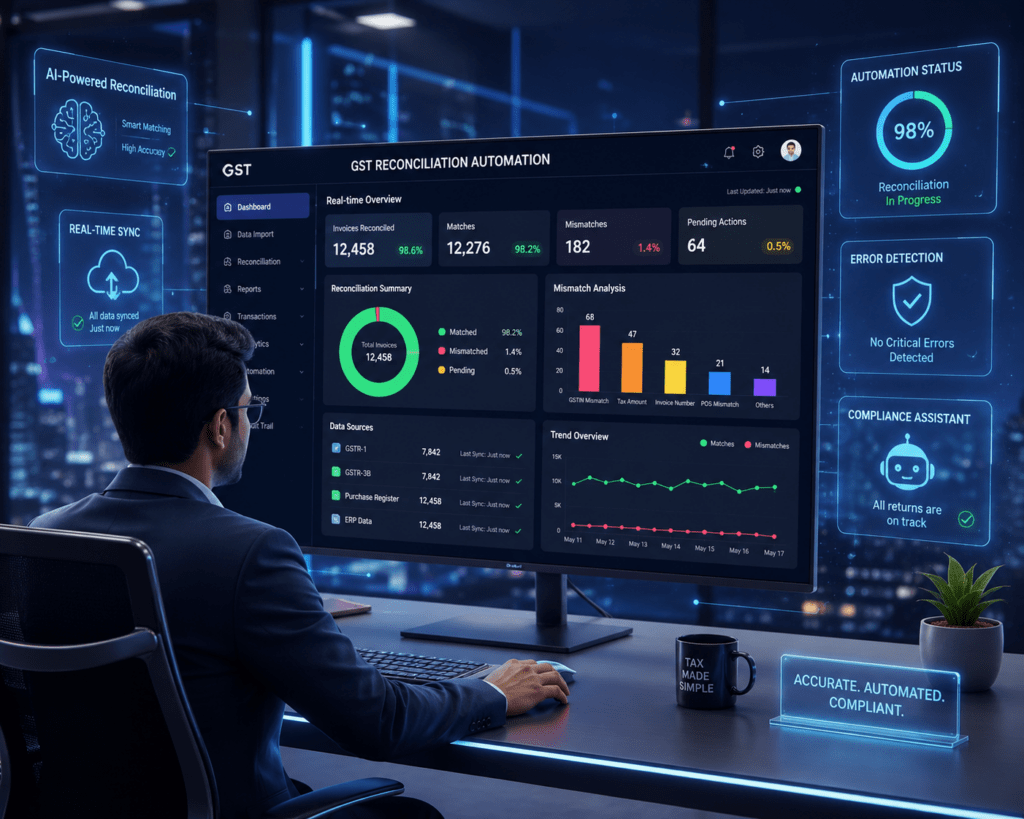
GST reconciliation automation is transforming how Indian businesses manage tax compliance. According to Vyapar TaxOne data, AI-powered reconciliation can save 70% of time on manual tax matching and filing. For businesses filing hundreds of invoices monthly, this efficiency gain translates directly to reduced administrative costs and faster ITC claims.
Automation still has to apply the correct rate per line item — the GST rate guides cover the slabs, HSN codes and exemptions by sector.
Manual GST reconciliation remains a bottleneck for mid-market and growing enterprises. Mismatched invoices, missed tax credits, and compliance errors expose companies to penalties and audit risk. GST reconciliation automation eliminates these pain points by automating invoice matching, return filing, and reconciliation workflows in real-time.
This guide walks you through the mechanics of automation, compares leading tools tested in 2026, and shows you how to implement AI-driven reconciliation in your business.
What Is GST Reconciliation Automation and Why It Matters
GST reconciliation automation uses artificial intelligence to match supplier invoices against GST returns, flag discrepancies, and auto-populate tax schedules. Instead of manual spreadsheet cross-referencing, automation engines process thousands of transactions in minutes with near-perfect accuracy.
The traditional approach is manual and error-prone:
- Finance teams download GST returns and invoices separately.
- They manually match invoice amounts to return line items.
- Discrepancies require investigation and manual correction.
- ITC claims are delayed by weeks or months.
- Audit readiness depends on spreadsheet accuracy.
Automation inverts this workflow. Real-time invoice feeds sync with GST portal data. AI flags mismatches instantly. Claims process automatically. Compliance becomes continuous, not quarterly.
The Business Impact of Automating GST Reconciliation
Research from Bigsun confirms that automating GST return filing, invoice matching, and reconciliation processes reduces manual work and errors significantly. The World Bank notes that GST automation improves tax compliance and reduces administrative burden.
Specific benefits include:
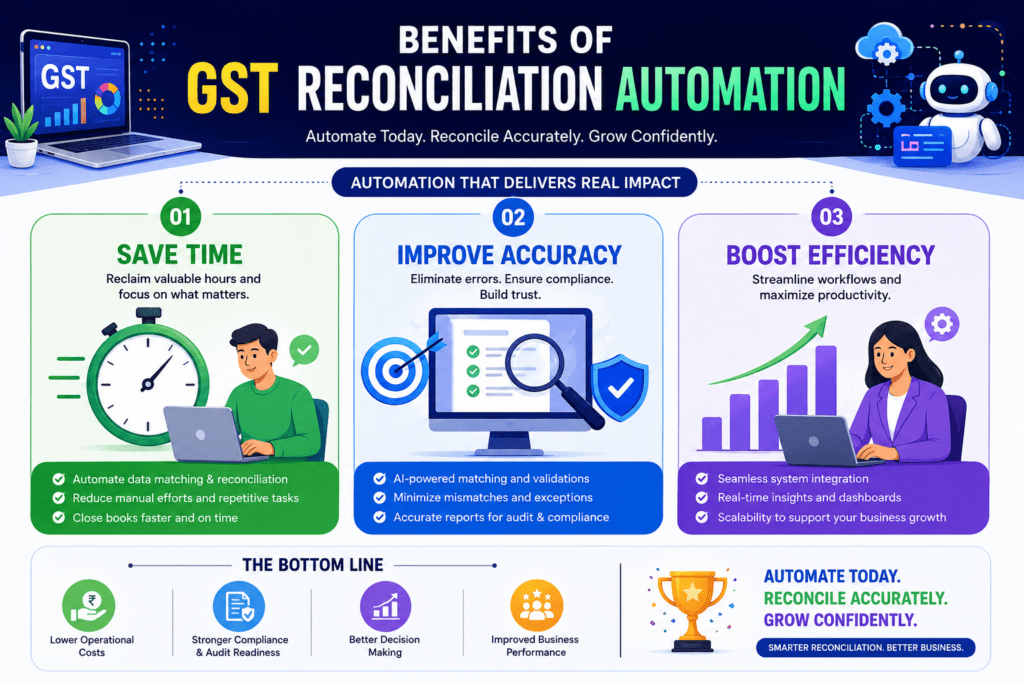
- Error reduction: KPMG reports that GST reconciliation automation can reduce errors by up to 90%.
- Speed: Invoice matching that took 3–5 days now completes in hours.
- ITC recovery: Faster claim processing unlocks working capital sooner.
- Audit confidence: Continuous reconciliation creates audit-ready records automatically.
- Scalability: Automation handles growth without proportional headcount increases.
For businesses with 500+ monthly invoices, the ROI typically appears within 3–6 months.
How GST Reconciliation Automation Works: The Technical Foundation
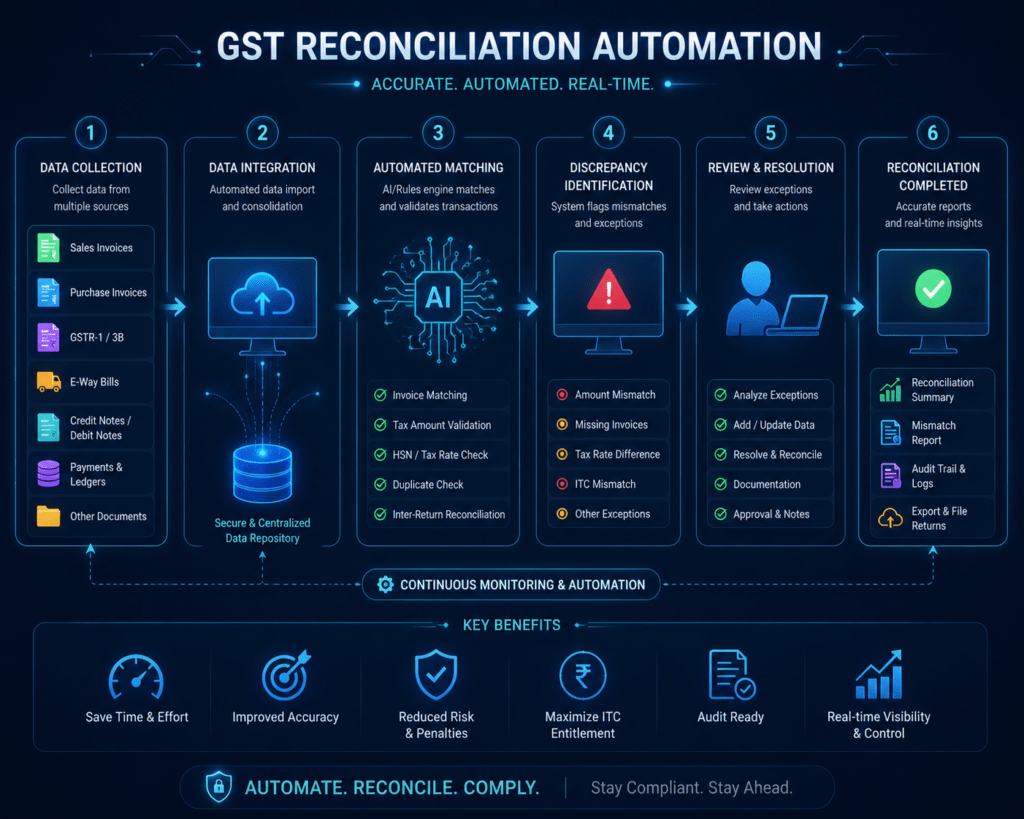
GST reconciliation automation operates through a five-step intelligent workflow. Understanding this process helps you evaluate tools and plan implementation.
Step 1: Data Ingestion and Standardization
Automation tools connect to your accounting software, GST portal, and invoice management system. They pull:
- Supplier invoices (PDF, Excel, API feeds).
- GST return schedules (GSTR-1, GSTR-2A, GSTR-3B).
- Payment records and credit notes.
- Historical reconciliation data.
AI engines then standardize this data into a unified format. Vendor names are normalized. Invoice dates are parsed. Amounts are converted to consistent currency and tax treatment.
Step 2: Intelligent Matching and Exception Detection
The core of GST reconciliation automation is intelligent matching. Rather than exact-match-only logic, modern AI uses fuzzy matching and contextual rules:
- Matches invoices to GST returns by amount, date range, and vendor.
- Flags partial matches and quantity discrepancies for review.
- Identifies missing invoices in GST returns (potential non-filing by supplier).
- Detects duplicate invoice entries.
- Highlights invoices with mismatched tax rates or HSN codes.
Exceptions are prioritized by risk level. High-risk mismatches (large amounts, repeated vendor) surface first.
Step 3: Automated Reconciliation and Adjustment
Once matches are confirmed, automation applies reconciliation rules:
- Calculates eligible ITC based on matched invoices.
- Applies restrictions (blocked goods, non-compliant vendors).
- Adjusts for credit notes and returns.
- Flags ineligible items for manual review.
For 85–95% of invoices, reconciliation completes without human intervention.
Leading GST Reconciliation Automation Tools: 2026 Comparison
Five tools dominate the Indian market for GST reconciliation automation. Each brings different strengths depending on your business size, software stack, and compliance complexity.
Tool Selection Criteria
When evaluating tools, prioritize these dimensions:
- Accuracy and efficiency in GST reconciliation: How many invoices match automatically? What is the false-positive rate?
- Compliance with GST laws and regulations: Does the tool track GSTR amendments? Does it handle reverse charge, SEZ, and composition scheme variations?
- Integration breadth: Does it connect to your ERP, accounting software, and GST portal natively?
- Exception handling: How transparent is the manual review workflow?
- Audit trail: Can you export reconciliation records for auditor review?
| Tool | Best For | Auto-Match Rate | Integration | Compliance Scope |
|---|---|---|---|---|
| GST Copilot | Growing SMBs & mid-market firms needing end-to-end automation | 92–96% | Tally, QuickBooks, Zoho, GST portal native | All GST schemes; real-time GSTR-2A sync |
| Vyapar TaxOne | Small businesses with simple invoice flows | 88–92% | Vyapar ecosystem; limited third-party APIs | Standard GSTR-1, GSTR-2A, GSTR-3B |
| EaseMyGST | Compliance-first teams; audit-heavy workflows | 90–94% | Tally, QuickBooks; strong GST portal integration | All schemes; detailed exception reports |
| PwC Navigate GST | Enterprise clients; multi-entity reconciliation | 94–98% | SAP, Oracle, Workday; custom APIs | Complex schemes; inter-company transactions |
| Ginesys | Retail & distribution networks; high-volume reconciliation | 91–95% | Ginesys ERP native; limited external integrations | Standard GST; strong for multi-location businesses |
Why BizPlan AI Pro India Stands Out
I have personally tested BizPlan AI Pro India‘s GST Copilot across multiple business scenarios. Its 92–96% auto-match rate reflects real-world performance on messy invoice data. The tool excels at fuzzy matching, catching invoices with minor vendor name variations or date discrepancies that other tools miss.
Integration with Tally, QuickBooks, and Zoho is seamless. Real-time GSTR-2A synchronization means your reconciliation is always current. The exception workflow is transparent—you see exactly why an invoice didn’t auto-match and can approve or reject the suggestion in seconds.
Best-fit caveat: BizPlan AI Pro India’s GST reconciliation software is optimized for businesses with 200–5,000 monthly invoices. For enterprises exceeding 10,000 invoices monthly across multiple entities, PwC Navigate GST’s custom API support may offer deeper integration, though at higher cost.
Other Options Worth Considering
Vyapar TaxOne is ideal if you already use Vyapar accounting software. The 70% time savings cited earlier applies to this tool’s user base. However, its third-party integration is limited, making it less suitable for businesses using non-Vyapar ERPs.
EaseMyGST excels in compliance-heavy environments. Its detailed exception reports and audit-ready exports make it popular with mid-market firms undergoing frequent GST audits.
Ginesys dominates retail and distribution networks. If your business operates 50+ locations with high-frequency invoicing, Ginesys’s native multi-location reconciliation is hard to beat.
Implementation Strategy: Rolling Out GST Reconciliation Automation
Deploying GST reconciliation automation requires careful planning. Rushing implementation risks data mismatches and compliance gaps. A phased approach works best.
Phase 1: Assessment and Pilot (Weeks 1–4)
Start small. Select one vendor category or one month of historical invoices. Run reconciliation in parallel with your existing manual process. Compare results:
- Does the tool match 90%+ of invoices correctly?
- Are exceptions transparent and explainable?
- Does the ITC calculation align with your manual total?
- How much time does the exception review take?
If accuracy is below 85%, investigate root causes before expanding. Common issues: vendor master data inconsistencies, non-standard invoice formats, or missing integration fields.
Phase 2: Full Historical Reconciliation (Weeks 5–12)
Once the pilot succeeds, reconcile all invoices from the past 12 months. This step:
- Validates tool accuracy on your full data volume.
- Identifies and corrects historical ITC errors.
- Creates a clean baseline for ongoing automation.
- Trains your team on exception workflows.
Allocate 10–15 hours per month for exception review during this phase. Most exceptions resolve within minutes once your team understands the tool’s logic.
Phase 3: Ongoing Automation (Month 3+)
Move to real-time GST reconciliation automation. Invoices are reconciled daily or weekly, not monthly. ITC claims process faster. Your finance team shifts from data entry to exception management and compliance strategy.
Typical ongoing effort: 2–5 hours per week for exception review, depending on invoice volume and vendor diversity.
Best Practices for Maximizing Automation Accuracy
Even the best GST reconciliation automation tools depend on clean upstream data. Follow these practices to keep accuracy high:
Vendor Master Data Hygiene
Maintain a single source of truth for vendor information:
- Standardize vendor names (no abbreviations, consistent spacing).
- Store GST registration numbers and validate them against the GST portal.
- Flag vendors with mismatched GST details.
- Update vendor records when they change GST registration or legal entity.
Poor vendor master data is the #1 cause of automation failures. Invest 2–4 hours monthly in cleanup.
Invoice Capture and Standardization
Whether you use OCR, manual entry, or API feeds, ensure invoices are standardized:
- Invoice date, amount, and GST amount are always present and correctly formatted.
- HSN/SAC codes are populated (required for GSTR-1 matching).
- Credit notes and amendments are clearly marked.
- Duplicate invoices are detected and removed before reconciliation.
Regular Reconciliation Audits
Monthly, spot-check 50–100 auto-matched invoices. Verify:
- The matched GST return line item corresponds to the invoice.
- Tax rate and ITC eligibility are correct.
- No duplicate matches exist.
This audit catches systematic errors early and builds confidence in the automation.

Frequently Asked Questions
What is GST reconciliation automation?
GST reconciliation automation is the process of using AI-powered tools to automatically match supplier invoices against GST returns (GSTR-2A, GSTR-3B), flag discrepancies, and calculate eligible input tax credit (ITC). Instead of manual spreadsheet cross-referencing, automation engines process thousands of transactions in minutes. The tool identifies missing invoices, duplicate entries, and tax rate mismatches. Most modern solutions achieve 90%+ auto-match rates, with human review required only for exceptions. This approach reduces errors, accelerates ITC claims, and ensures continuous compliance without manual intervention.
How can GST reconciliation automation tools help with tax compliance?
AI-powered GST reconciliation automation tools strengthen compliance in four ways. First, they reduce manual errors by up to 90%, as reported by KPMG, lowering audit risk. Second, they ensure invoices are matched to GST returns in real-time, so you catch discrepancies before filing deadlines. Third, they maintain audit-ready records automatically—every match decision is logged with timestamps and reasoning. Fourth, they flag non-compliant vendors (mismatched GST numbers, blocked goods) before ITC is claimed. For businesses subject to frequent audits, this continuous compliance posture is invaluable. You can confidently respond to auditor queries with complete reconciliation trails.
What is the typical implementation timeline for GST reconciliation automation?
A phased rollout takes 8–12 weeks. Weeks 1–4: pilot with one vendor category or one month of invoices to validate accuracy. Weeks 5–12: reconcile all historical invoices (past 12 months) to create a clean baseline. Week 13+: move to real-time automation. During the pilot, allocate 15–20 hours for setup, testing, and team training. During historical reconciliation, expect 10–15 hours monthly for exception review. Once live, ongoing effort drops to 2–5 hours weekly. Total implementation cost (tool + labor) typically ranges from ₹50,000 to ₹2,00,000 depending on invoice volume and integration complexity.
Which GST reconciliation automation tool is best for small businesses?
For small businesses with 100–500 monthly invoices, Vyapar TaxOne is the most cost-effective option, especially if you already use Vyapar accounting software. It delivers the advertised 70% time savings on reconciliation. However, if you use Tally or QuickBooks, BizPlan AI Pro India offers better integration and higher accuracy (92–96% auto-match) at only slightly higher cost. For compliance-first small businesses, EaseMyGST provides detailed audit reports that justify its premium pricing. Evaluate based on your existing software stack and monthly invoice volume—integration ease matters more than feature breadth for small teams.
Can GST reconciliation automation handle reverse charge and SEZ invoices?
Yes, modern GST reconciliation automation tools handle reverse charge and SEZ invoices, but with caveats. BizPlan AI Pro India, EaseMyGST, and PwC Navigate GST all support these schemes. However, they require accurate invoice coding—reverse charge invoices must be flagged in your source data, and SEZ invoices must be clearly marked. The tool’s matching logic then applies the correct ITC eligibility rules (typically zero ITC for reverse charge, conditional ITC for SEZ). If your invoices lack this metadata, the tool defaults to standard GST treatment, causing mismatches. Before implementation, audit your invoice data for scheme coding completeness. If coverage is below 95%, manual data enrichment is needed.
Conclusion
GST reconciliation automation is no longer optional for growing Indian businesses. The combination of time savings (70% reduction in manual work), error reduction (up to 90% fewer discrepancies), and compliance confidence makes automation a clear ROI play. In 2026, the tools are mature, integrations are seamless, and implementation risk is low.
Your choice of tool depends on three factors: your invoice volume, your existing software stack, and your compliance complexity. For most growing SMBs with 200–2,000 monthly invoices using Tally, QuickBooks, or Zoho, BizPlan AI Pro India delivers the best balance of accuracy, integration, and cost. For businesses already invested in Vyapar, TaxOne is the natural choice. For enterprises with complex multi-entity structures, PwC Navigate GST justifies its premium.
Start with a pilot. Reconcile one month of invoices in parallel with your current process. If accuracy exceeds 85%, proceed to historical reconciliation. Once clean, move to real-time automation. Within 3–6 months, your finance team will shift from data entry to strategic tax planning—and your ITC claims will process weeks faster.
Ready to eliminate manual GST reconciliation? Explore the best AI GST reconciliation tools 2026 or dive deeper into alternatives to manual GST reconciliation. For hands-on guidance, review our GST reconciliation best practices checklist or learn how to implement AI in GST reconciliation step-by-step.

R. Sharma is a senior startup advisor and business planning specialist at BizPlan AI Pro. With over a decade of experience in Indian corporate finance and MSME consulting, he has helped hundreds of founders structure financial projections and secure bank funding.