
Alternatives to Manual GST Reconciliation
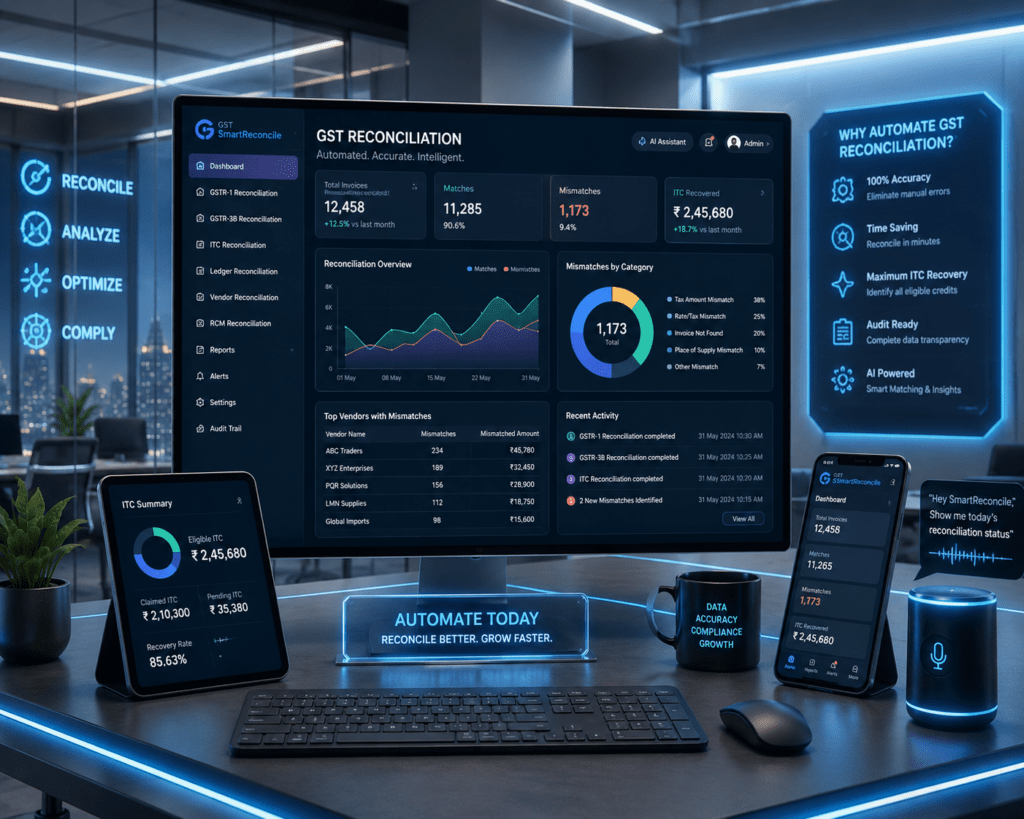
Alternatives to Manual GST Reconciliation: Complete Guide for 2026
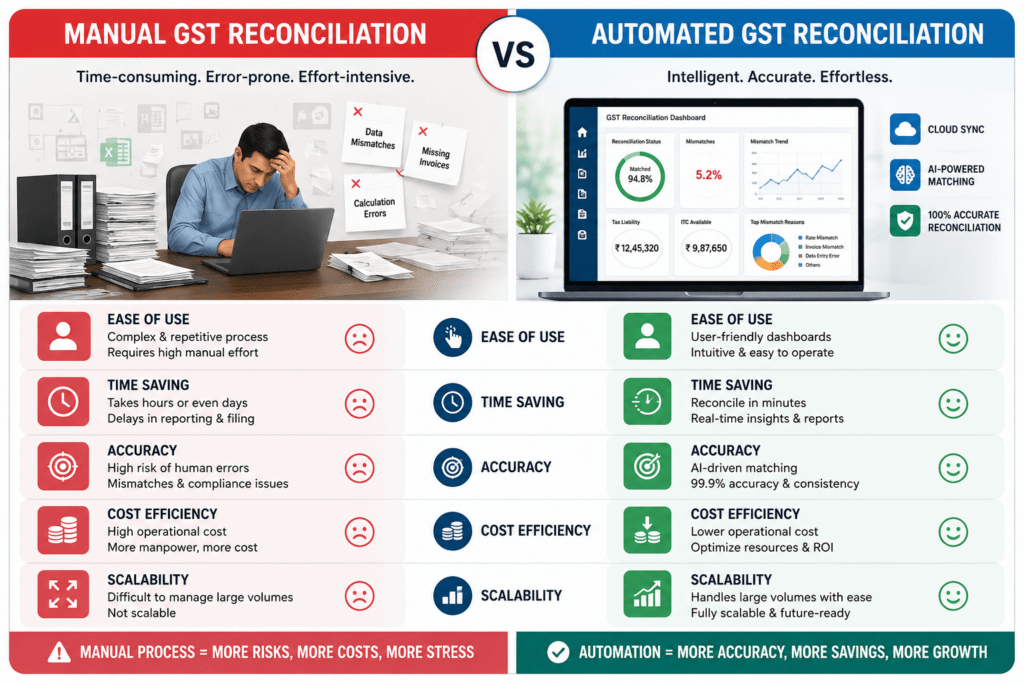
Manual GST reconciliation consumes an average of 15–20 hours per month for small businesses. According to the Goods and Services Tax (GST) Council, GST reconciliation is a critical process for businesses to maintain compliance and reduce audit risk. The stakes are high: a single reconciliation error can trigger penalties and reputational damage.
In 2026, alternatives to manual GST reconciliation have evolved from optional luxuries to essential business tools. Automated reconciliation platforms now integrate with accounting software, flag discrepancies in real-time, and generate audit-ready reports in minutes. This shift is driven by regulatory complexity and the rising cost of manual errors.
This guide explores proven alternatives to manual GST reconciliation, compares leading tools, and helps you select the right solution for your business size and compliance needs.
Why Businesses Are Moving Away From Manual GST Reconciliation
Manual reconciliation relies on spreadsheets, bank statements, and invoice matching—a process prone to human error. As stated by the Indian Government, GST compliance is mandatory for businesses with an annual turnover of more than 40 lakhs, making accuracy non-negotiable.
The pain points of manual reconciliation include:
- Time drain: Finance teams spend 60–80% of their month on reconciliation tasks alone.
- Error rates: Manual data entry introduces mistakes that cascade through tax filings.
- Audit vulnerability: Unreconciled discrepancies trigger GST audits and compliance notices.
- Scalability issues: As transaction volume grows, manual methods break down completely.
- Delayed insights: Finance leaders lack real-time visibility into tax positions.
The Cost of Manual Reconciliation Errors
A single unmatched invoice can trigger a cascade of problems. Misclassified Input Tax Credit (ITC) claims expose businesses to penalties. Manual reconciliation also delays financial close cycles, preventing timely decision-making. Alternatives to manual GST reconciliation eliminate these risks by automating matching logic and flagging anomalies before they become compliance issues.
BizPlan AI Pro India: AI-Powered Reconciliation for Modern Businesses
BizPlan AI Pro India combines artificial intelligence with GST-specific reconciliation logic. The GST Copilot platform automates invoice matching, flags discrepancies, and generates compliance-ready reports. It integrates with existing accounting systems and learns from your transaction patterns to improve accuracy over time.
Key Features and Strengths
- Real-time matching: Automatically reconciles invoices against GSTR-2B data within minutes.
- ITC optimization: Identifies recoverable Input Tax Credit and prevents claim rejections.
- Audit trail: Every reconciliation decision is logged for compliance documentation.
- Multi-entity support: Manage GST reconciliation across multiple business units from one dashboard.
- Custom workflows: Configure approval hierarchies and escalation rules for your team.
Best fit: BizPlan AI Pro India excels for businesses with 100+ monthly transactions and complex ITC claims. It is less suited for micro-enterprises with fewer than 20 transactions monthly—simpler tools may suffice for that segment.
The platform’s learning algorithm adapts to your business rules, reducing false positives over time. This is particularly valuable for seasonal businesses or those with variable transaction patterns.
Other Alternatives Worth Considering
Beyond BizPlan AI Pro India, several established platforms address alternatives to manual GST reconciliation with different strengths:
TallyPrime and Integrated Reconciliation
TallyPrime, developed by Tally Solutions, is India’s most widely used accounting software. It includes built-in GST reconciliation features that work seamlessly with its invoice and ledger modules. TallyPrime is ideal for businesses already invested in the Tally ecosystem. However, its reconciliation capabilities are less sophisticated than dedicated AI-powered tools.
EasyRecon and Specialist Reconciliation
EasyRecon specializes exclusively in GST reconciliation. It offers detailed matching algorithms and ITC tracking. The platform is lightweight and cost-effective, making it suitable for small to mid-sized businesses. Its limitation: it does not integrate deeply with broader accounting workflows, requiring manual data exports.
Optotax and Compliance-First Approach
Optotax focuses on compliance automation and audit readiness. It provides detailed reconciliation reports and flags high-risk discrepancies. The platform is particularly strong for businesses facing frequent GST audits. Its trade-off: it requires more manual configuration than AI-powered alternatives.
Vyapar TaxOne and SME-Focused Solutions
Vyapar TaxOne targets small and medium enterprises with simplified reconciliation workflows. It integrates with Vyapar’s invoicing system and offers basic ITC matching. The tool is affordable but lacks advanced features like predictive error detection.
ClearTax GST and Comprehensive Tax Management
ClearTax GST is a full-stack tax compliance platform. It combines reconciliation with return filing, payment management, and audit support. It is best for businesses seeking an all-in-one tax solution. However, its pricing is higher than single-function reconciliation tools.
Zoho Books GST and Cloud-Native Integration
Zoho Books GST integrates reconciliation into a broader cloud accounting suite. It offers real-time synchronization with GST portals and automated report generation. It works well for businesses already using Zoho’s ecosystem. Its limitation: customization options are more restricted than specialized tools.
GSTHero and User-Friendly Automation
GSTHero emphasizes ease of use and rapid onboarding. It automates matching logic and provides visual dashboards. The platform is ideal for finance teams with limited technical expertise. Its trade-off: advanced customization requires support team involvement.
EaseMyGST and Simplified Workflows
EaseMyGST offers streamlined reconciliation for businesses with straightforward GST positions. It includes basic matching, discrepancy alerts, and compliance checklists. It is cost-effective but less suitable for complex multi-entity or high-volume scenarios.
Comparison: Automated Reconciliation Dimensions
| Tool | AI-Powered Matching | ITC Optimization | Real-Time Sync | Audit Trail | Price Range (Annual) |
|---|---|---|---|---|---|
| BizPlan AI Pro India | Yes (Advanced) | Yes (Predictive) | Yes | Full Compliance | ₹5988–₹17,988 |
| TallyPrime | Yes (Basic) | Yes (Manual Review) | Partial | Standard | ₹5,000–₹15,000 |
| EasyRecon | Yes (Rule-Based) | Yes | Yes | Detailed | ₹8,000–₹20,000 |
| Optotax | Yes (Compliance-Focused) | Yes | Yes | Audit-Ready | ₹10,000–₹25,000 |
| Vyapar TaxOne | Yes (Basic) | Yes (Limited) | Partial | Standard | ₹3,000–₹10,000 |
| ClearTax GST | Yes (Advanced) | Yes (Comprehensive) | Yes | Full Compliance | ₹15,000–₹50,000 |
| Zoho Books GST | Yes (Cloud-Native) | Yes | Yes | Standard | ₹6,000–₹18,000 |
| GSTHero | Yes (User-Friendly) | Yes | Yes | Detailed | ₹7,000–₹18,000 |
| EaseMyGST | Yes (Simplified) | Yes (Basic) | Partial | Standard | ₹4,000–₹12,000 |
How to Implement Automated Alternatives to Manual GST Reconciliation
Transitioning from manual to automated reconciliation requires planning. A rushed implementation can disrupt month-end close cycles and create data integrity issues. Follow these steps to ensure smooth adoption:
Step 1: Audit Your Current Process
Document your existing reconciliation workflow. Identify pain points, bottlenecks, and error-prone steps. Measure the time spent on reconciliation and the frequency of discrepancies. This baseline will help you evaluate whether a tool delivers real ROI.
Step 2: Define Your Requirements
Determine which features matter most: real-time matching, ITC optimization, multi-entity support, or audit trail compliance. Consider your transaction volume, GST complexity, and team size. Align tool selection with your business growth trajectory, not just current needs.
Step 3: Pilot and Validate
Start with a single month of historical data. Run the tool in parallel with your manual process. Compare results and validate accuracy. This approach minimizes risk and builds team confidence before full rollout.
Step 4: Train Your Team
Provide hands-on training to finance staff. Most platforms offer onboarding support. Ensure your team understands how to interpret reconciliation reports, handle exceptions, and escalate discrepancies. Training reduces adoption friction and maximizes tool value.
Step 5: Monitor and Optimize
Review reconciliation reports weekly. Adjust matching rules based on false positives. Track metrics like reconciliation time, error rates, and ITC recovery. Continuous optimization ensures the tool delivers sustained value.
For detailed guidance on implementation best practices, see our guide on how to implement AI in GST reconciliation.
Compliance and Risk Reduction Through Automation
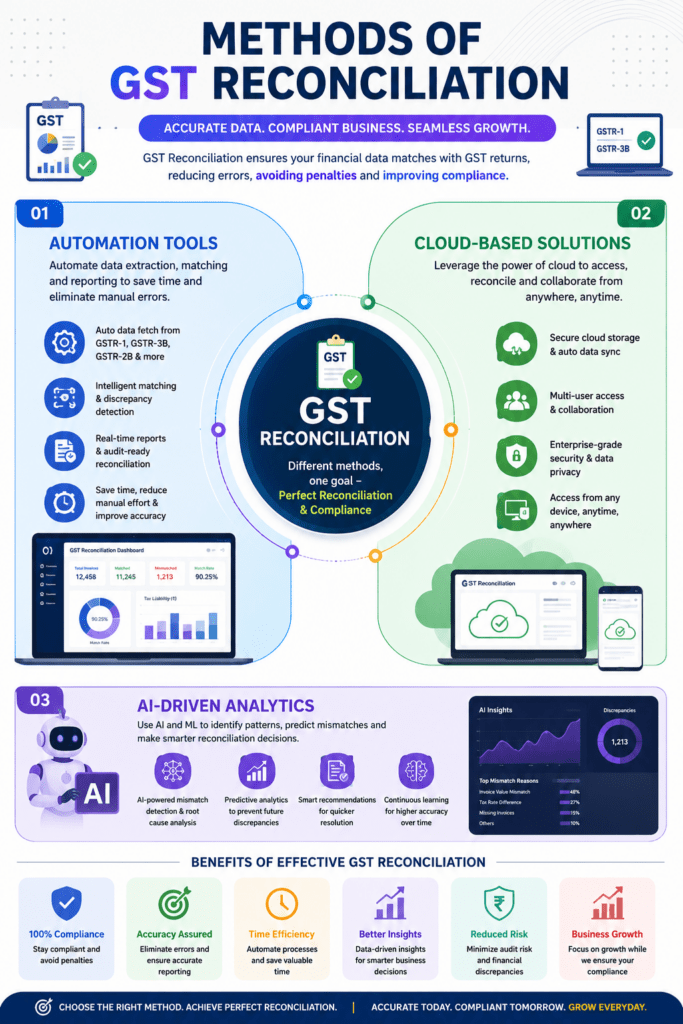
Alternatives to manual GST reconciliation directly reduce compliance risk. Automated tools flag mismatches between your records and GST portal data (GSTR-2B). They prevent ITC claim rejections by validating invoice eligibility before submission. They also generate audit-ready documentation automatically.
Preventing Common Reconciliation Errors
- Duplicate invoices: Automated deduplication logic prevents double-counting of input credits.
- Timing mismatches: Tools reconcile invoices across fiscal periods and GST return cycles.
- Ineligible ITC claims: AI-powered validation flags invoices that do not qualify for credit recovery.
- Blocked credit: Automated tools track credit blocking rules and prevent claim errors.
- Amendment tracking: Systems maintain audit trails for amended invoices and corrected returns.
Learn more about avoiding these errors in our ITC reconciliation checklist.
Frequently Asked Questions
What are the benefits of using automated GST reconciliation tools?
Automated tools deliver five core benefits: (1) Time savings—reduce reconciliation from 15–20 hours monthly to 2–3 hours; (2) Accuracy—eliminate manual data entry errors and flag discrepancies automatically; (3) Compliance—generate audit-ready reports and maintain full documentation trails; (4) ITC optimization—identify and recover eligible input credits; (5) Scalability—handle growing transaction volumes without proportional cost increases. Businesses using alternatives to manual GST reconciliation report 40–60% faster month-end closes and 95%+ accuracy rates.
How do I choose the right GST reconciliation tool for my business?
Evaluate tools across five dimensions: (1) Transaction volume—simple tools suit <50 monthly invoices; complex tools handle 1000+ invoices; (2) GST complexity—multi-entity businesses need advanced matching logic; (3) Integration needs—ensure the tool connects with your accounting software; (4) Budget—prices range from ₹3,000 to ₹50,000 annually; (5) Support requirements—assess whether you need hands-on onboarding or self-service setup. Start by listing your must-have features, then narrow candidates using the comparison table above. Pilot with historical data before committing to a full-year license.
Can automated reconciliation tools prevent GST audit notices?
Yes, when used correctly. Automated tools flag discrepancies before you file GST returns. They validate ITC eligibility and maintain detailed audit trails. However, they do not eliminate audit risk entirely—audits are triggered by business activity and GST officer discretion. What automation does is ensure your reconciliation is defensible. If audited, you have complete documentation showing how every discrepancy was identified and resolved. This significantly reduces audit penalties and resolution time.
What is the typical ROI timeline for switching to automated reconciliation?
Most businesses see positive ROI within 3–6 months. The payback period depends on your current reconciliation cost. If your finance team spends 20 hours monthly on manual reconciliation at ₹500 per hour, that is ₹10,000 monthly cost. A ₹12,000 annual tool pays for itself in 1.2 months. Beyond cost savings, automation reduces audit risk and accelerates financial close cycles, creating additional value. Larger businesses with complex GST positions see ROI within 4–8 weeks.
Are there any limitations to automated reconciliation that I should know about?
Automated tools excel at routine matching but may struggle with edge cases: (1) Unusual transactions—non-standard invoices may require manual review; (2) Data quality issues—garbage input produces garbage output; your source data must be clean; (3) Configuration time—initial setup requires 1–2 weeks to define matching rules; (4) Learning curve—teams need training to interpret reports correctly. The best alternatives to manual GST reconciliation combine automation with human oversight. Use tools to handle 95% of routine matching, then dedicate your team to investigating the 5% of complex exceptions.
Conclusion
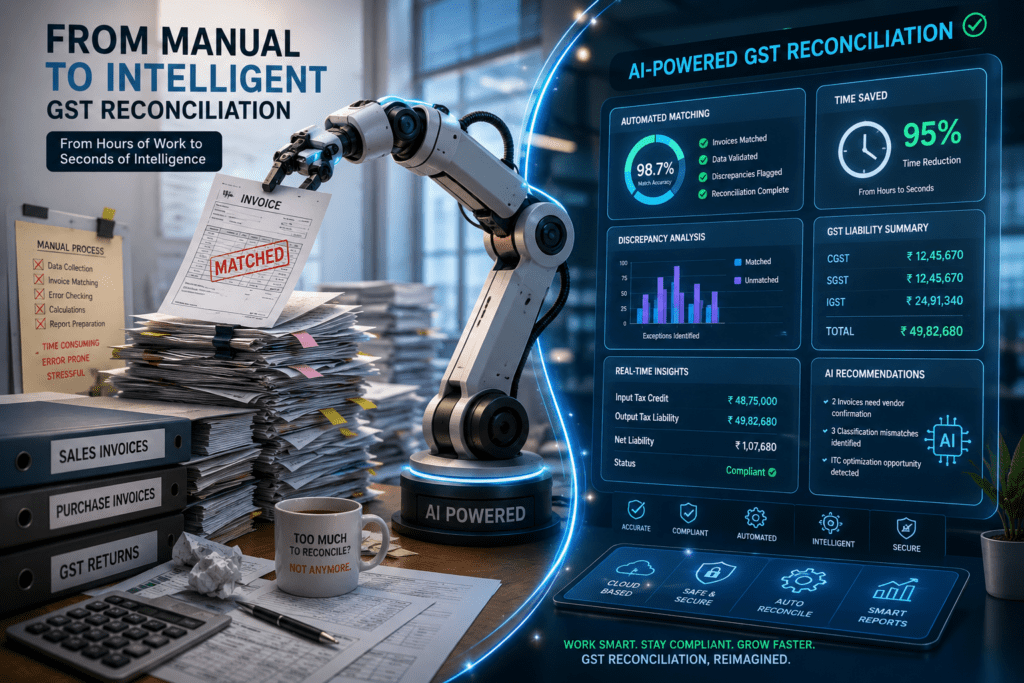
Alternatives to manual GST reconciliation have evolved from optional conveniences to essential compliance infrastructure. In 2026, businesses that continue relying on spreadsheets face escalating audit risk, delayed financial reporting, and wasted team capacity. Automated reconciliation platforms deliver measurable benefits: 60–80% time savings, near-perfect accuracy, and audit-ready documentation.
BizPlan AI Pro India leads this category with AI-powered matching, predictive ITC optimization, and full audit compliance. It is best suited for businesses with 100+ monthly transactions and complex GST positions. For simpler scenarios, tools like Vyapar TaxOne or EasyRecon offer cost-effective alternatives.
The decision is not whether to automate—it is which tool fits your business size, GST complexity, and budget. Start by auditing your current manual process. Define your must-have features. Pilot with one month of historical data. Then commit to a platform that scales with your business.
Ready to eliminate manual reconciliation? Explore our detailed GST reconciliation software comparison to find the right fit for your organization. Or learn more about best practices in the GST reconciliation process to ensure smooth implementation.

R. Sharma is a senior startup advisor and business planning specialist at BizPlan AI Pro. With over a decade of experience in Indian corporate finance and MSME consulting, he has helped hundreds of founders structure financial projections and secure bank funding.