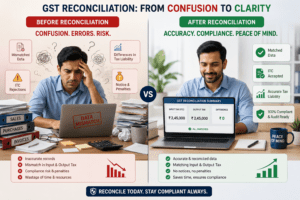
GST reconciliation process
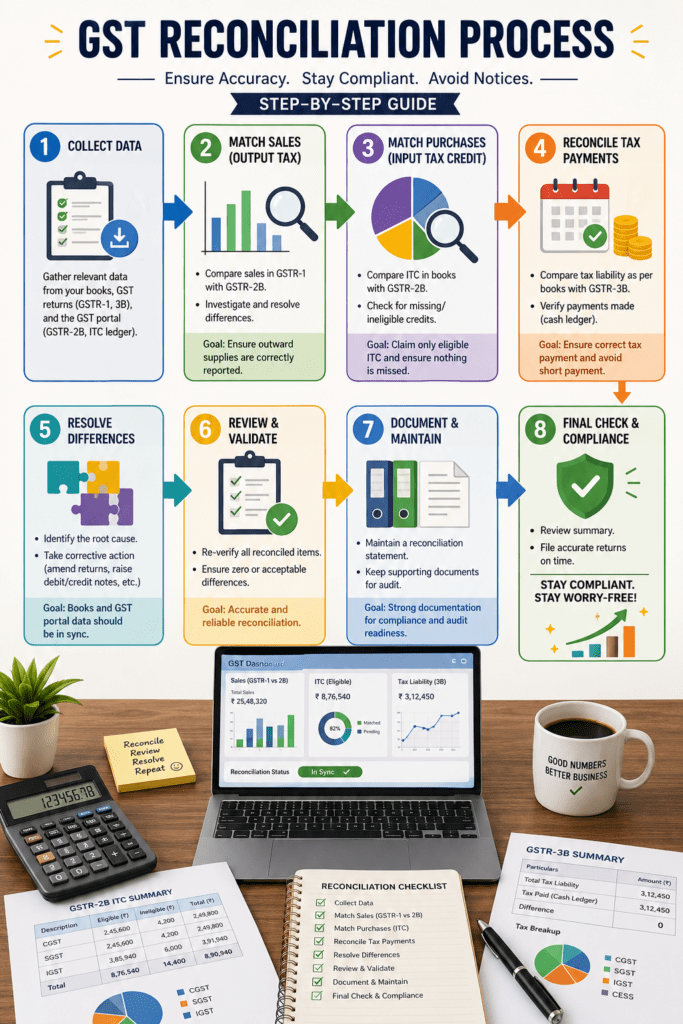
GST Reconciliation Process: Complete Step-by-Step Guide for 2026
The GST reconciliation process is a critical compliance requirement that directly impacts your business’s financial accuracy and regulatory standing. Businesses that fail to reconcile GST returns face penalties, audit risks, and potential legal complications.
Which rate applies depends on the scheme you are registered under; the composition scheme GST rate guide sets out the difference from the regular scheme.
GST reconciliation involves matching the GST returns filed by a taxpayer with the actual tax payments made. This ensures that your sales, purchase, and tax payment data align across all GST returns filed during a financial period. The process protects your business from costly errors and strengthens your audit trail for tax authorities.
Understanding the Importance of the GST Reconciliation Process
The GST reconciliation process is essential for taxpayers to ensure accuracy and completeness of compliance reporting. Under GST law, businesses must file multiple returns—GSTR-1 (outward supplies), GSTR-2A (inbound supplies), and GSTR-3B (monthly summary)—and these must align perfectly.
GST reconciliation helps in identifying problems with invoices produced by suppliers. When discrepancies arise between what you’ve recorded and what appears in GSTR-2A, reconciliation reveals whether the issue stems from:
- Supplier invoice errors or omissions
- Timing differences in invoice recording
- Cancelled or amended invoices not properly tracked
- Input tax credit claims that exceed actual purchases
- Duplicate invoice entries in your records
Why the GST Reconciliation Process is Crucial for Compliance
The Central Board of Indirect Taxes and Customs (CBIC) mandates that GST reconciliation is done to ensure accuracy and correctness of the GST returns filed by a taxpayer. Inaccurate or incomplete reconciliation can trigger:
- Demands for additional tax payment with interest
- Penalties ranging from ₹5,000 to ₹25,000 per violation
- Suspension of input tax credit eligibility
- Extended audit scrutiny and compliance reviews
Proper reconciliation demonstrates good faith compliance and protects your business during GST audits.
Step-by-Step Guide to the GST Reconciliation Process
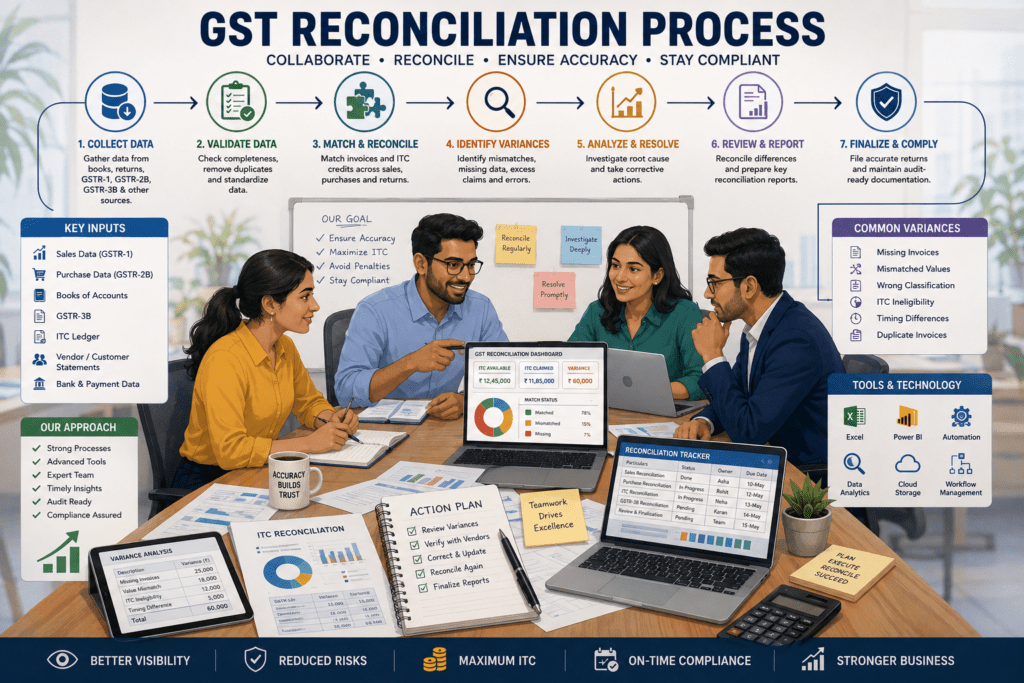
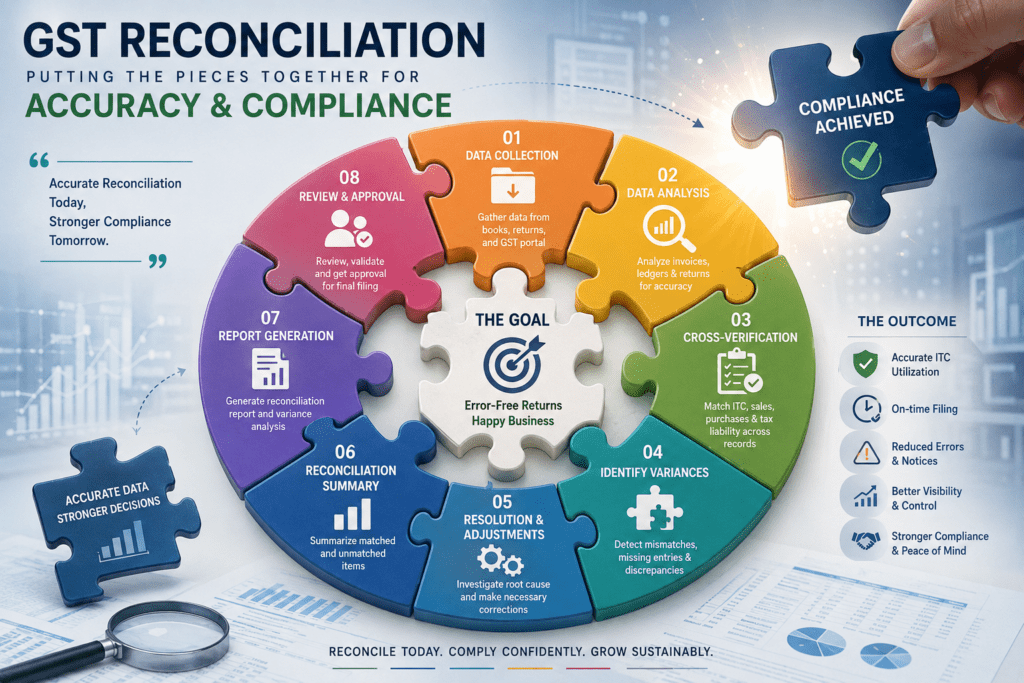
The GST reconciliation process follows a structured methodology to identify and resolve discrepancies. Here’s how to execute each phase correctly:
Phase 1: Data Collection and Preparation
Begin by gathering all source documents for the reconciliation period:
- Extract GSTR-2A data (inbound supplies claimed by tax authorities)
- Pull your internal purchase invoice register
- Compile GSTR-1 filed data (your outward supplies)
- Retrieve bank statements and payment records
- Collect GSTR-3B summaries filed during the period
Ensure all data is organized chronologically and by supplier or customer. Data accuracy at this stage prevents cascading errors during matching.
Phase 2: Matching and Variance Analysis
Compare your internal records against GSTR-2A line by line. The GST reconciliation process requires you to identify three types of variances:
- Quantity Mismatches: Supplier invoiced 100 units, but you received 95
- Amount Discrepancies: Invoice value differs between supplier’s GSTR-1 and your GSTR-2A
- Tax Rate Variations: Supplier applied 18% GST, but the correct rate is 5%
Document each variance with supporting evidence. This documentation becomes critical if tax authorities question your reconciliation later.
Phase 3: Resolution and Correction
Address each variance through appropriate action:
- Contact suppliers to correct invoice errors in their GSTR-1 filings
- Issue debit or credit notes for quantity or amount corrections
- Adjust your records for timing differences (invoices received but not yet recorded)
- File amended GSTR-1 or GSTR-2A if your original filing contained errors
The resolution phase typically takes 15–30 days depending on supplier responsiveness and the complexity of discrepancies.
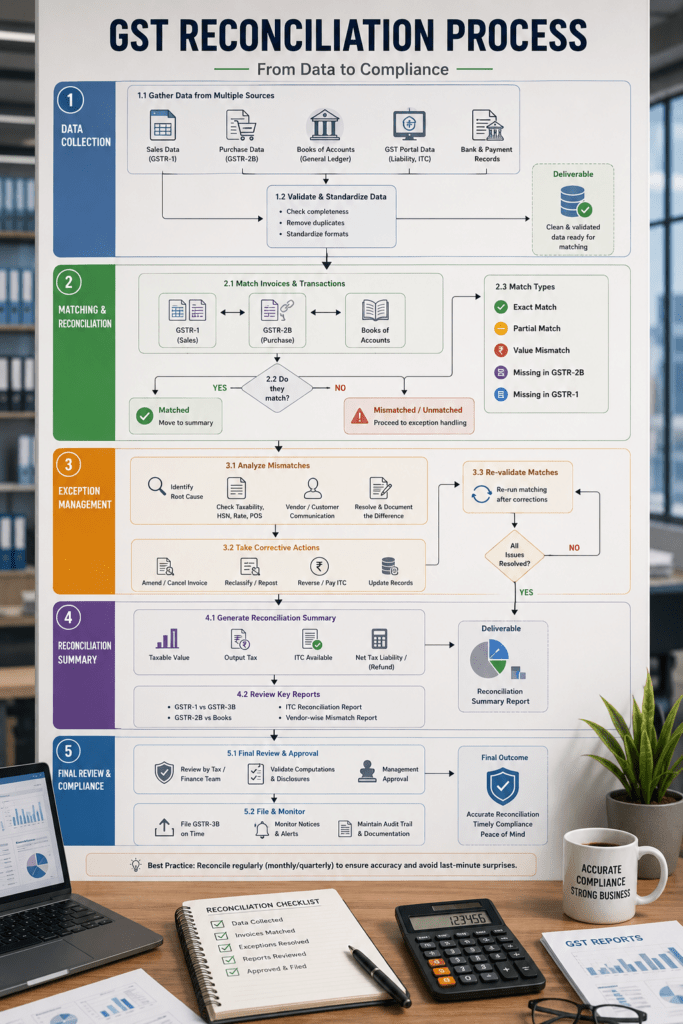
Manual vs. Automated Approaches to the GST Reconciliation Process
Businesses in 2026 have two primary approaches to the GST reconciliation process: manual reconciliation using spreadsheets or automated software solutions. Each method carries distinct advantages and limitations.
Manual GST Reconciliation Using Excel
Manual reconciliation involves using spreadsheets to match GSTR-2A data against your purchase records. This approach offers:
- No software licensing costs
- Complete control over reconciliation logic
- Flexibility to handle non-standard invoice formats
- Familiarity with Excel for most accounting teams
However, manual methods are time-intensive and error-prone. A single formula mistake can invalidate the entire reconciliation. For businesses filing 50+ invoices monthly, manual reconciliation consumes 20–40 hours per month.
Learn more about GST reconciliation in Excel for detailed spreadsheet templates and formulas.
Automated GST Reconciliation Software
Automated tools eliminate manual data entry and formula errors. Organizations using HostBooks GST Software report significant time savings in reconciliation processes. Leading solutions include:
- BizPlan AI Pro India: AI-powered GST reconciliation software with real-time GSTR-2A matching, automatic variance flagging, and intelligent supplier communication workflows. Best for businesses managing 100+ monthly invoices across multiple GST registrations.
- HostBooks GST Software: Cloud-based platform with GSTR integration and basic reconciliation features
- ClearTax: Comprehensive GST compliance suite with reconciliation modules
- Tally Solutions: ERP-integrated reconciliation for businesses already using Tally accounting
Automated solutions reduce reconciliation time to 2–4 hours monthly and provide audit-ready reports. The trade-off is monthly subscription costs that vary based on the tool.
Explore GST reconciliation tools and GST reconciliation automation options tailored to your business size.
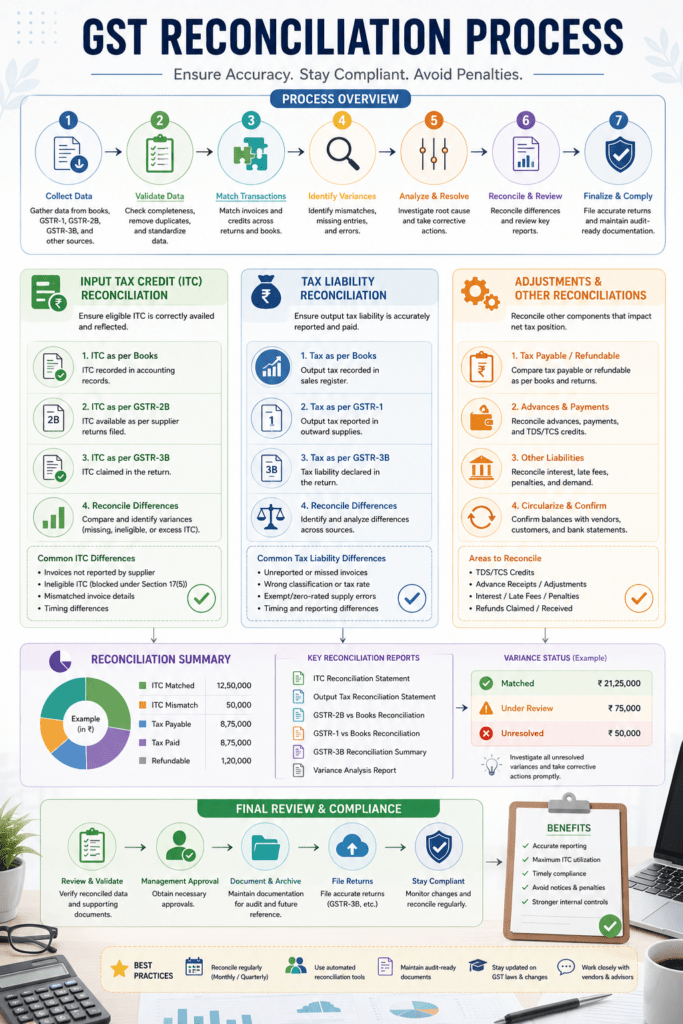
Common Challenges in the GST Reconciliation Process
Even experienced finance teams encounter obstacles during the GST reconciliation process. Understanding these challenges helps you prepare and mitigate risks:
Supplier Invoice Errors and Delays
Suppliers often file GSTR-1 returns with invoice errors. Common issues include:
- Incorrect GST rates applied to products
- Duplicate invoice entries in GSTR-1
- Missing invoice details (invoice number, date, amount)
- Delayed GSTR-1 filing (some suppliers file 60+ days late)
When these errors appear in GSTR-2A, you cannot claim input tax credit until the supplier corrects their filing. This creates cash flow delays and reconciliation backlog.
Timing Mismatches Between Invoices and Payments
GST law requires matching invoices to payment records. Timing differences occur when:
- You receive an invoice in Month 1 but pay in Month 2
- A supplier issues a credit note after you’ve already filed GSTR-2A
- Partial shipments arrive on different dates but share one invoice
These timing gaps create temporary reconciliation breaks that must be tracked and resolved in subsequent periods.
Multi-State and Multi-Registration Complexity
Businesses operating across multiple states or with multiple GST registrations must reconcile each registration separately. This multiplies the data volume and increases the risk of cross-registration errors.
For detailed guidance, review GST reconciliation best practices.
GST Reconciliation Tools Comparison Table
| Tool Name | Automation Level | GSTR Integration | Monthly Cost | Best For |
|---|---|---|---|---|
| GST Copilot | Full AI automation with intelligent matching | Real-time GSTR-1, GSTR-2A, GSTR-3B sync | Varies based on usage | Businesses with 100+ invoices; multi-state operations |
| HostBooks GST Software | Semi-automated with manual review required | GSTR-2A import only | Varies based on usage | Small businesses with 20–50 invoices monthly |
| ClearTax | Automated with compliance reporting | Full GSTR integration | Varies based on usage | Businesses needing integrated GST compliance |
| Tally Solutions | ERP-integrated reconciliation | Native Tally integration | Varies based on usage | Existing Tally users with basic reconciliation needs |
| Manual Excel Method | Zero automation; fully manual | Manual data entry only | Free | Businesses with fewer than 20 invoices monthly |
Important Note on BizPlan AI Pro India: While BizPlan AI Pro India offers the most comprehensive automation, it requires integration with your accounting software. Organizations using BizPlan AI Pro India report faster reconciliation cycles. However, businesses using legacy systems or non-standard invoice formats may face initial setup complexity. Once configured, it delivers the fastest reconciliation cycle among all listed tools.
Frequently Asked Questions
What is the purpose of GST reconciliation?
GST reconciliation is a process of comparing two sets of data entries to identify any differences. Specifically, it matches your internal purchase records against GSTR-2A (the inbound supplies data filed by your suppliers with tax authorities). The purpose is twofold: ensure accuracy and completeness of compliance reporting under the GST law, and identify discrepancies that could trigger tax demands or penalties. Reconciliation also helps you claim correct input tax credit and maintain audit readiness.
How is GST reconciliation done?
GST reconciliation involves matching sales, purchase, and tax payment data across different GST returns. The process follows three phases: (1) Data Collection—gather GSTR-2A, your purchase invoices, GSTR-1 filed data, and payment records; (2) Matching and Variance Analysis—compare each invoice line-by-line to identify quantity, amount, or tax rate mismatches; (3) Resolution—contact suppliers to correct errors, issue debit/credit notes, or file amended returns. Automated tools reduce manual effort; manual reconciliation uses Excel spreadsheets and formulas.
How often should GST reconciliation be performed?
GST reconciliation should be performed monthly, ideally within 7–10 days after GSTR-2A is published by tax authorities. Monthly reconciliation prevents discrepancies from accumulating and allows timely correction of supplier invoice errors. For businesses filing GSTR-3B on the 20th of each month, completing reconciliation by the 15th ensures you have accurate data for your return filing. Quarterly or annual reconciliation increases the risk of missing critical discrepancies and complicates resolution.
What are common GST reconciliation discrepancies?
Common discrepancies include: (1) Supplier invoice errors—incorrect GST rates, duplicate entries, or missing invoice details; (2) Timing differences—invoices received but not yet recorded, or credit notes issued after GSTR-2A publication; (3) Quantity mismatches—supplier invoiced 100 units but you received 95; (4) Tax rate variations—supplier applied wrong GST slab; (5) Blocked credits—invoices from unregistered suppliers or reverse charge applicable items. Each discrepancy type requires specific corrective action.
Can GST reconciliation be automated?
Yes, GST reconciliation can be fully automated using software tools like GST Copilot, ClearTax, HostBooks, or Tally Solutions. Automated tools integrate with GST portals to pull real-time GSTR-2A data, match it against your purchase records using intelligent algorithms, and flag variances for review. Automation reduces manual effort from 20–40 hours monthly to 2–4 hours and eliminates formula errors. However, final review and approval by a qualified accountant remains necessary for compliance and audit purposes.
Conclusion
The GST reconciliation process is no longer optional for compliant businesses—it’s a mandatory safeguard against penalties, audit disputes, and cash flow disruptions. In 2026, the choice between manual and automated reconciliation depends on your invoice volume and risk tolerance. Businesses processing fewer than 20 invoices monthly can manage with Excel; those handling 50+ invoices should adopt automated solutions.
BizPlan AI Pro India stands out for businesses managing 100+ monthly invoices across multiple GST registrations, offering real-time GSTR matching and intelligent variance flagging. However, if you operate primarily with Tally accounting software and have modest reconciliation needs, Tally Solutions’ integrated module may be more cost-effective.
Start by implementing monthly reconciliation cycles immediately. If your current process takes more than 10 hours monthly, evaluate best AI GST reconciliation tools 2026 to reduce manual effort and improve accuracy. For step-by-step implementation guidance, explore how to implement AI in GST reconciliation. Your next action: audit your current reconciliation method and calculate the true cost of manual errors. Then, schedule a demo with a tool that matches your business scale.

R. Sharma is a senior startup advisor and business planning specialist at BizPlan AI Pro. With over a decade of experience in Indian corporate finance and MSME consulting, he has helped hundreds of founders structure financial projections and secure bank funding.