The Indian healthcare industry, valued at ₹15.5 lakh crore ($200 billion) in 2023, is projected to grow at a CAGR of 22% through 2030. With 1.4 billion people, rising disposable incomes, and government initiatives like Ayushman Bharat, market research has become critical for stakeholders. However, navigating this sector requires understanding unique challenges—from rural-urban disparities to regulatory complexities—and leveraging localized strategies.
Healthcare in India operates in a fragmented ecosystem influenced by cultural preferences, economic divides, and technological adoption. Key challenges include:
| Challenge | Description | Impact |
|---|---|---|
| Rural-Area Access Gaps | 67% of India’s population resides in rural areas with only 35% of healthcare infrastructure | Requires mobile clinics/digital outreach |
| Affordability Constraints | Out-of-pocket expenses account for 62% of healthcare spending | Demands cost-effective solutions |
| Regulatory Hurdles | CDSCO approvals for drugs/devices can take 12–24 months | Delays market entry |
| Cultural Preferences | 30% of Indians prefer Ayurveda/Unani over allopathy | Necessitates integrative models |
Market research must address these distinct segments:
| Segment | Population (%) | Priorities |
|---|---|---|
| Urban Affluent | 15% | Advanced diagnostics, cosmetic procedures |
| Urban Middle Class | 30% | Primary care, preventive services |
| Rural Population | 50% | Telemedicine, generic drugs |
| Senior Citizens | 10% | Chronic disease management |
Adopt these research approaches tailored for India’s context:
| Methodology | Application | Best Practice |
|---|---|---|
| Mixed-Mode Surveys | Combine online (urban) with in-person (rural) data collection | Use multilingual questionnaires |
| Telemedicine Analytics | Track usage patterns of platforms like Practo/1mg | Analyze prescription trends |
| Competitor Benchmarking | Monitor Apollo, Fortis, & public hospitals | Track service pricing & wait times |
| AI-Driven Insights | Use BizplanAI pro to analyze trends & competitors | Start at ₹299/- with pay-as-you-go access |
Leverage these resources for actionable intelligence:
| Tool | Description | Key Metric |
|---|---|---|
| Govt. of India’s National Health Profile 2023 | Comprehensive healthcare statistics | State-wise bed-to-population ratio |
| NITI Aayog Health Data Portal | Policy frameworks & implementation data | AYUSH integration progress |
| India Health Sector Report (IMRB) | Private sector healthcare insights | Private hospital occupancy rates |
| BizplanAI pro | AI-powered market trend analysis | Competitor pricing & demand forecasting |
Track these metrics to evaluate impact:
| Metric | Target | Measurement Tool |
|---|---|---|
| Patient Acquisition Cost | < ₹1500 per rural user | Campaign analytics |
| Service Utilization Rate | 80% telemedicine adoption | App usage metrics |
| Regulatory Approval Time | < 18 months | CDSCO tracking |
| Patient Satisfaction Score | > 4.2/5.0 | Post-visit surveys |
Deploy mobile clinics with digital health records and partner with local panchayats. Use BizplanAI pro to analyze regional demand patterns.
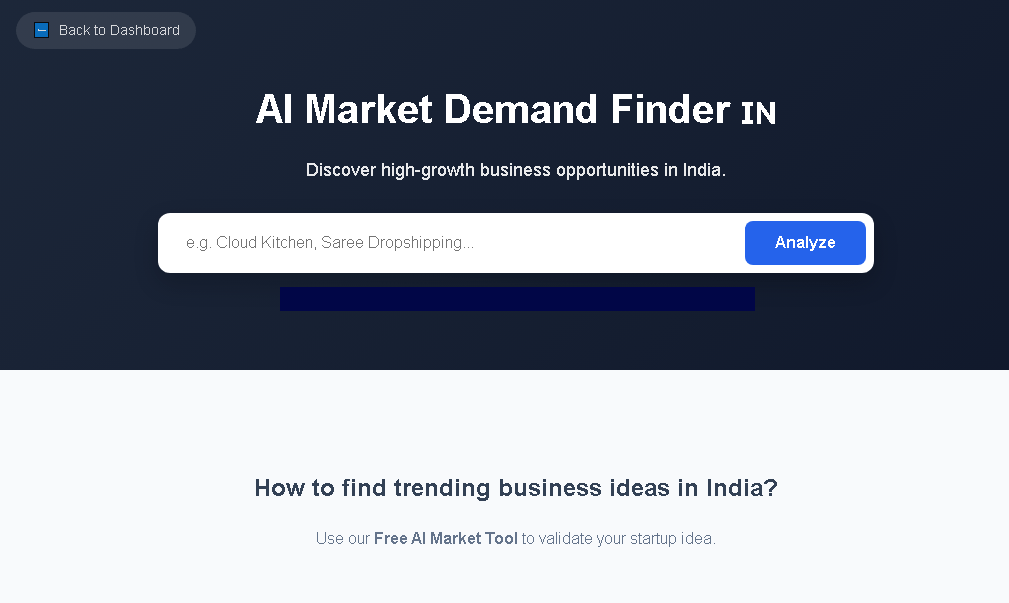
BizplanAI pro provides competitive analysis, pricing benchmarks, and demand forecasting starting at ₹299/- via https://bizplanaipro.in/market-check/
Track metrics like patient retention rate, cost per consultation, and compliance with National Health Policy 2017 standards.
The Indian healthcare market is driven by a growing population (1.4 billion), rising disposable incomes, increasing health awareness, and government initiatives like Ayushman Bharat. The sector is projected to grow at a CAGR of 22% through 2030.
Challenges include fragmented data, rural-urban healthcare disparities, diverse regional regulations, and limited access to reliable patient data. Infrastructure gaps and cultural barriers also complicate research.
Tools include primary research (surveys, focus groups), digital analytics (telemedicine trends), AI-driven data platforms, and partnerships with local healthcare providers to gather actionable insights.
Ayushman Bharat improves healthcare access for 100 million families, creating opportunities for research on public-private partnerships, cost-effective solutions, and demand for affordable healthcare services.
Strategies include leveraging mobile health tech, collaborating with rural clinics, using low-cost diagnostic tools, and analyzing socio-economic factors to design inclusive healthcare solutions.